Decanonising Tagore: The recursion of recentered greatness

Even if Rabindranath Tagore occupies what might appear to be a singular position in world literature today, this centrality was neither inevitable nor uncontested. Contemporaries, including Dwijendralal Roy and Mohitlal Majumdar, sought, at least implicitly, to provincialize him, treating his achievement as the overextended afterlife of nineteenth-century lyricism rather than the point of departure for a new canonical order. What is striking is not that these efforts failed, but that they were gradually absorbed into the process by which Tagore’s authority was consolidated. The figure once provincialized as historically contingent has since hardened into a condition of literary intelligibility. Canonization did not erase early resistance; it metabolized it, transforming critique into a mechanism through which centrality was secured.
Tagore is not simply read; he is installed. As the first non-European Nobel laureate in Literature, the author of Gitanjali, and a global emblem of spiritual humanism, he has long functioned as a stable point of reference in Bengali cultural life and beyond, circulating through diasporic and translational circuits spanning Dhaka, Kolkata, London and New York. Yet this stability is deceptive. What appears as recognition is better understood as overdetermination: Tagore is less a writer than a form of cultural infrastructure. He marks a point at which agency and structure become difficult to disentangle, where the author is folded into the system of reception as one of its organising conditions, more often institutionalised than actively read.
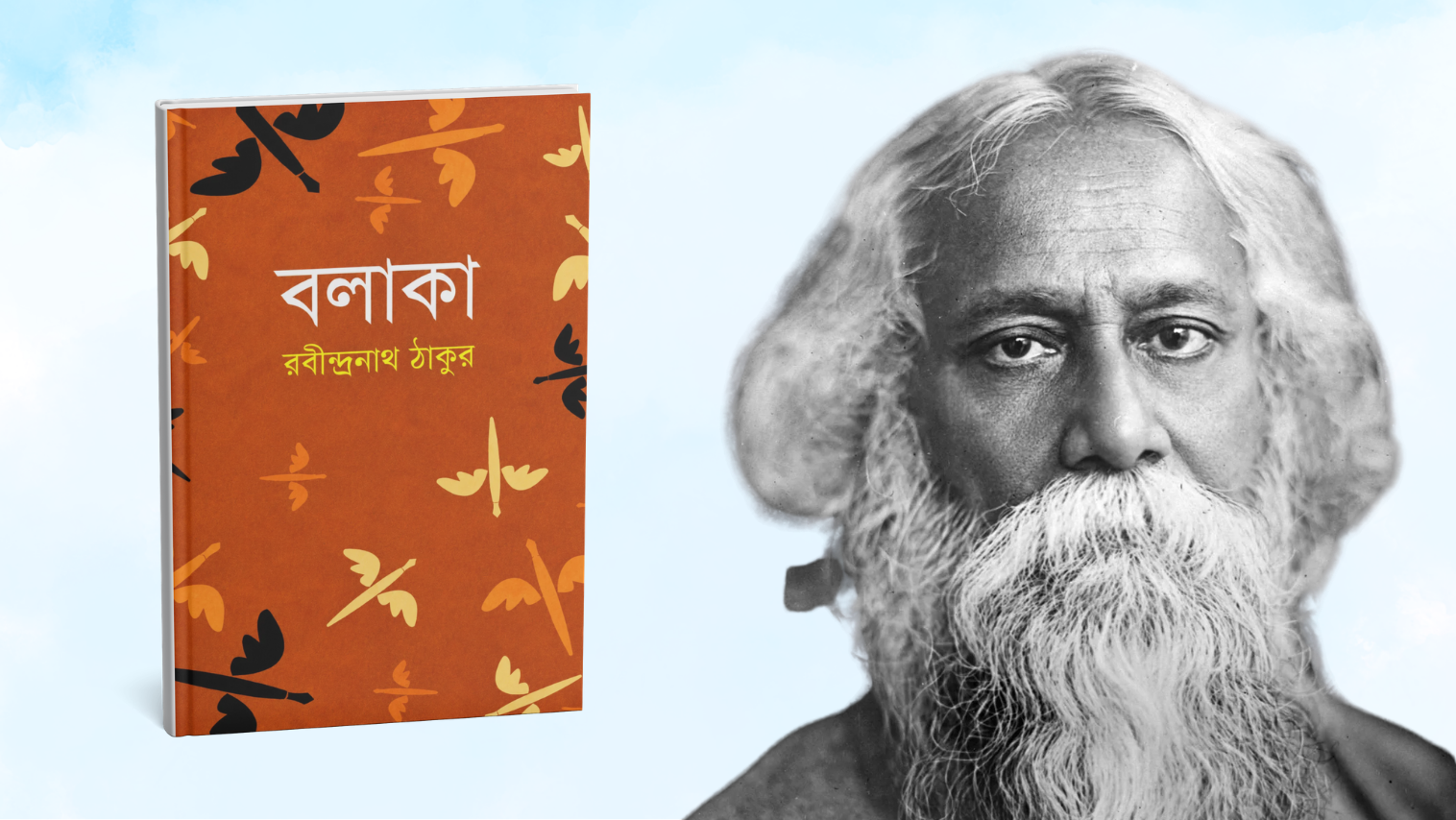
To speak of "decanonising" Tagore is therefore to misread the problem. It suggests a removal from hierarchy, when what is at issue is a figure whose authority is reproduced through the very gestures that seek to loosen it. Movements away from Tagore tend to circle back, not least because the language in which they are formulated has already been shaped by him. Decentring becomes another way of marking the centre: critique confirms what it contests, and resistance returns as dependence, as marginality and centrality fold into one another within the same field of reproduction. This is not to claim an absolute "no outside"—folk, Dalit, Islamic, and Adivasi literary traditions in Bengal have never organised their intelligibility through Tagore. But within the institutionalised sphere of Bengali bhadralok literary criticism, the field of contestation remains recursively Tagorean. It is that specific field which this essay delves into.
This logic is not confined to Bengali literary history. Abu Sayeed Ayub, in his sustained engagement with Tagore, returns to a diagnostic claim: the problem is not over-reading but a mode of reverential reception that forecloses critical distance. Tagore is not merely interpreted but stabilised through forms of reading that convert inquiry into affirmation. The result is a condition in which even dissent must pass through him, thereby reproducing the authority it seeks to unsettle.
From another vantage, Buddhadeb Bose arrives at a similar impasse. His early modernist essays attempt to prise Bengali poetry away from Tagore’s lyric authority, yet even at their most pointed they depend on him as their horizon. The difference they seek is intelligible only against the field he organises. Bose’s later career—editing Tagore’s letters, returning to his work—does not read as reversal so much as a thickening of attention, the critic moving closer to the object he once held at a distance.
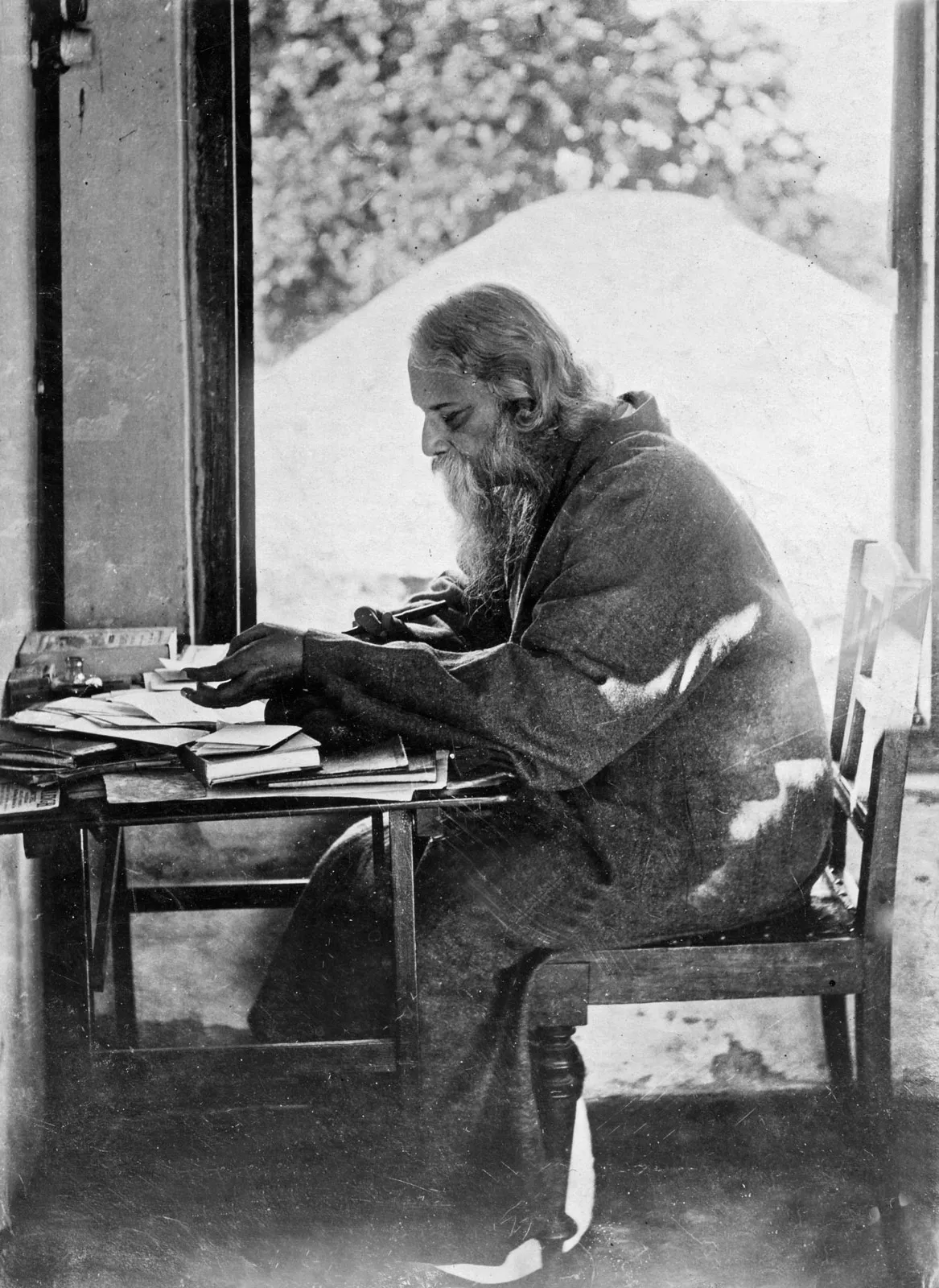
Pramathanath Bishi puts the matter with characteristic dryness: in Bengal, to be "anti-Tagore" is still to be defined by Tagore. The prefix does not secure an outside; it marks a relation. Ayub, Bose and Bishi are not offering competing readings. They register a condition in which Tagore is not only what is read, but part of what makes reading possible within that critical tradition.
The canon and its discontents
The canon is often described as a storehouse of "great works." It may not be wide of the mark, however, to think of it instead as a set of practices—selection, repetition, exclusion—through which literature is arranged and rendered legible over time. What presents itself as inheritance is less accumulation than an effect of ordering: a way of reading that confers centrality on some texts while allowing others to recede into partial visibility. The distinction between canon and apocrypha is procedural rather than ontological: the former names what has been made central through sustained acts of validation, the latter what lingers at the threshold of recognition, structurally outside those circuits.
In T.S. Eliot, this ordering takes the form of a living arrangement in which each new work subtly alters the whole, so that past and present are mutually reconstituted within a continuously adjusting order. In Harold Bloom, by contrast, the same field appears as agon: a scene of struggle structured by the anxiety of influence, in which writers labour under the paternal shadow of precursors—Shakespeare above all—whose presence is less historical than organising. Literary creation proceeds through misprision: the necessary misreading of precursors through which originality emerges as revisionary distortion. The relation between past and present is not transmission but agonistic reception, the present coming into being through its struggle with a refracted past. Where Eliot imagines continuity under revision, Bloom imagines rupture under pressure.
Poststructuralist accounts shift the emphasis from works to discourse. In Michel Foucault, the canon becomes an effect of the rules governing enunciability and exclusion; in Jacques Derrida, even such formations are unsettled by différance, which prevents closure. Edward Said exposes the imperial conditions under which canonical authority is assembled, while Pierre Bourdieu restores the institutional dimension, showing how consecration is bound to systems of education, publication, and symbolic capital. What these approaches share is a tendency to treat the literary field as something that settles, however provisionally, into recognisable forms. Even where instability is acknowledged, it is often contained within an assumption of coherence. Harder to capture is the extent to which such coherence is itself produced through continuous labour: acts of reading that stabilise meaning even as they displace it.
Reading does not merely interpret the canon; it participates in its making. Each act of attention reorders the field it inhabits, redistributing emphasis, reactivating some texts while allowing others to lapse. Stability emerges not as a given condition but as a temporary settlement within ongoing adjustment. The canon holds only because it is continually made to hold. Tagore is one of the places where this becomes visible. His position does not illustrate the canon’s operations; it exposes their recursive structure, the way authority is maintained through the very forces that appear to unsettle it.
The difficulty with Tagore is not simply that he dominates, but that his dominance persists through the very forms of critique that seek to displace it within the institutionalised literary sphere. He functions as a condition of legibility through which literary judgment is organised, meaning that authority does not precede interpretation but is continually reconstituted by it. What emerges, therefore, is not a static model of canonization but a recursive structure: the canon stabilises only through reading. Each act of interpretation re-enters the field it describes, altering its configuration without breaking its dependence on the figure it addresses.
The gravity of influence
Bloom’s "anxiety of influence" offers a familiar picture: a field structured by strong precursors. Shakespeare does not simply occupy the centre; he organises what follows. Writers may revise or resist him, but they do not step outside his field. Something analogous operates in Bengali literature with respect to Tagore, though the fit is not exact. The modernist turn of the 1930s and 1940s—the group later gathered under the name of the Panchapandavas—is often described as a break with Tagore’s lyric humanism. In Jibanananda Das, especially, the move towards discontinuity and estrangement reads as withdrawal from Tagorean plenitude.
Yet the withdrawal does not produce an outside. The new textures are legible in part because of what they refuse. Bose would later remark that Tagore’s presence remained too large to compete with directly. His own trajectory suggests as much: early insistence on distance gives way to a long return—editing, annotating, writing again. The position proves difficult to sustain without qualification. A similar movement appears in Bishnu Dey. Early Marxist critique frames Tagore as ideological limitation; later work approaches him with slower attention. The language shifts; the object remains. Across these episodes, critique does not thin Tagore’s presence. It redistributes it.
Eliot, Bloom, and Deleuze and Guattari
The paradox sharpens when placed between Eliot and Bloom. For Eliot, tradition is a dynamic but integrated order in which each new work alters the whole. The past is continually reconfigured through present composition. Influence operates as adjustment within continuity. For Bloom, literary history is structured as agon: writers confront precursors through anxiety, misreading, and revisionary distortion. Writing proceeds through misprision: a swerve forced by inherited dominance. Neither model fully accommodates Tagore. Eliot presupposes coherence, yet Tagore’s centrality produces friction within any such order. Bloom presupposes agonistic symmetry, yet Tagore’s interlocutors are not external rivals but positions already constituted within his authority. Resistance is internal to the field it contests.
Deleuze and Guattari’s Body without Organs offers a more adequate register. It names not the absence of structure but resistance to fixation: a field of flows in which organisation appears only as provisional stabilisation. Order is continuously produced and undone. On this view, the canon is neither system nor agon, but a field without final form that nonetheless generates recurring configurations of value. Stability is episodic rather than foundational. Tagore exemplifies this condition. His oeuvre cannot be reduced to a single regime: Gitanjali, the short stories, the late paintings, the political songs—these are distinct intensities within a circulating field.
Crucially, critical responses do not displace this field but reorganise it. Tagore remains constant only insofar as the system of reading reconstitutes him through its interventions. What changes is not his centrality but its mechanism of production. Canonization is not a settled structure but a process of reterritorialization: provisional order imposed on instability. Tagore is not a monument but a recurrent node through which literary relations are reassembled.
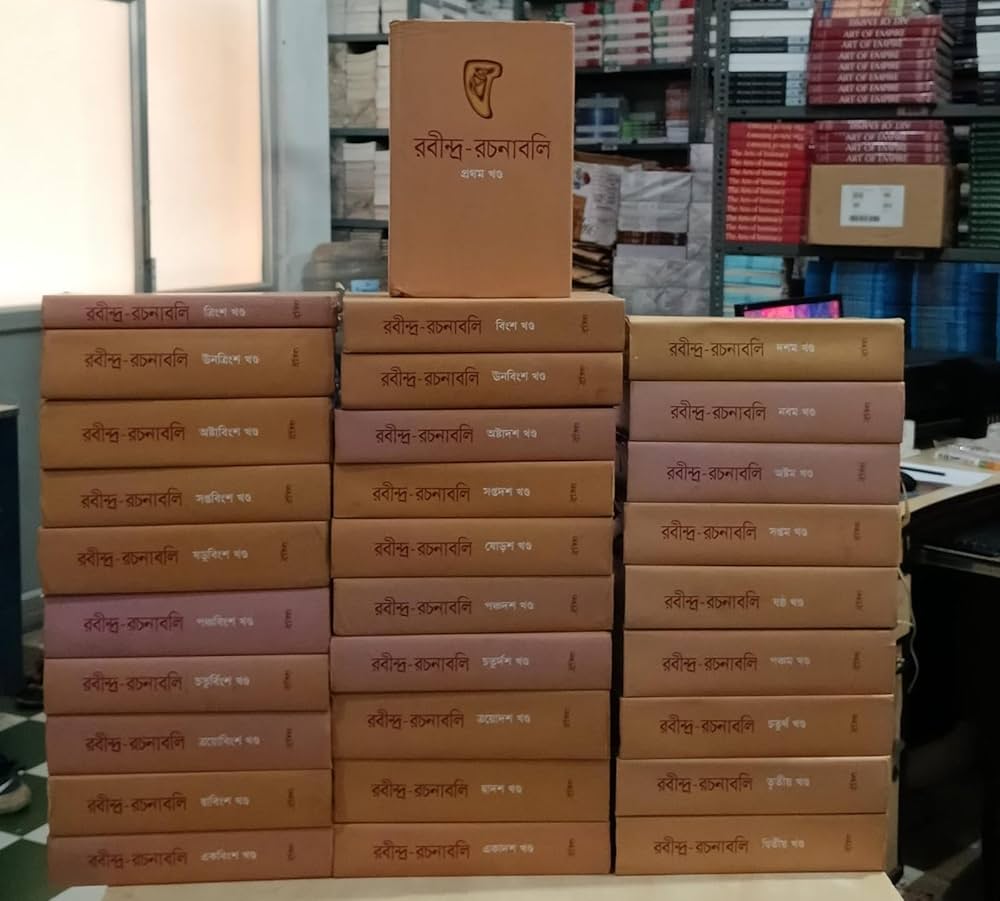
Canon as field
It has been convenient to picture the canon spatially: a solar system with Shakespeare at its centre, others arranged in orbit. Eliot’s dynamic order still carries something of this geometry; Bloom intensifies it into a hierarchy that borders on the constitutive. There are other ways of thinking about literary relation. Eliot’s account of tradition presupposes a dynamic but integrated order: the past forms a coherent system, continuously adjusted by the present but never fundamentally disarticulated. Borges, by contrast, dissolves this coherence. In his fictions, writers do not inherit a stable tradition; they produce their precursors retrospectively, rearranging the past through acts of reading. Where Eliot assumes an order that persists through modification, Borges exposes a tradition that exists only in its continual recomposition. Borges’s fictions thus suggest a less stable arrangement: a library without centre, traditions assembled retrospectively, writers discovering their "precursors" after the fact. The past shifts as it is read.
If Eliot foregrounds the canon as order—a dynamically integrated structure in which past and present adjust within an underlying coherence—Borges refigures it as field, where tradition has no prior unity but is continuously recomposed through acts of reading that retroactively produce their own precursors. A further complication emerges when this contrast is read alongside Michel Foucault. Like Borges, Foucault unsettles the idea of a stable past, but at a different register of analysis: not at the level of literary imagination, but at the level of discursive formation itself. If Borges shows how writers retroactively generate their precursors, Foucault demonstrates how regimes of knowledge determine in advance what can count as a "past," what can be archived, and what can become visible as historical material at all. The instability of tradition is thus not only interpretive but epistemic.
What is often described as an "Eastern canon" complicates the very opposition between order and field. Whereas the modern Western canon tends towards closure, organising literature around fixed texts, authorial singularity, and bounded curricular lists, many Eastern traditions historically operate through more porous regimes of transmission, in which textual authority is sustained through commentary, repetition, and reactivation rather than fixity. In such formations, the "work" is less an autonomous object than a node within an interpretive lineage. This distinction, however, is increasingly unstable under modern conditions of global literary institutionalisation, where canonicity itself becomes a hybrid field structured by both archival fixation and recursive re-reading.
From this angle, Bengali literature appears less as a settled hierarchy than as a field whose very intelligibility is retrospectively produced. In a manner closer to Borges, the past is continually rearranged through present acts of reading, so that Tagore’s centrality is not simply inherited but repeatedly reconstituted. At the same time, in a more Foucauldian sense, the field is not freely reconfigured but structured by the conditions that determine what can appear as literature at all. What results is neither stable order nor pure dispersion, but a recursive formation in which a powerful centre persists precisely because it is continuously reproduced within a shifting field of interpretation.
To speak of "decanonising" Tagore is therefore to misread the problem. It suggests a removal from hierarchy, when what is at issue is a figure whose authority is reproduced through the very gestures that seek to loosen it. Movements away from Tagore tend to circle back, not least because the language in which they are formulated has already been shaped by him. Decentring becomes another way of marking the centre: critique confirms what it contests, and resistance returns as dependence, as marginality and centrality fold into one another within the same field of reproduction.
Conclusion
The difficulty with Tagore is not simply that he dominates, but that his dominance persists through the very forms of critique that seek to displace it within the institutionalised literary sphere. He functions as a condition of legibility through which literary judgment is organised, meaning that authority does not precede interpretation but is continually reconstituted by it. What emerges, therefore, is not a static model of canonization but a recursive structure: the canon stabilises only through reading. Each act of interpretation re-enters the field it describes, altering its configuration without breaking its dependence on the figure it addresses.
"Decanonisation" misidentifies this structure by presupposing that authority can be displaced, as though the canon were an arrangement of positions rather than a process of relation. What the Tagore case reveals instead is that centrality is procedural—produced through circulation, repetition, and dissent. To step outside it entirely would require a language uncontaminated by the field it seeks to negate—an impossibility within that field, though not necessarily an impossibility for traditions that never entered it. The provincialization of Tagore, then, would not be achieved by further critique of him, but by constructing alternative conditions of literary intelligibility that render his centrality irrelevant rather than contested.
Tagore’s position is thus less that of a monument than of a recurrent organising node within a shifting system of intelligibility. Even attempts at rupture do not exit this field; they reconfigure its internal relations. Authority, in this sense, survives not despite critique but through its accumulation. To register this is not to restore an unquestioned centre, but to acknowledge that within the Bengali bhadralok critical tradition, the field has no simple outside—and that the real decanonizing gesture would be to build literacies that do not require passing through Tagore at all. Until then, Tagore persists not as apex but as a recurrent force that can only be re-entered under altered conditions.
This is a sequel to Tagore’s “Balaka” and the decolonial poetics of becoming, published in The Daily Star on May 30, 2026.
Dr. Faridul Alam, a former academic, writes from New York City.
Send your articles for Slow Reads to [email protected]. Check out our submission guidelines for details.
What Sufism can teach us about the modern world
The journey of Qawwali across South Asia: Music, mysticism, and cultural exchange
Thinking with Partha Chatterjee
Why secularism is losing ground in South Asia

Interview / Modern Islam has always been a 'secular' entity

How the banned film Satluj reopened the darkest wound in Punjab's history

What the 2026 World Cup reveals about racism in football

How Kolkata shops preserve the memories of East Bengal

How Roman Jakobson changed modern thought