How Kolkata shops preserve the memories of East Bengal
Sometimes, even the most ordinary things appear before us as something utterly unbelievable. They feel like folklore, too.
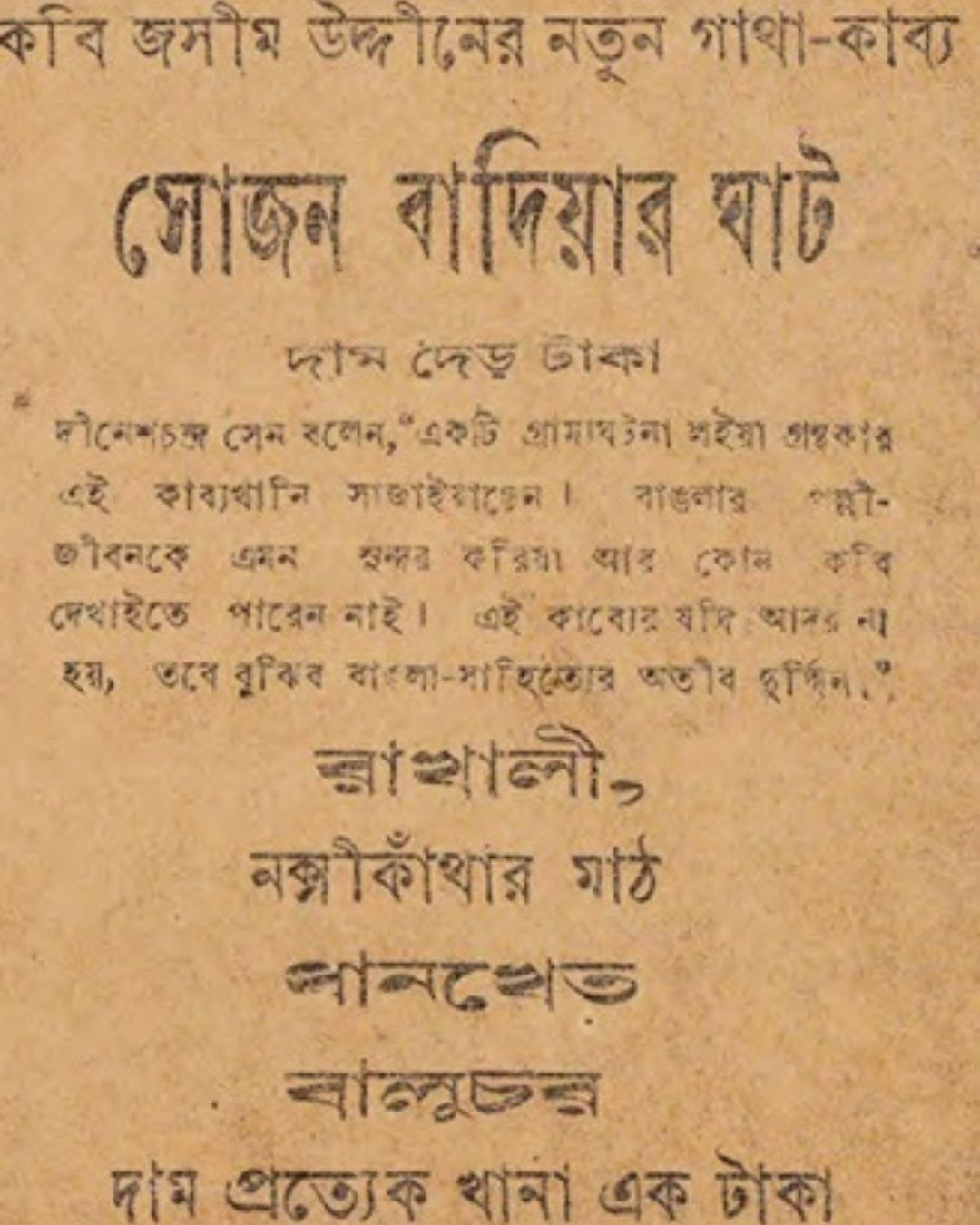
Recently, my eyes caught a book advertisement in a daily newspaper published in Kolkata. It was a modest, fleeting promotion for the narrative poem Sojon Badiar Ghat, written by the poet Jasimuddin (the advertisement spelled it জসীম উদ্দীন). The advertisement also mentioned his other works: Rakhali, Nokshi Kanthar Math, Dhankhet, and Baluchor. Each was priced at one rupee, except Sojon Badiar Ghat, which cost one and a half rupees.
My gaze lingered because the publisher, to ensure sales, had quoted the legendary scholar Dinesh Chandra Sen. The quotation read: "The author has woven this poem around a simple village incident. No other poet has ever portrayed the rural life of Bengal so beautifully. If this poem is not adored, I shall consider it a dark age for Bengali literature."
The publisher of the book was Gurudas Chattopadhyay. Jasimuddin himself mentions in the preface that Professor Bishwapati Choudhury had helped him in various ways to write this ballad. 'Shriman' Shobhanlal Gangopadhyay, whom he regarded as a brother, compiled the index. A well-wisher named Kalyankor Gupta had even gifted him a notebook in which to write the poems. And it did not end there. Jasimuddin writes: "The deeply revered Dinesh Chandra Sen and Abanindranath Tagore have encouraged me in numerous ways after reading the manuscript of this book. I remain indebted to both of them in many ways."
According to the address at the bottom of this preface, Jasimuddin wrote it while sitting in a village named Gobindapur in Faridpur. He mentioned that he would speak of these eminent personalities in greater detail only when he could beautifully build his own life.
Gradually, in undivided Bengal, the fratricidal atmosphere orchestrated by the exploiters ensured that the pastoral poet (পল্লীকবি) could perhaps never build his life beautifully again. This remains a supreme misfortune for all of us. Therefore, in today's toxic environment of discord, when an opportunity arises to touch such hidden gems, it truly feels as though we do not even know what we have lost. What we have lost—in today's context, what else can I call it but a fairy tale?
Many might notice, and many might not, that even in the heart of Kolkata, or more broadly, in every nook and cranny of West Bengal, many such fairy tales of harmony lie hidden. Coincidentally, I possess a letter written by my paternal grandfather's brother. He had written that letter to his elder sister. Two lines in it read: "If I can ever set foot in Sirajganj again, and spend time at Anisur's adda, my heart will overflow with joy. But due to the crushing pressure of my job at Calcutta University, I do not know if that fortune will ever be mine again."
My grand-uncle's sister's name was Leela. As for me, I have never had the good fortune of setting foot on the other side of Bengal. Yet, much like that letter written by my grand-uncle, a wave of nostalgia engulfs me whenever I see the signboards of certain shops in Kolkata. It feels as though a living fairy tale stands right before my eyes.
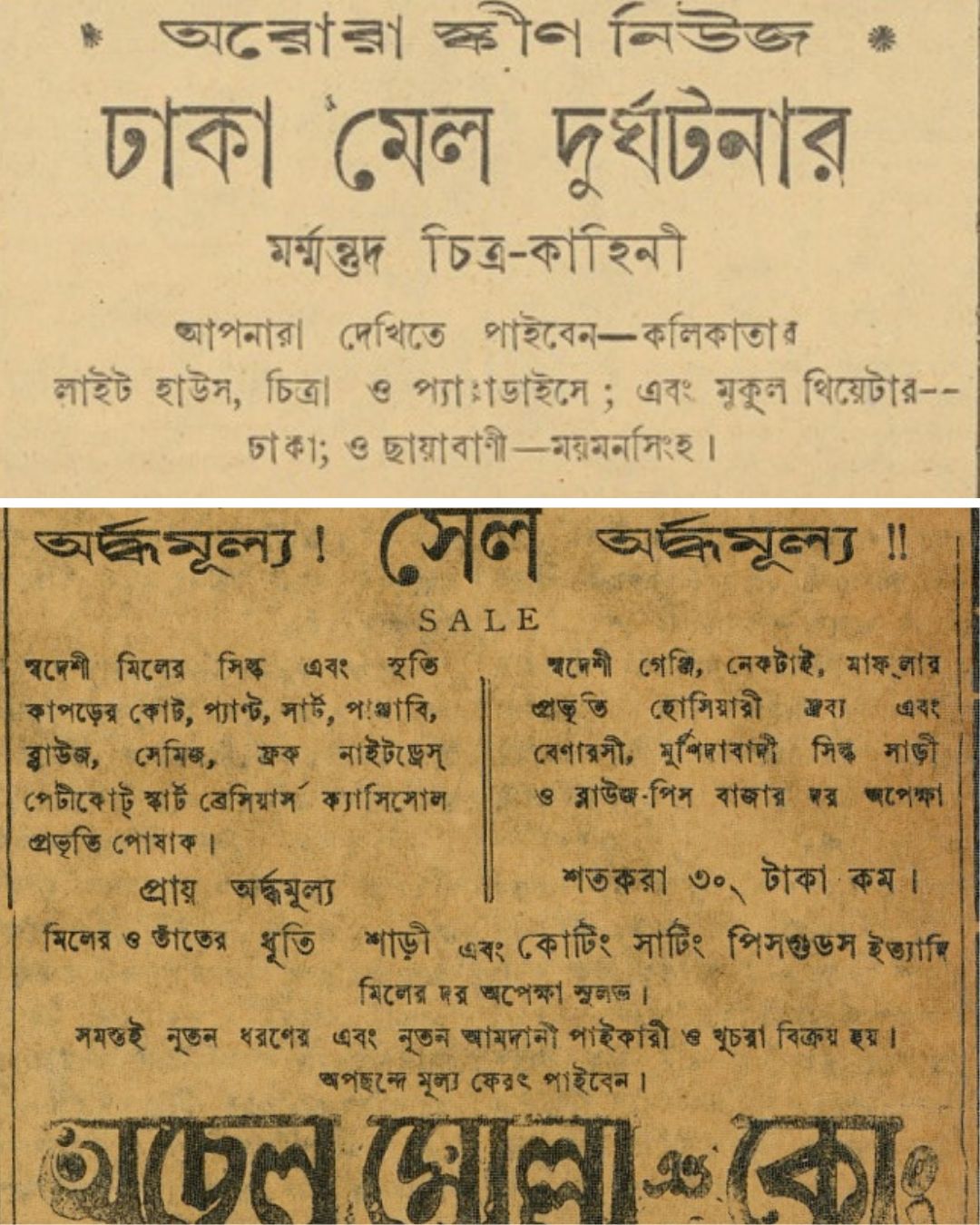
In the theatres of Kolkata today, there is no longer an opportunity to witness the heartbreaking newsreel of the Dhaka Mail train accident by Aurora Screen News. Just as it was screened in Dhaka's Mukul Theatre and Mymensingh's Chhayabani, it was also shown in Kolkata's Light House, Chitra, and Paradise in 1940. I wonder if that documentary still lies hidden somewhere, neglected and forgotten.
Much like in Dhaka, at 20 Upper Circular Road in Kolkata, one could find the authentic coconut oil from a certain G. Ghosh's shop, advertised to make "women's beloved hair long, thick, and deep black." Today, even if we pluck our own greying hairs in despair, no one will find the signboard of that shop.
The money-lending company on Jatindramohan Avenue in Chittagong, which offered 6 per cent interest on savings in 1934 and allowed withdrawals after six months, has seen its Kolkata branch office crumble into dust.
Surely, much like the Town Medical Hall of Barisal, some shop in Kolkata too sold Jaymangal Ras, the ultimate fever pill formulated by Banamali Ganguly. Otherwise, why would a certain Ramaprasanna Ganguly advertise it in the newspapers of Kolkata in 1934? But to find out which shop in Kolkata sold that pill today is as impossible as discovering Aladdin's magic lamp!
How many people know that, once, at the Soap Training House in Rangpur, the art of soap-making was taught? The instructor was highly educated, possessing eleven years of factory management experience. He taught entirely with his own hands. One could even learn through postal correspondence. In 1934, that anonymous teacher from Rangpur claimed that his students, by making toilet soaps, were earning at least 300 rupees a month across Bengal, Bihar, Bombay, Uttar Pradesh, Punjab, Burma, Ceylon, Persia, and China! I wonder which resident of Kolkata had an ancestor enlightened by that education, successfully burning away the agony of unemployment for a nominal fee.
It was destined to shut down—the shop at 75/1 Colootola Street belonging to P. K. Sen, which sold the infallible Chalmoogra ointment and soap for all kinds of wounds and skin diseases. An ointment that travelled all the way from Chittagong!
The Comilla Bank had a grand office at 4 Clive Street (now Netaji Subhas Road). Along with Dhaka, Comillabazar, Chittagong, Brahmanbaria, and Hajiganj, they reportedly had an office in London as well. Nearly 110 years ago, that bank began its journey thanks to the lawyer Narendra Chandra Datta. Coincidentally, the linguist Sukumar Sen was also a man from Comilla. It is said that, during the establishment of the bank, he had assisted the owners in various ways. In the town of banks and tanks (large ponds), that red-brick office of Comilla Bank is now a branch of another bank. And in Kolkata, the old Clive Street office of Comilla Bank now houses various other financial businesses. After Partition, the Dattas migrated to Kolkata. Following the post-Second World War recession, their banking business pulled down its shutters permanently. Among those who sit in that same building today counting money, how many even know the story of this bank?
The era I speak of (roughly between 1930 and 1940) was a time when, during the month of Falgun, the people of Assam and Bengal would board the E.B. Railway trains and steamers at concessionary fares to offer prayers at the foothills of Chittagong's Chandranath Hill on Shivratri and witness the Shivachaturdashi fair.
The "exquisite and durable" fabrics of Dhaka Cotton Mill would travel from Dhaka's Postogola to Kolkata. At the Kolkata address of 139-B Russa Road, belonging to the Dattas' Comilla Union Bank, a Bengali could sleep in absolute peace after depositing jewellery and legal documents. Lalmohan Saha of Dhaka's Babubazar sold pills and ointments for fever, scabies, toothache, and headache from Room 34 at 31 Jaxon (Jackson Lane) in Kolkata. They even published advertisements stating that they did not sell the patents of their medicines to any canvasser. A reward of 50 rupees was promised to anyone who could catch and prove such an offence. Jackson Lane has now become Indra Kumar Karnani Street. The name has changed. This street is part of the Burrabazar area. In some alley of that neighbourhood, house number 31 surely stands as a silent witness to history. It was a time when the citizens of Kolkata, by consuming the Mrita Sanjeevani Tonic prepared by Mathur Babu's Shakti Oushadhalaya in Dhaka, genuinely believed they were attaining immortality.
Though attaining immortality is a myth, it is not an impossibility when it comes to relationships. The proof that the two Bengals were once one remains bright even today in the names of several shops in Kolkata. And it is also true that, sitting in the present era, it mistakenly feels like a fairy tale. Yet, in reality, it is no fable. It is much like a birthmark on the human body—even if covered by clothes, it can never be erased.
At 156 Harrison Road, a certain Karim bhai was running a flourishing shop selling fine indigenous cotton fabrics from his Karimbhai Cloth Depot. A certain M. M. "Jyotirbhushan" of Rangpur was selling Mahakal amulets. Swayed by the Swadeshi breeze, Bengalis were crowding the East Bengal Khadi Stores on Cornwallis Street. Asgel Molla & Co. on Dharmatala Street advertised that even after buying clothes at half price, if a customer did not like them upon returning home, a full refund would be granted.
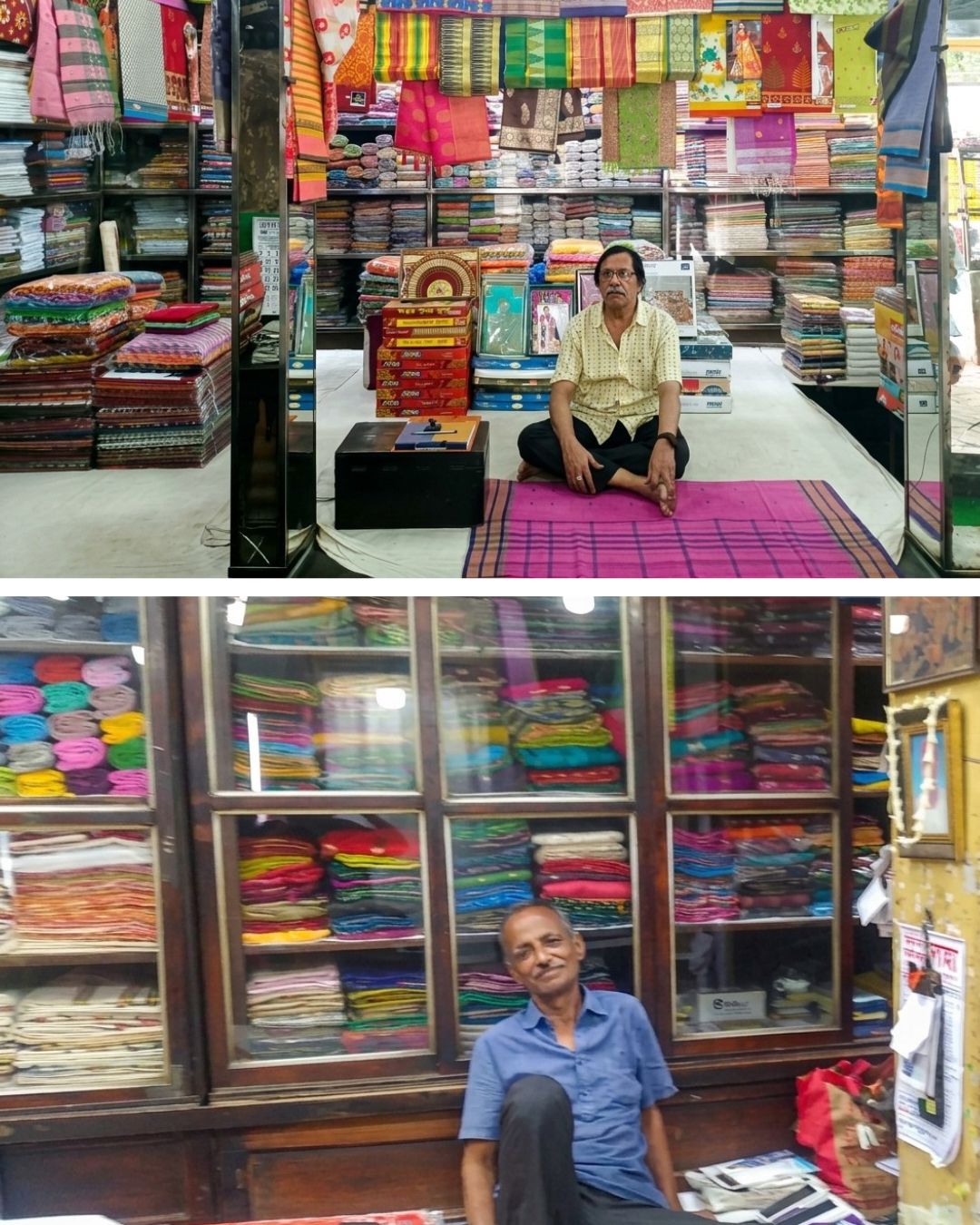
Today, in the year 2026, though it might be difficult to find the signboard of Asgel Molla's shop in the heart of Kolkata, the birthmark has not faded at all. Walk into Hatibagan; you will see the signboard still glowing brightly: "Khulna Bastralaya". Take two steps forward, and there is "Bikrampur Bastralaya". If you leave Vivekananda Road and start walking towards Vidyasagar College, you will encounter "The Dhakeswari Bastralaya".
Who knows how many shops connected to Dhaka are scattered across the city of Kolkata! The name Dhakeswari Bastralaya alone is enough. Someone has prefixed the word Adi (original) to Dhakeswari, while someone else has added Naba (new). It is there in College Street; it is there in Rashbehari. The shop in Rashbehari is probably the oldest Dhakeswari Bastralaya. Even in Baguiati, Naba Bikrampur Bastralaya continues its business, just as Adi Bikrampur Bastralaya does in College Street.
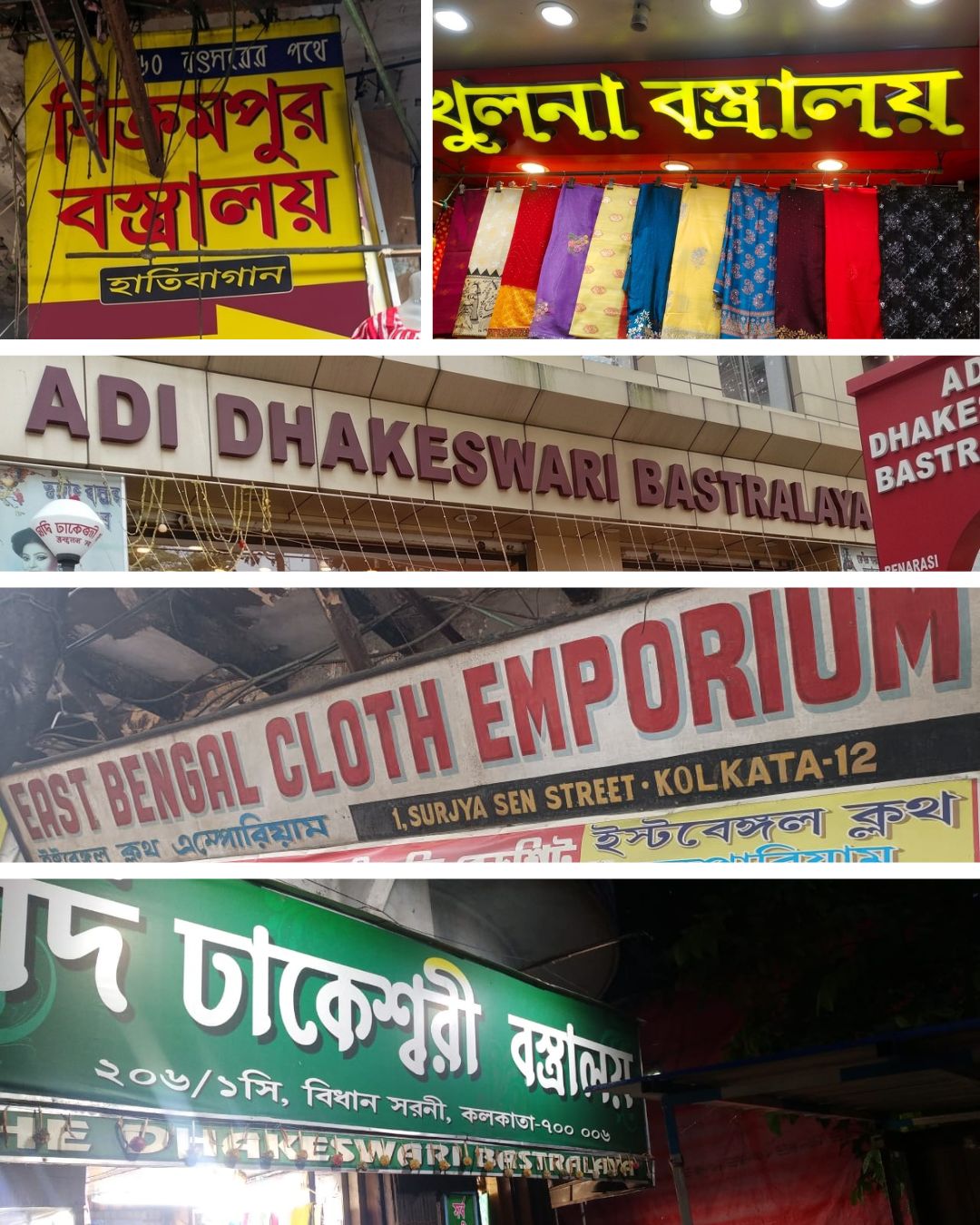
One is struck with awe upon seeing the 124-year-old East Bengal Cloth Emporium adjacent to College Square. That too is a clothing store, and in its décor, the old, traditional essence of yesteryear Kolkata still seems to breathe.
The culinary yearning of the people on this side for the flavours beyond the Padma River is heavily capitalised upon by eateries for their commercial interests. And why should they not? In a way, this is nothing but acknowledging the existence of that "brotherly soul" from the other side, as Jasimuddin put it.
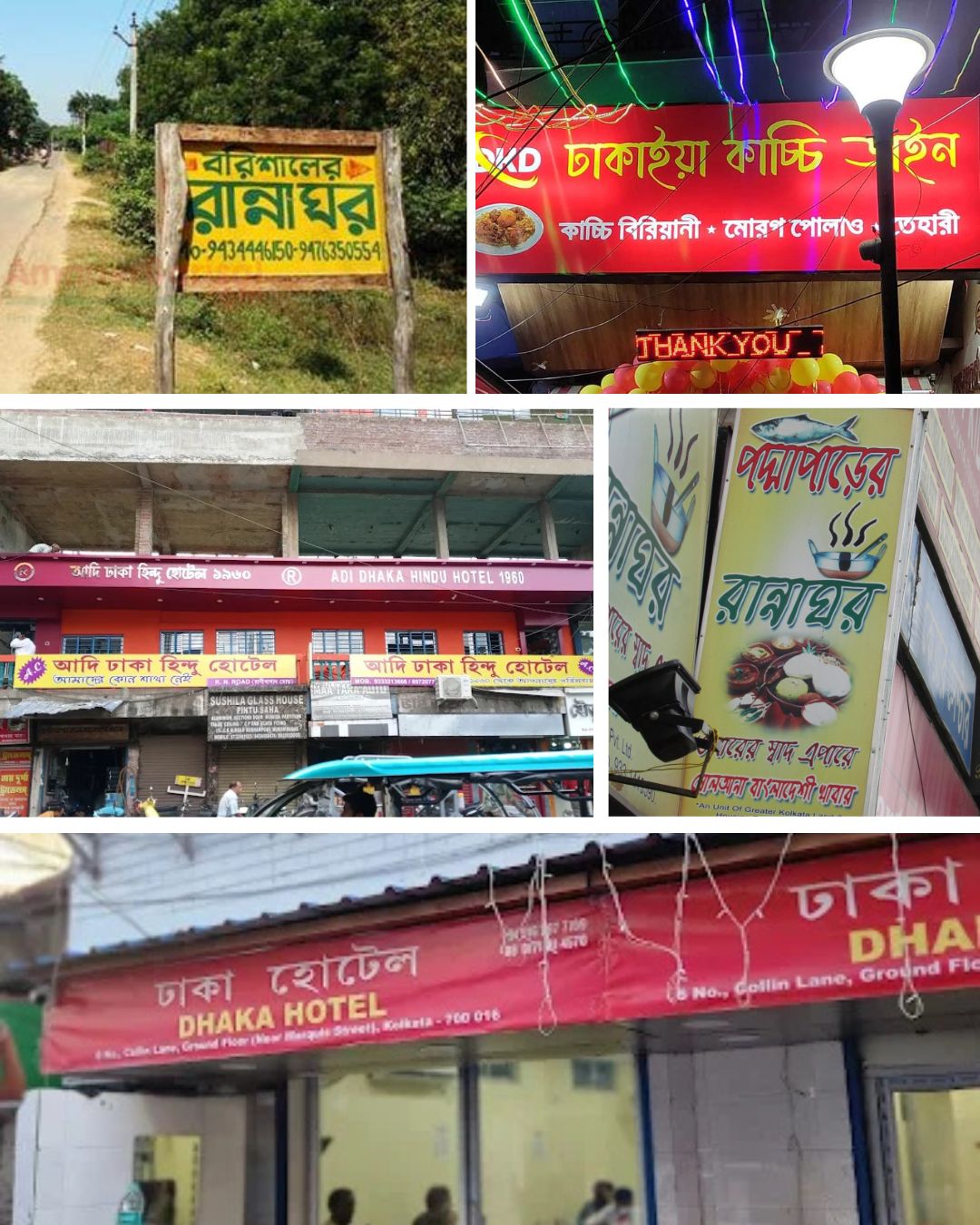
If someone searches a little, from Taltala in Kolkata to Berhampore or Siliguri, they will easily find a Dhaka Hotel. Some have even placed the word "Hindu" before Dhaka, so that non-Muslims could enter without the fear of losing their caste!
In our childhood, we ate a lot of Dhakai Parota. Now, if you go to Raja Subodh Mullick Square in Jadavpur, you can taste Dhakai Kacchi Biryani. At Kalicharan Ghosh Lane in Sinthi, Dhakai Handi awaits the gourmet Bengali. Similarly, in central Kolkata, the address of Barisal's kitchen shines brightly. I do not know, however, whether the sour hog-plum curry cooked with coconut milk is available there. And if one ever visits Santiniketan, one can check how many of the Barisali dishes from the birthplace of Jibanananda Das are actually cooked there.
If you cannot travel from Kolkata to Santiniketan to please your palate with the flavours of the other side, there is no problem. Paddaparer Rannaghar (The Kitchen of Padma's Bank) is right there in Gariahat. Their menu says they serve Dhakaiya Manbhanjan Chingri Pui. What a wonder!
The history behind Kolkata's shops named after East Bengali regions transcends the mere tragedy of Partition or refugee struggles. Since the late nineteenth century, people have migrated to Kolkata for livelihood, business, or education, naming shops out of regional pride. Marital ties also brought brides who started businesses infused with memories of their homeland, while others preserved their roots during the political upheavals of 1971. This historical continuity has sketched a permanent cultural and commercial map of the city, acting like an indelible birthmark.
Today, however, the use of the names of places in Bangladesh is heavily driven by "sentiment marketing" and business acumen. Traders exploit the immense popularity of Tangail looms, Jamdani, and culinary traditions to build instant credibility, transforming regional names into self-contained brand advertisements. Similarly, incorporating the names of deities such as Dhakeswari or Chutteswari blends spiritual faith with commercial well-being, fostering a sense of purity and honesty among consumers.
Yet, many locals without ancestral links do not share this nostalgia. This geographical and cultural divide mirrors the traditional 'Ghoti-Bangal' friction, where West Bengal Bengalis sometimes view migrants through a critical lens, while those from the other side proudly celebrate their industrious, risk-taking, and fighting spirit.
Take the example of Mimo Saha. His ancestors used to live in Alaipur in Khulna. During the Liberation War of '71, this place on the banks of the Rupsa River was constantly in the news. It was there that Mimo's family ran a stationery shop. His ancestor, Manibhushan Saha, migrated to this side with very little capital. They left their homestead a year before East Pakistan broke away to give birth to Bangladesh. Born out of inhuman struggle from that precarious state was their saree shop in Hatibagan, Khulna Bastralaya.
The young and vibrant Mimo has never been to Alaipur in Khulna. He has never seen the beauty of the winding Rupsa, a tributary of the Padma. Since his birth and upbringing have been entirely on this side, it is natural that he does not feel a distinct pull towards the other side. Mimo said: "Most of the shops in Hatibagan belong to Hindu Bengalis who came from the other side. Not everyone, of course, named their shops after their abandoned villages or districts. And the majority of them bear the surname 'Saha', whose members are primarily known as a trading community."
Sanjit Saha, the proprietor of Bikrampur Bastralaya in Hatibagan, however, visited his ancestral home in Mirkadim Kamalaghat village of erstwhile Bikrampur about a decade ago out of sheer curiosity. Their house was made of mud. Sanjit Babu did not know the people who now live there in concrete houses. The new Muslim owners, however, treated him with great hospitality. Long before India's independence, his father, Haripada Saha, left his homestead at a young age, came to Kolkata, and started his life by spreading out and selling Gamchhas (traditional cotton towels) on the railings of College Square. Gradually, his other brothers also migrated to this side. From there, the next generation of the family established shops named Bikrampur Bastralaya in various locations. The one in Hatibagan is simply Bikrampur. In College Street, it is Aadi. In Baguiati, it is Naba. Since Haripada Saha began his life selling Gamchhas, Gamchhas are still neatly kept on one side of the Hatibagan shop and spread out for sale the moment a customer arrives.
Behind the establishment of all these shops lies a narrative of immense struggle. Tapan Saha, one of the proprietors of The Dhakeswari Bastralaya on Vivekananda Road, shared that their ancestral home was in Bagmara in Dhaka district. At the tender age of fourteen or fifteen, their ancestors arrived in Kolkata and would carry clothes on their shoulders to sell at College Square and Harisha Hat.
Near College Square, I came across Soumyen Modak of the East Bengal Cloth Emporium. Generations ago, their surname was Kuri. His grandfather, Rebatimohan Modak, was a prominent Juri. He had never seen their ancestral home in Nagar Kasba of Munshiganj. His birth and deeds were all rooted in West Bengal. His ancestors had a jute business in Nagar Kasba, complete with steamers and godowns. The local people had built a mosque on land donated by them. If one tells the rickshaw pullers to go to 'Kuribari', they take them straight to the ancestral homestead. Sitting in his century-old shop at one of Kolkata's principal crossroads, Soumyen Babu recounted: "A few years ago, a gentleman from Bangladesh came to my shop and introduced himself. I didn't even know many stories about our house or village. He sat down and told me everything. He even invited me repeatedly to visit at least once, saying that once I reached there, he would take full responsibility for everything." I asked if he had ever been to Munshiganj. Soumyen Babu replied in a melancholic voice: "No, why should I go to a place from where I would have to return to Kolkata with a heart full of sorrow?"
Coincidentally, in a Bengali daily dated 15 August 1947, I found an advertisement from their shop celebrating a free India. At the very top of the advertisement, Rabindranath Tagore was quoted: "To whomsoever you give your flag, grant them the strength to bear it." ("তোমার পতাকা যারে দাও / তারে বহিবার দাও শক্তি") Back then, of course, it was not East Bengal Cloth Emporium; the name of the shop was East Bengal Society. I saw the address written as 1 Mirzapur Street, Kolkata. Later, Mirzapur Street was renamed Surya Sen Street.
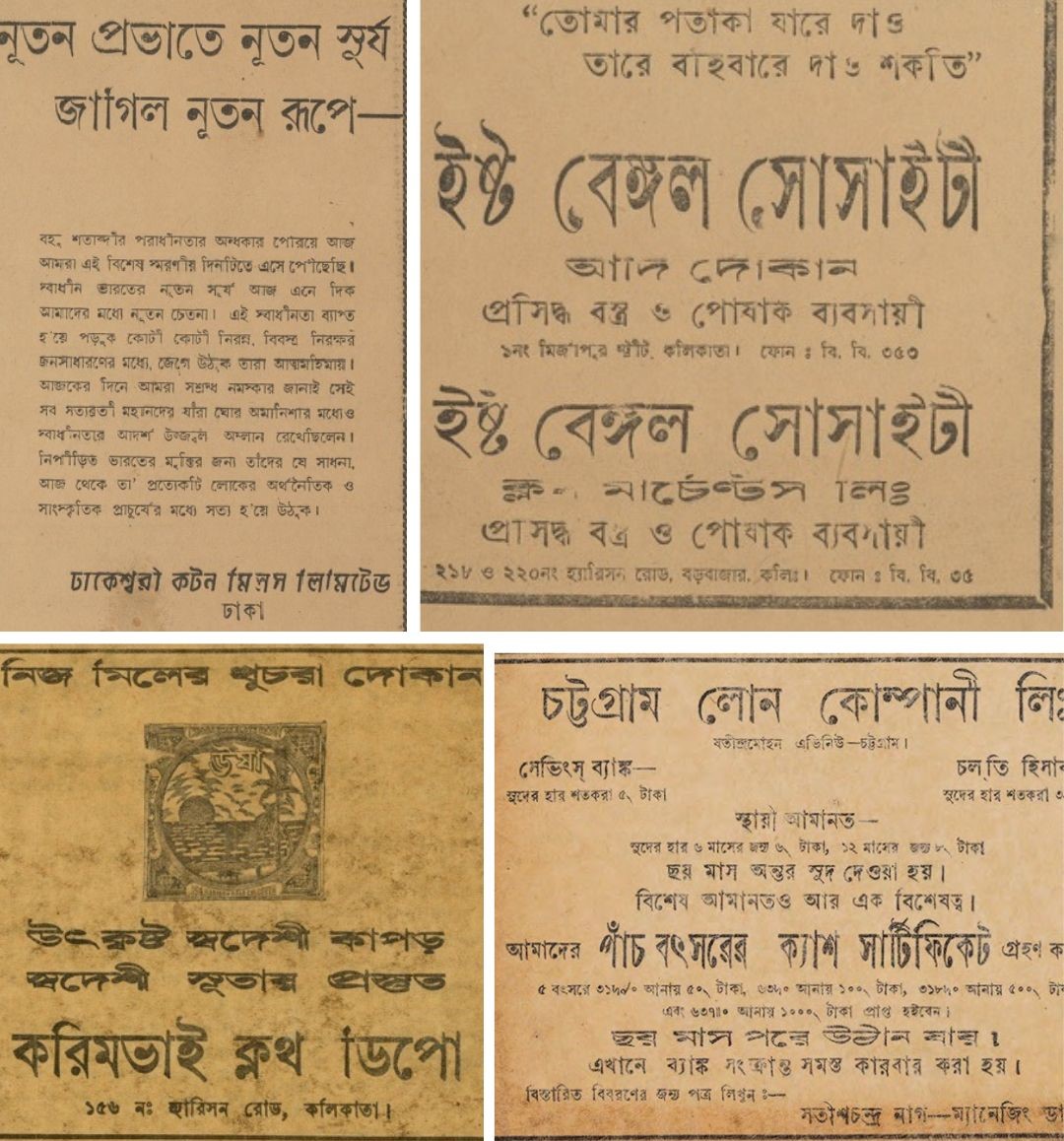
In the 1960s, when the properties were divided among the brothers of the Modak family, the shop was renamed East Bengal Cloth Emporium. In the aftermath of Partition and India's independence, Dhaka's Dhakeswari Cotton Mill published an advertisement that read: "In the new dawn, a new sun awoke in a new form."("নুতন প্রভাতে নুতন সূর্য জাগিল নুতন রূপে")
A few more business institutions whose head offices were in erstwhile East Pakistan published similar advertisements on 15 August 1947. However, the owners of those institutions were Hindus.
Similarly, in 1971, to celebrate the birth of a new Bangladesh, numerous advertisements from local business institutions appeared in the Bengali newspapers of West Bengal. Although political, diplomatic, and commercial interests lay behind these advertisements, it is equally true that a brother was blessed in a truly authentic Bengali manner.
We merely assume that the soulful connection between the people on the two sides is mirrored only in literature or in the news and advertisements of old newspapers. That is not the case.
How many of us stop to think about the fairy tales behind Comilla Bastralaya or Bikrampur Bastralaya? Upon deeper reflection, Putul Pal, in her spirit, embodies Dulali from Jasimuddin's Sojon Badiar Ghat. While Dulali was never forced to leave her village in the poem, her essence of harmony lives on in Putul Pal. In her childhood, Putul Pal was forced to flee her home to escape riots, leaving behind the canals and rivers of her beloved Barisal. Yet, much like Dulali's village, where a lamp was lit at the base of the sacred Tulsi plant even upon a Muslim neighbour's passing, Putul Pal carries that same soul of undivided Bengal. If you wish, you too can go and converse with the elderly Putul Pal of Dwaronda village in Bolpur today. Lighting two massive clay ovens, she opens her eatery and supervises the cooking from early morning. This daughter of a lime trader from Barisal did not name her shop near Santiniketan after any writing of Rabindranath Tagore. She has given immortality to her own birthmark by naming her hotel Barisaler Rannaghar (The Kitchen of Barisal).
Sandip Dasgupta has spent nearly three decades working in the editorial offices of newspapers and news portals. He has authored several history-based books, and a subject particularly close to his heart is the illustrations created by Bengali artists.
Send your articles for Slow Reads to [email protected]. Check out our submission guidelines for details.

How Roman Jakobson changed modern thought
Football as freedom: From colonial Bengal to Bangladesh
The forgotten South Asian soldiers of the First World War
How Dhaka lost its green and water: Revisiting the first master plan of the city
Bengal’s forgotten connections with Nazi Germany
Muzharul Islam and his spaces of belonging
The rise, decline and revival of Buddhism in Bengal
Two visions of Sulh-i Kul: Akbar and Dara Shukoh
Pachapdi Gazi, the 'Jim Corbett of Bengal', and the truth about Sundarbans 'man-eaters'