The forgotten South Asian soldiers of the First World War
While conducting oral history interviews on the Partition of 1947, I was surprised by how often memories of the World Wars surfaced in conversation. One interviewee, now living in Dhaka, fondly recalled spending afternoons with his sister drawing the newly constructed Howrah Bridge in pre-Partition Kolkata. He mentioned, almost in passing, that the bridge had been camouflaged during the Second World War to protect it from aerial attack, but it still remained a source of fascination for local residents. His story was one of several unexpected wartime memories that emerged during these interviews.
These conversations led me to realise how little I had associated South Asia with the two World Wars. People from the Indian subcontinent served across multiple fronts in both conflicts, and yet their stories occupy a surprisingly small place in our collective memory. For Bangladeshis in particular, more defining events in modern history, such as the 1952 Language Movement and the 1971 Liberation War, have often eclipsed these earlier experiences. Traces of this forgotten past still endure in living memory, preserved in stories like that of the camouflaged Howrah Bridge.
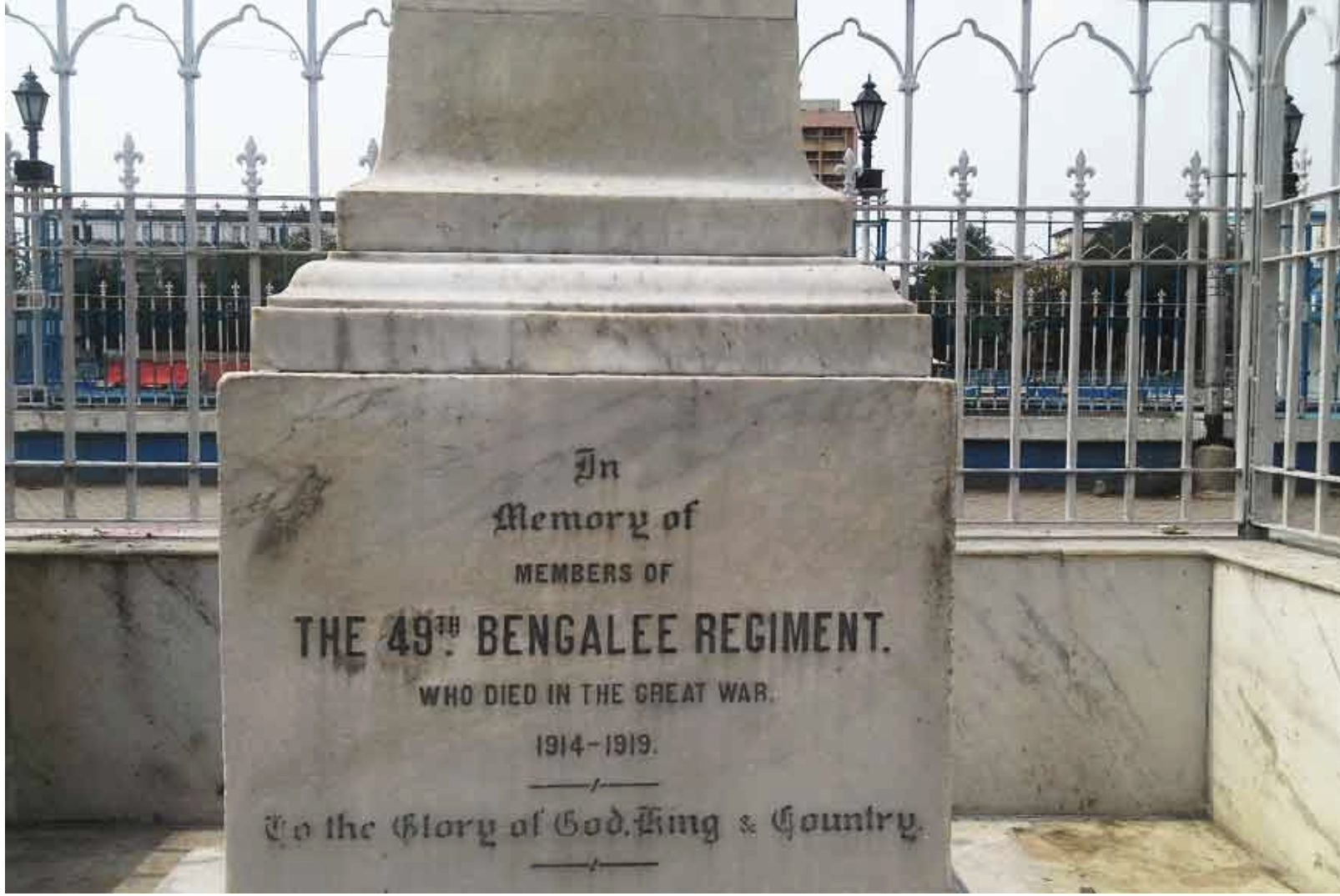
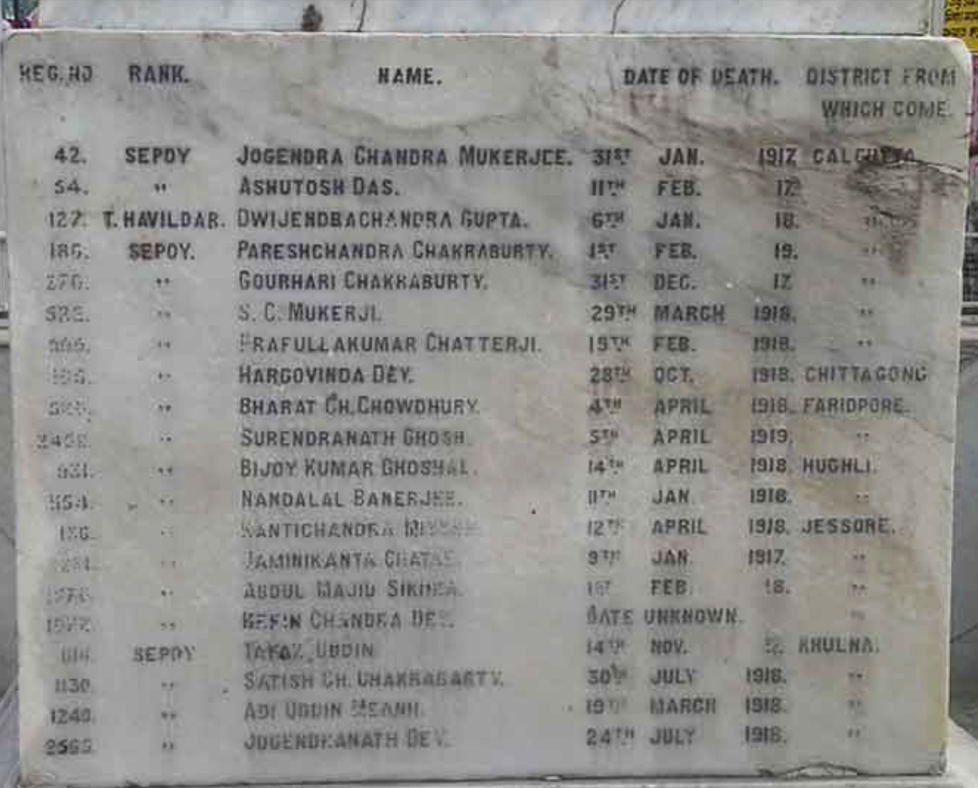
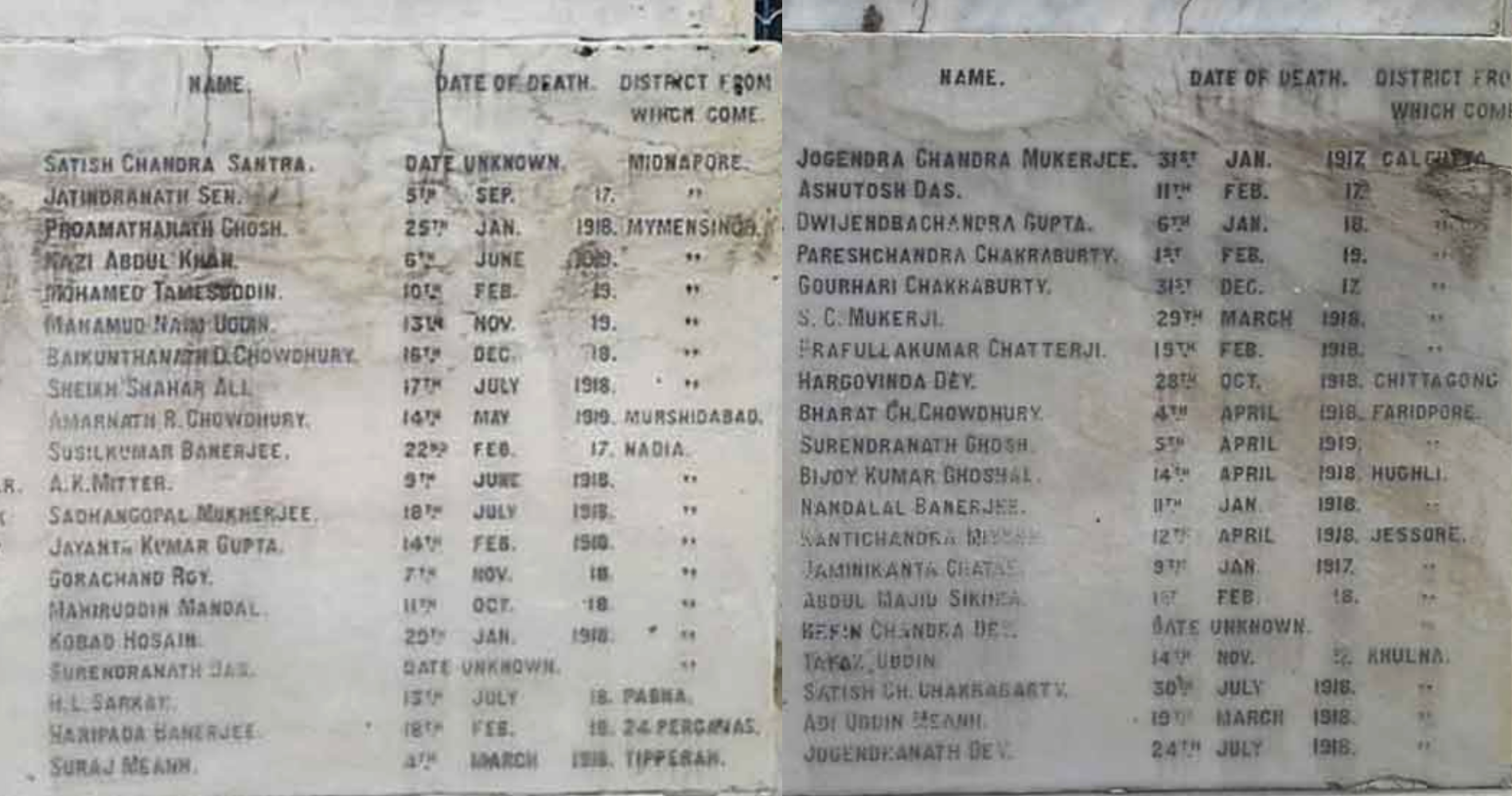
A memorial to the soldiers of the 49th Bengal Regiment who died in the First World War stands at the eastern gate of College Square in Kolkata. When it was first erected, it was a striking white marble monument. Today, it sits weathered and neglected, often used to hang clothes or plastered with posters. One face bears the inscription: "In memory of members of the 49th Bengalee Regiment who died in the Great War, 1914–1919, To the Glory of God, King & Country." The other three are engraved with the names of 56 fallen soldiers whose home districts stretched across undivided Bengal, including Dhaka, Calcutta, Pabna, Mymensingh, Murshidabad, Jessore, Burdwan, Chittagong, 24-Parganas, and Tipperah (present-day Cumilla). Like these men, millions from British India served during the First World War, and among them were Kazi Nazrul Islam and Khwaja Habibullah Bahadur, the fifth Nawab of Dhaka. Yet despite their service, their stories remain largely absent from popular historical memory.
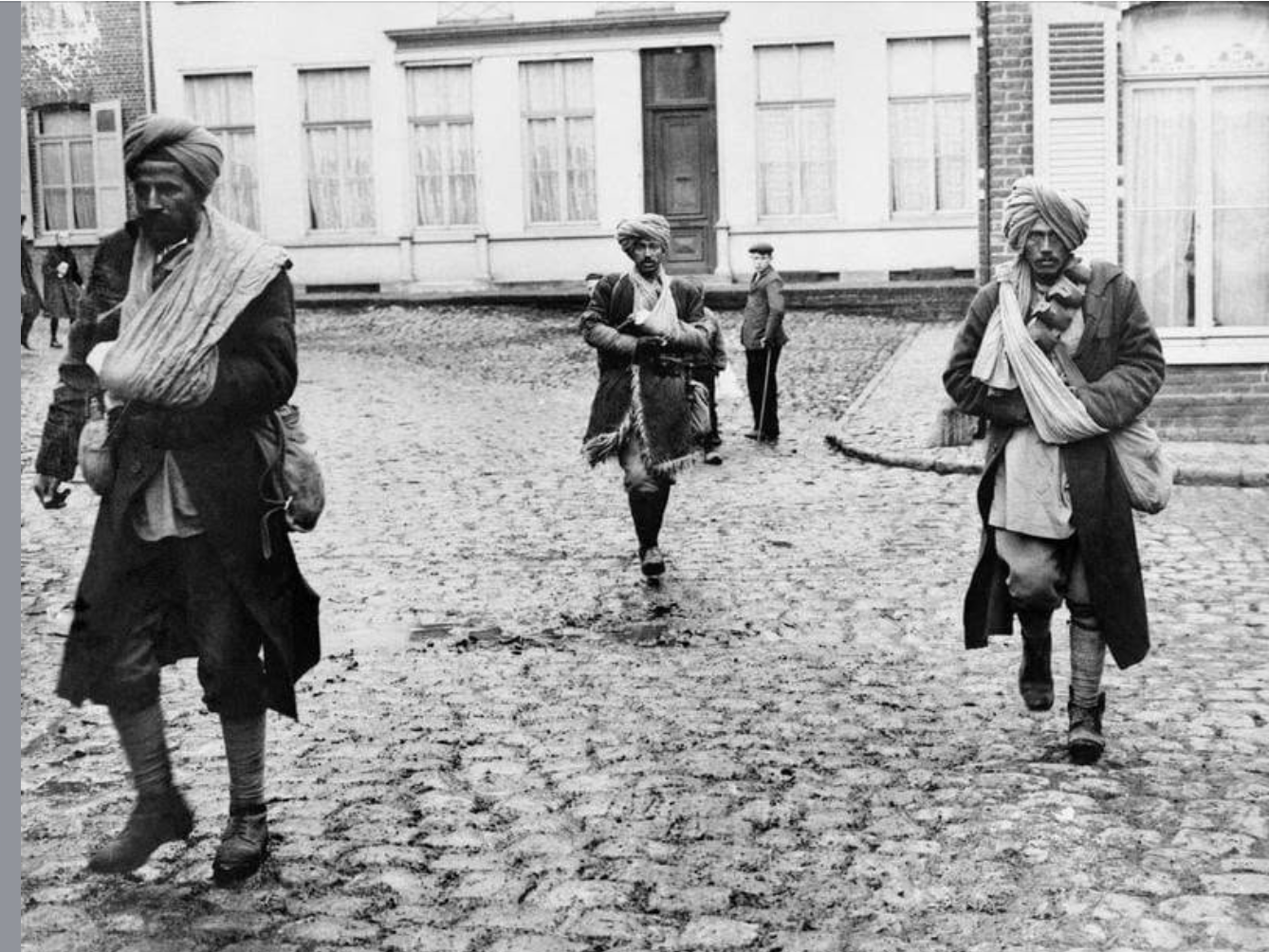
Indian troops entered the Great War in 1914 as part of the British Indian Army, serving across multiple fronts, including France, Belgium, Mesopotamia, and East Africa. Their deployment to the Western Front came after the near destruction of the British Expeditionary Force at Le Cateau on 26 August 1914. With Britain lacking a large standing reserve, the only troops immediately available were from the British Indian Army. As a result, units originally destined for Egypt were redirected to France.
A war diary of the 15th Ludhiana Sikhs records the regiment leaving Karachi before dawn on 29 August 1914, marching "in absolute silence" to the railway siding. Locked carriage doors, the absence of lights, and cramped boarding arrangements delayed their embarkation aboard the SS Takada. The commanding officer later described the ship as "very overcrowded." Soldiers shared space below deck with more than a hundred mules where, with the portholes shut against the monsoon seas, "the heat and smell... were already very bad." Many of the men, unaccustomed to sea travel, quickly became seasick, while there was not even enough room to spread out their bedding. Crossing the sea, or kala pani ("black waters"), had long carried religious and social significance in parts of India, with fears that overseas travel could affect one's ritual status and ties to home. Now, these men were being sent across waters they had never seen before, towards a war unlike anything they had known.
Amid the hardships of the journey, moments of religious observance offered a sense of comfort and familiarity. A war diary entry dated 11 September 1914 records that, as the ship passed Mecca, Muslim soldiers were informed and permitted to come onto the promenade deck to pray facing east towards the holy city. Lieutenant Colonel C. Caffin noted that they "appreciated this very much" and were "most grateful" for the gesture.
About a month later, two Indian divisions arrived in Marseille under the command of Lieutenant-General James Willcocks. A war diary entry dated 3 October 1914 describes their reception in France as "magnificent", recalling how crowds gathered at railway stations and lined the tracks to cheer the troops. Along the route, French civilians distributed fruit, coffee, biscuits, and flags, while the diarist concluded that "nothing could possibly have exceeded the kindness and hospitality with which the French civilians and soldiers received all ranks." The war diary of the 15th Ludhiana Sikhs echoes this account, recalling that "the march through Marseilles was one of great enthusiasm and so full were the streets with cheering crowds that the pace was of necessity slow."
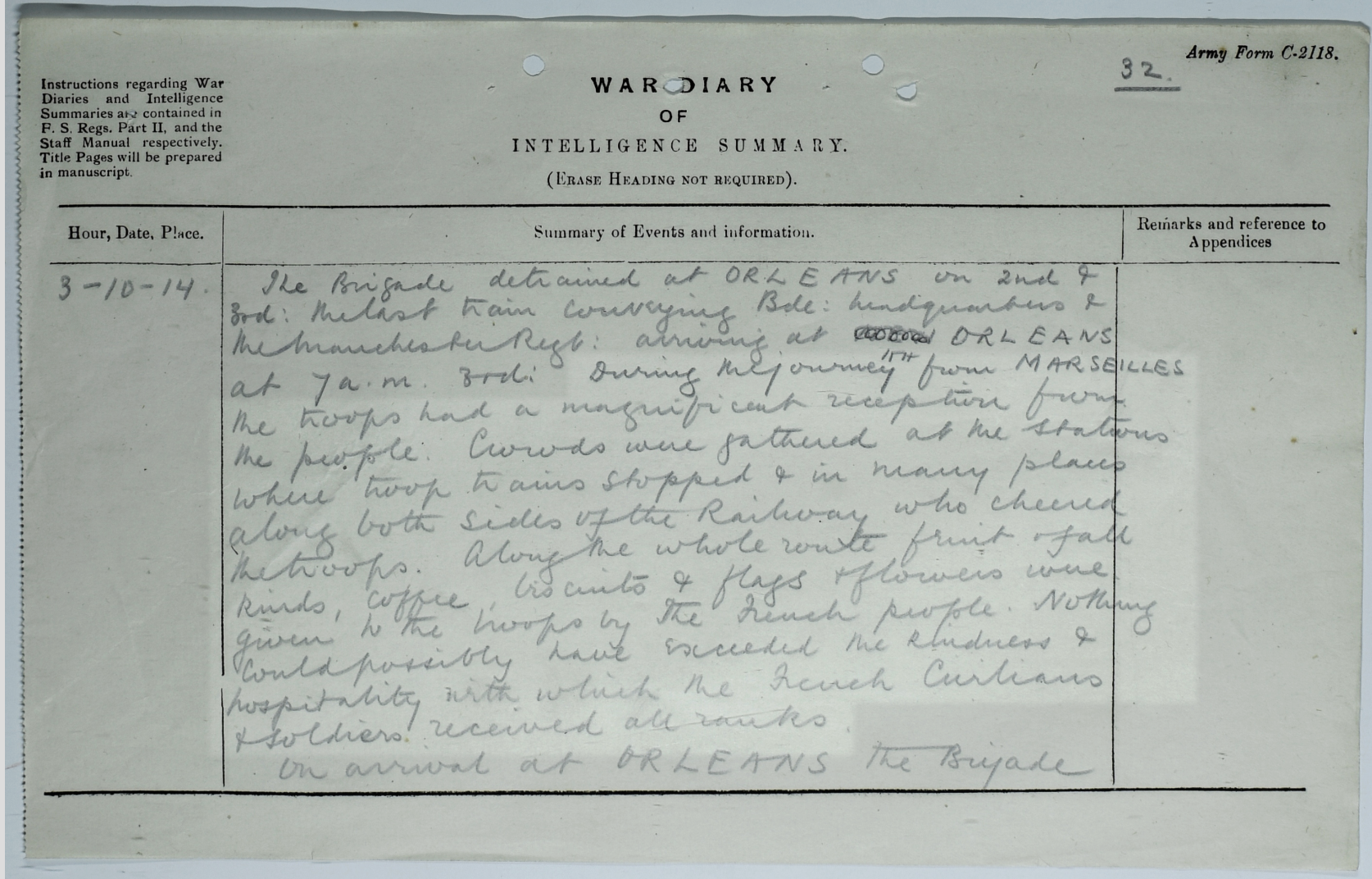
The diary then returns to the practical realities of military life. Each man's field kit was reduced to the essentials: "one waterproof sheet, one blanket, one towel, one comforter, one pair of socks", while surplus belongings were left behind. Although rations were reported to be adequate, the diary also notes that the weather was "hot during the day but very cold at night with heavy dew", an understated observation that hinted at the far harsher conditions Indian troops would soon face on the Western Front.
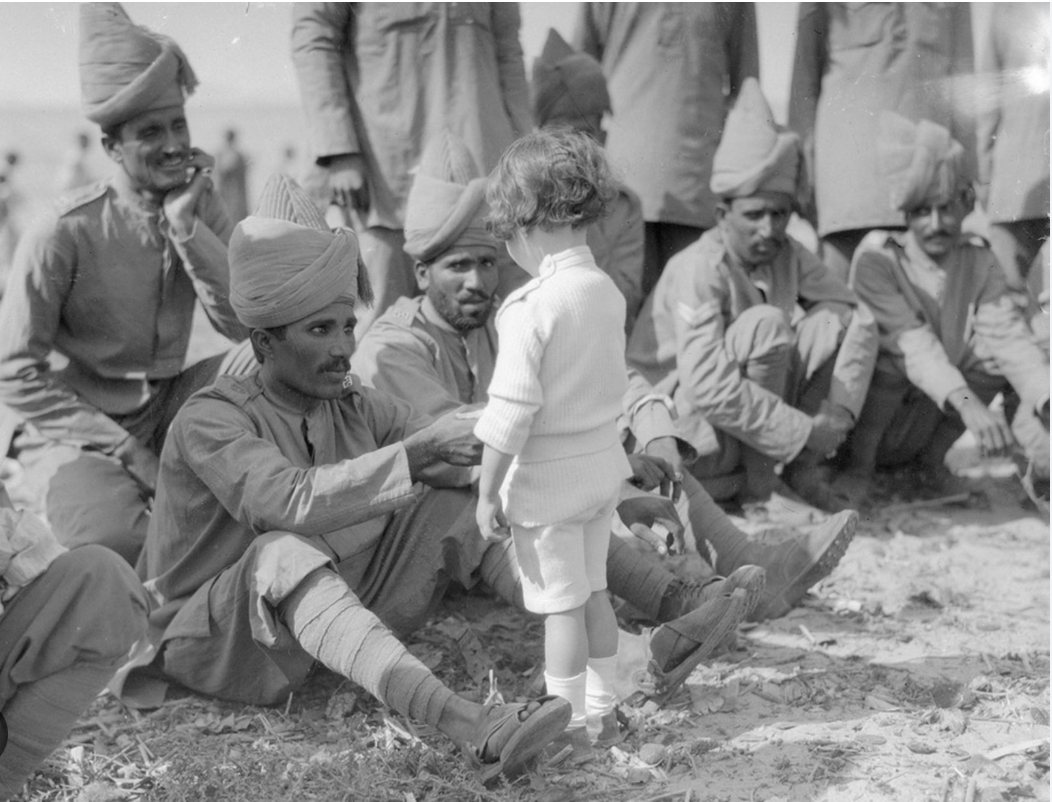
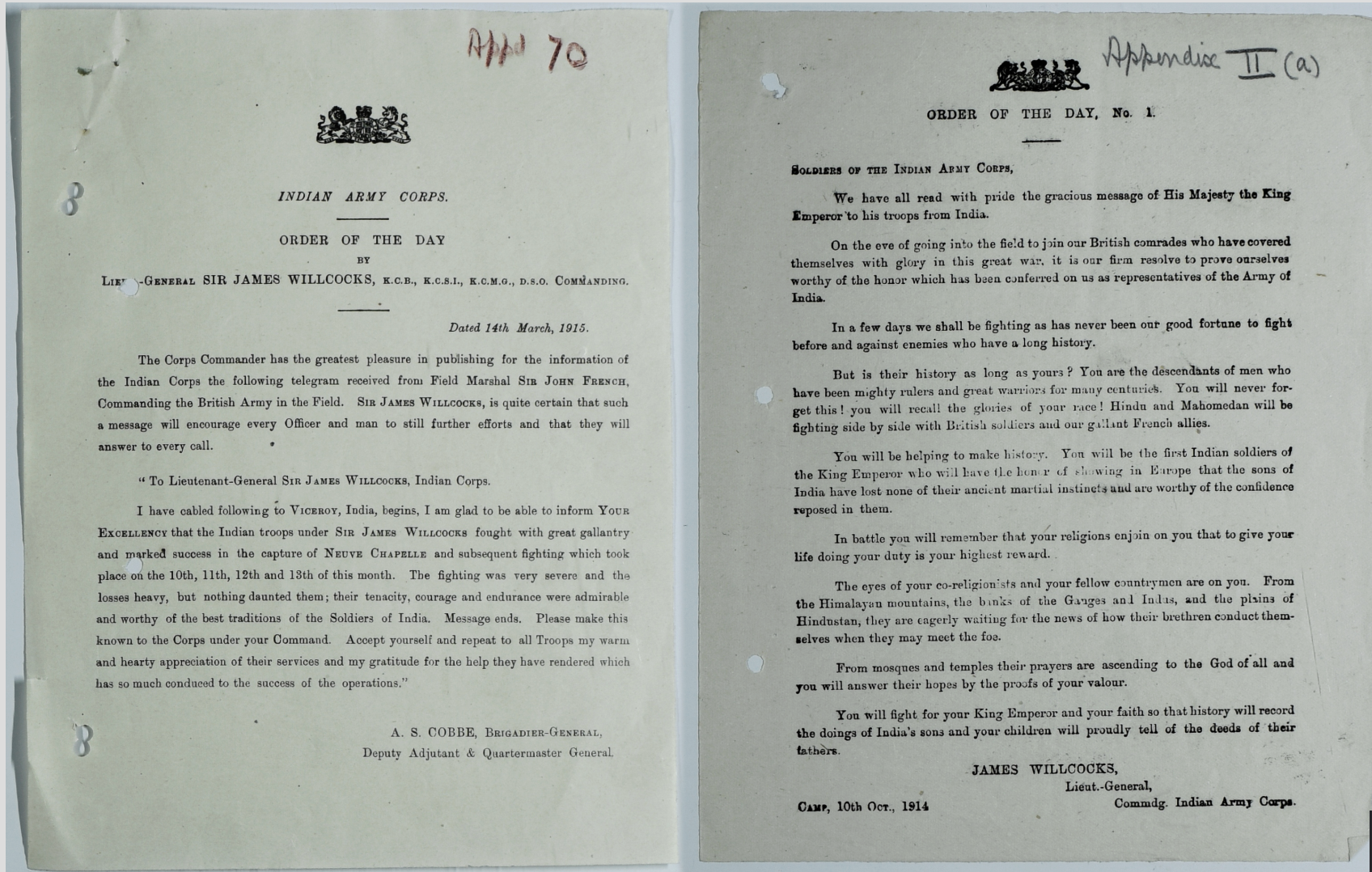
As the troops prepared to enter battle, Lieutenant-General Willcocks issued an "Order of the Day" on 10 October 1914. Addressing Indian soldiers as heirs to India's martial traditions, he invoked lineage, religion, and duty to both empire and faith. Hindu, Muslim, and Sikh soldiers alike were reminded that they were "descendants of men who have been mighty rulers and great warriors for many centuries", while assuring them that "from mosques and temples their prayers are ascending to the God of all." He further declared that their religions taught them "that to give your life doing your duty is your highest reward." The order concluded by framing the campaign as a historic moment: "You will be helping to make history. You will be the first Indian soldiers of the King Emperor who will have the honour of showing in Europe that the sons of India have lost none of their ancient martial instincts and are worthy of the confidence reposed in them."
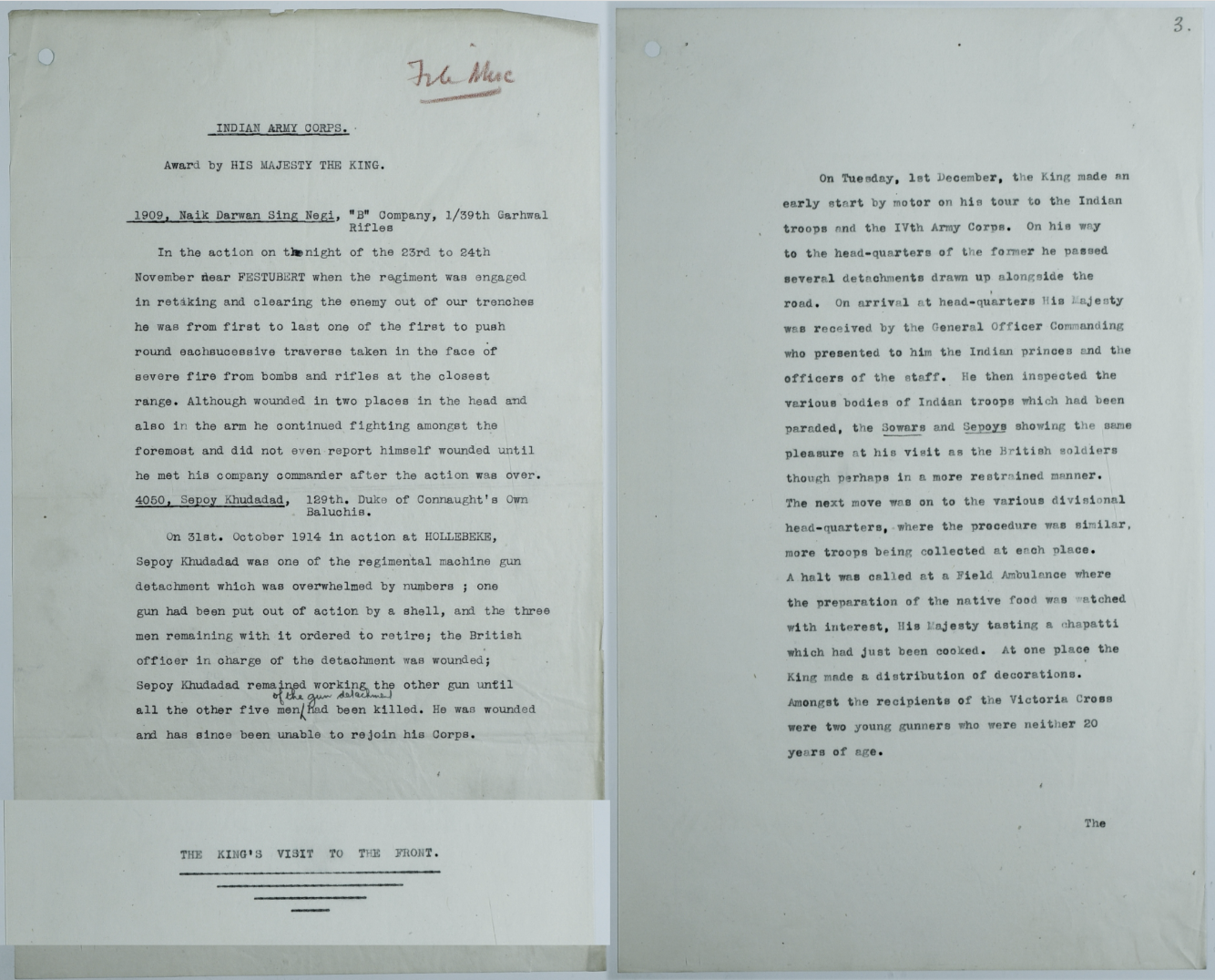
The troops were then sent to the Western Front, where the conditions that awaited them stood in stark contrast to the celebrations that had greeted their arrival. The first months of combat produced accounts of extraordinary courage. A war diary from the 57th Wilde's Rifles, dated November 1914, describes an action near Festubert in which Indian and British troops fought together to recapture trenches lost to the enemy. The account notes "many instances of distinguished courage and devotion which will never be recorded" before highlighting the actions of Naik Darwan Sing Negi of the 1/39th Garhwal Rifles. During the assault, Negi was "first in every dash on the traverses with the bayonet." Although wounded three times, including injuries to his head and arm, he continued fighting and "did not even report his wounds till his company fell in." His actions earned him the Victoria Cross, making him one of the first two Indian recipients of the award during the First World War, alongside Sepoy Khudadad Khan.
These acts of bravery, however, took place amid conditions that were both physically and emotionally devastating. The winter of 1914–15 brought a battlefield that was unfamiliar in both its environment and its brutality. Many Indian soldiers had arrived without adequate warm clothing and soon faced freezing temperatures, waterlogged trenches, and the constant hardships of trench warfare. Some developed trench foot from prolonged exposure to wet and cold conditions. The First Battle of Ypres became their first major test on the Western Front, followed by months of fighting that took a heavy toll on Indian troops and their officers.
Letters home became one of the few ways Indian soldiers could communicate their struggles to their families. Their descriptions reveal not only the physical suffering of war, but also the psychological impact of encountering a conflict of unprecedented scale. One Punjabi Rajput wrote home, "This is not war. It is the ending of the world." Others compared their fate to that of "maggots" or "goats". British officials monitoring soldiers' correspondence noted an increase in letters from men who had "given way to despair" and expressed "a melancholy impression of a fatalistic resignation to a fate that is regarded as speedy and inevitable."
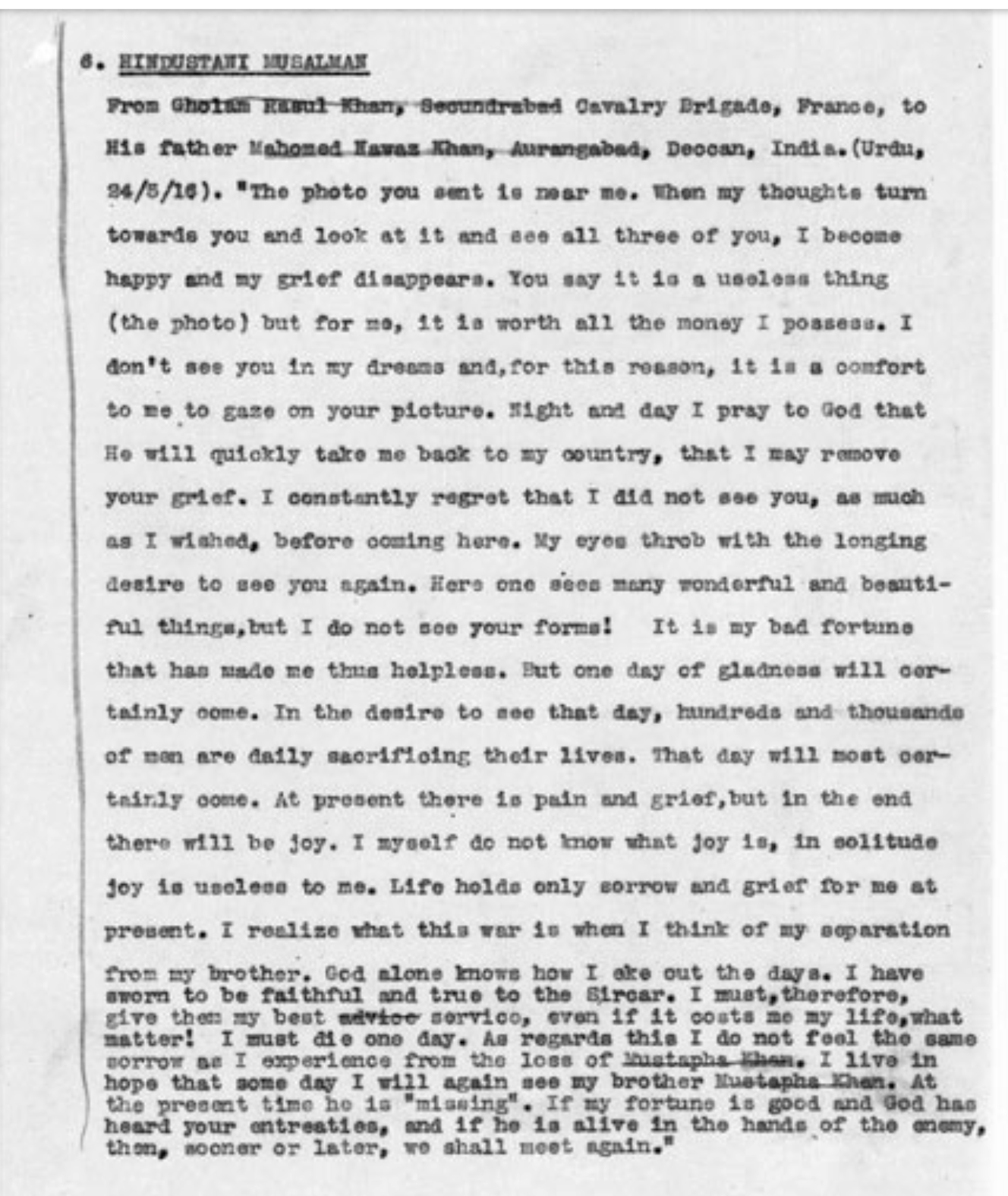
The emotional cost of war is perhaps most clearly visible in the soldiers’ own words. In a letter written from France to his father in the Deccan, Gholam Rasul described his loneliness. A photograph sent from home became a source of comfort during his time away. Although his family considered it “a useless thing,” Gholam wrote, “for me, it is worth all the money I possess.” “I become happy and my grief disappears” when looking at the photograph. Gholam’s letter reveals that the suffering of war extended far beyond the battlefield. He wrote, “Night and day I pray to God that He will quickly take me back to my country...” Although he had encountered “many wonderful and beautiful things” in Europe, they offered little comfort. His greatest sorrow came from separation: “I myself do not know what joy is; in solitude, joy is useless to me. Life holds only sorrow and grief for me at present.” The uncertainty of war was exacerbated by his concern for his brother Mustapha Khan, who was “missing.” Gholam wrote that he did not experience the same fear of his own death as he did over the loss of his brother, hoping that “if he is alive in the hands of the enemy, then, sooner or later, we shall meet again.” Yet alongside this grief was a continued sense of duty. Gholam declared, “I have sworn to be faithful and true to the Sirkar. I must, therefore, give them my best service, even if it costs me my life, what matter! I must die one day.” Behind the statistics of Indian soldiers who fought and died in the Great War are stories of individuals like Gholam, who carried memories of loved ones while confronting the possibility that they might never see them again.
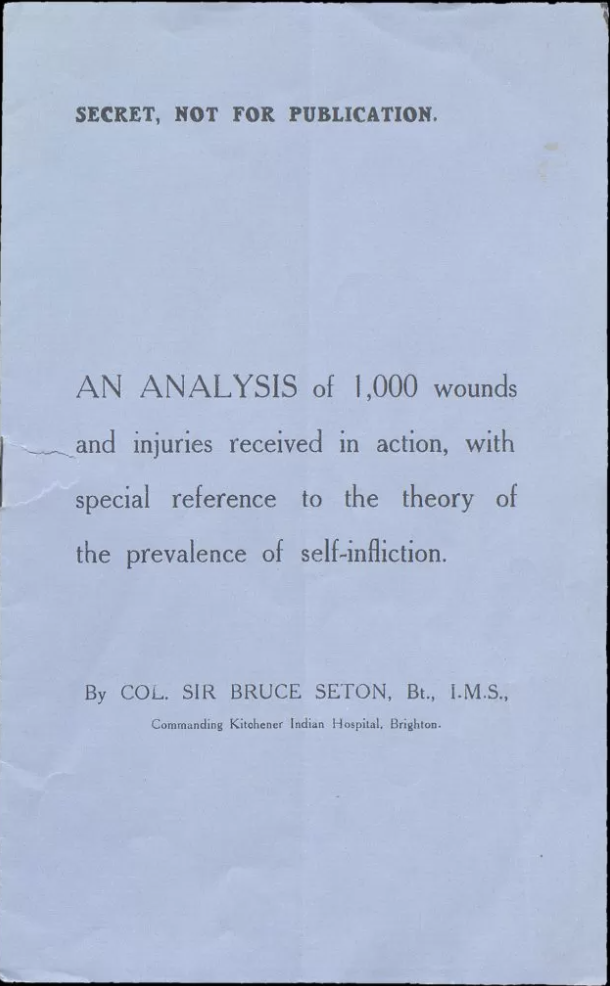
For some soldiers, the horrors of industrial warfare created a desperate desire to escape the front. Within a two-week period between 22 October and 3 November 1914, officials noted that the number of Indian soldiers admitted to hospital with hand wounds was unusually high. British authorities suspected that soldiers had resorted to malingering or self-inflicted injuries, driven by a war unlike anything they had encountered before. However, a subsequent confidential investigation by Colonel Bruce Seaton, who examined 1,000 wounds sustained by Indian troops at the Kitchener Hospital in Brighton, found no evidence to support the allegation of deliberate self-wounding.
This mass suffering at the front existed alongside growing frustration with inequalities within the imperial system. Since soldiers’ letters were subject to military censorship, many developed coded ways of expressing themselves. One such code was the use of “black pepper” and “red pepper” to refer to Indian and British troops respectively. In one instance, a Jat soldier wrote home that the “black pepper” was “very pungent” while the “red pepper” was “not so strong,” using the metaphor to express confidence in the fighting abilities of Indian troops. In other letters, the same coded language revealed deeper anxieties about sacrifice and unequal treatment. Sir Walter Lawrence, the Commissioner for the Welfare of Indian Soldiers, noted in his 1915 correspondence that in sepoys’ letters there was “constant mention” of the belief that the “black pepper” was being used up while the “red pepper” was being saved, suggesting that Indian troops felt they were being deliberately exposed to greater danger while British soldiers were being preserved. Lawrence also recorded dissatisfaction among Sikh soldiers regarding their pay and treatment. He described their “morose appearance” in hospitals, attributing it to their belief that “the pay of an Indian Sepoy is not sufficient remuneration for the work which they have been called upon to do in France.” At Milford-on-Sea, soldiers openly stated that while they did not expect the same pay as British soldiers, they believed they deserved “at least 20 rupees a month” rather than their existing rate of 11 rupees.
Even as soldiers struggled with discrimination and the psychological and physical demands of war, they continued to fight in some of the major battles of the conflict. By March 1915, their actions at the Battle of Neuve Chapelle had become a defining moment in the representation of Indian soldiers within the British military. In an official message dated 14 March 1915, Field Marshal Sir John French praised their role in the capture of Neuve Chapelle and the subsequent fighting. French wrote that Indian troops had fought “with great gallantry and marked success,” acknowledging that “the fighting was very severe and the losses heavy,” while emphasising that “nothing daunted them; their tenacity, courage and endurance were admirable and worthy of the best traditions of the soldiers of India.” For many soldiers, military service was connected to family and community traditions, with regimental service often passed down through generations and tied to ideas of izzat (honour). A war diary entry dated 3 October 1915 records the actions of Havildar Lal Singh, Havildar Wir Singh, and Lance Naik Buta Singh, who informed their Company Commander that leaving a rifle behind on the battlefield was “Sharam Ki Baat”, a matter of shame. The three men volunteered to recover the lost weapon, approaching a listening post where they were suddenly attacked by German soldiers. Buta Singh was shot through the head, but the two Havildars fought off the enemy and attempted to bring back his body. The three fought with great courage, yet stories like theirs gradually faded from public memory.
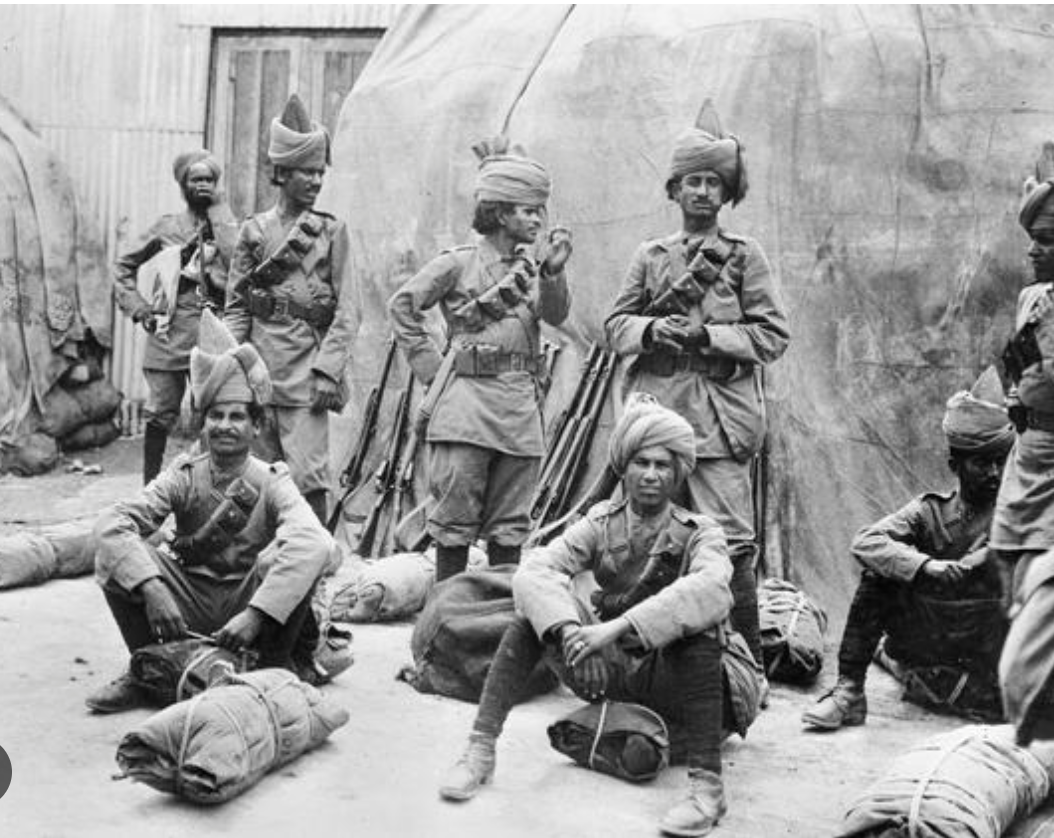
More than a century later, the names of these men survive only in fading records and weathered memorials like the one at College Square. It was through these fragments that I first encountered the story of Indian soldiers in the World Wars. Behind each name was a person who crossed thousands of miles to fight in unfamiliar lands while carrying memories of home. Their experiences remind us that the history of the Great War was not solely European. It was also a South Asian history, shared by people from regions that today form Bangladesh, India, Pakistan, and Myanmar.
Raisa Morshed is a nonprofit professional with experience in development at Human Rights Watch and humanitarian programming at Penny Appeal USA. She is also a researcher documenting oral histories of the 1947 Partition and the 1971 Liberation War. She can be reached at [email protected].
Send your articles for Slow Reads to [email protected]. Check out our submission guidelines for details.
Football as freedom: From colonial Bengal to Bangladesh
How Dhaka lost its green and water: Revisiting the first master plan of the city
Bengal’s forgotten connections with Nazi Germany
Muzharul Islam and his spaces of belonging
The rise, decline and revival of Buddhism in Bengal
Two visions of Sulh-i Kul: Akbar and Dara Shukoh
Pachapdi Gazi, the 'Jim Corbett of Bengal', and the truth about Sundarbans 'man-eaters'
How Mohammedan Sporting Club shaped Muslim identity in colonial Bengal
The untold history of the rivers that connect Bangladesh and Asia