


A higher growth target without credible reform will remain elusive

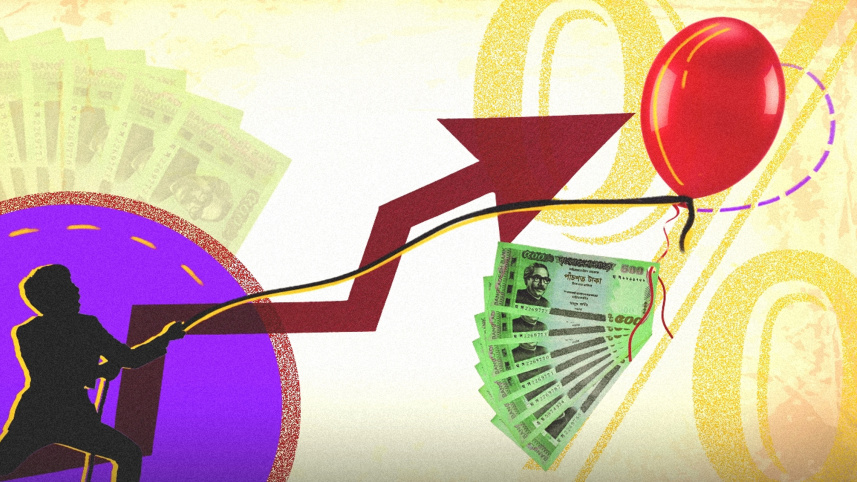
The government has set a target of 6.5 percent GDP growth for FY2026-27. The International Monetary Fund, by contrast, expects growth of only 3.5 percent and warns that this could fall below 3 percent over the medium term if revenue, banking, and other structural reforms remain stalled. The gap is too wide to be seen as a routine disagreement over forecasting. It also raises the question of what will drive growth when inflation remains high, private investment is weak, banks cannot support productive firms, and the government has little fiscal room.
Of course, the IMF may prove too pessimistic, just as government projections have often proven too optimistic. But the warning cannot be ignored. The World Bank has also projected weak growth, while Fitch Ratings has cautioned that delayed reforms may reduce Bangladesh’s long-term growth potential. Its revision of the sovereign rating outlook from stable to negative signals declining confidence in the pace and credibility of reform.

The core concern is that Bangladesh’s slowdown began before the latest global shocks. The Middle East conflict, higher energy prices, and supply disruptions have only worsened the pre-existing situation. The shocks are raising import costs, adding to subsidy pressures, and creating new risks for inflation, exports, and remittances. But these shocks have essentially hit an economy that was already losing momentum. And recovery cannot happen by treating every domestic weakness as the result of an external crisis.
Inflation remains the most immediate constraint as it has reduced real wages, weakened household consumption, and forced monetary policy to remain tight. If inflation stays close to 9 percent, the government’s target of 7.5 percent will appear increasingly unrealistic. High interest rates may be necessary to contain demand and stabilise the exchange rate, but they also raise working-capital costs and discourage investment. Premature easing could renew pressure on prices and the taka. Excessive tightening—without addressing food market distortions, energy shortages, and fiscal indiscipline—could suppress production without solving the causes of inflation.
The burden is also unevenly distributed. Low growth combined with high inflation limits employment while eroding people’s purchasing power. Poor and lower-middle-income households are hit first. Small businesses face higher borrowing and input costs. Salaried households cut consumption. Young people encounter fewer job opportunities. A growth strategy that overlooks these effects may produce an attractive aggregate target, but it will not restore confidence in the economy.
The banking sector is perhaps the largest domestic threat to economic recovery. Non-performing loans (NPLs) reached alarming levels by the end of 2025, while private sector credit growth slowed sharply. This reveals a broken transmission mechanism between savings and productive investment. Politically connected borrowers, weak boards, repeated rescheduling, and regulatory tolerance prevent bank resources from flowing efficiently to viable firms. Productive businesses face costly and scarce credit, while failed borrowers continue to receive concessions. The recent trend suggests that Bangladesh’s major conglomerates are increasingly borrowing abroad as foreign loans come far cheaper than local credit, even though a weaker taka could raise repayment burdens.
Banking reform must go beyond merging weak institutions or changing their names. Banks need credible asset-quality reviews, adequate provisioning, and time-bound restructuring plans. Public recapitalisation, where unavoidable, should be conditional based on changes in ownership, boards, and management. Wilful defaulters should not receive another blanket rescheduling facility. Bangladesh Bank must also have the operational independence to enforce rules without political interference. Otherwise, the cost will eventually be transferred to taxpayers, depositors, and responsible borrowers.
The fiscal constraint is equally serious. Bangladesh has entered the current period with one of the world’s lowest tax-to-GDP ratios, yet the budget assumes a sharp revenue increase. But if that target is missed, the expected response will be to compress development expenditure to keep the deficit within limits. This may protect the headline fiscal number, but it ultimately weakens infrastructure, health, education, and future growth.
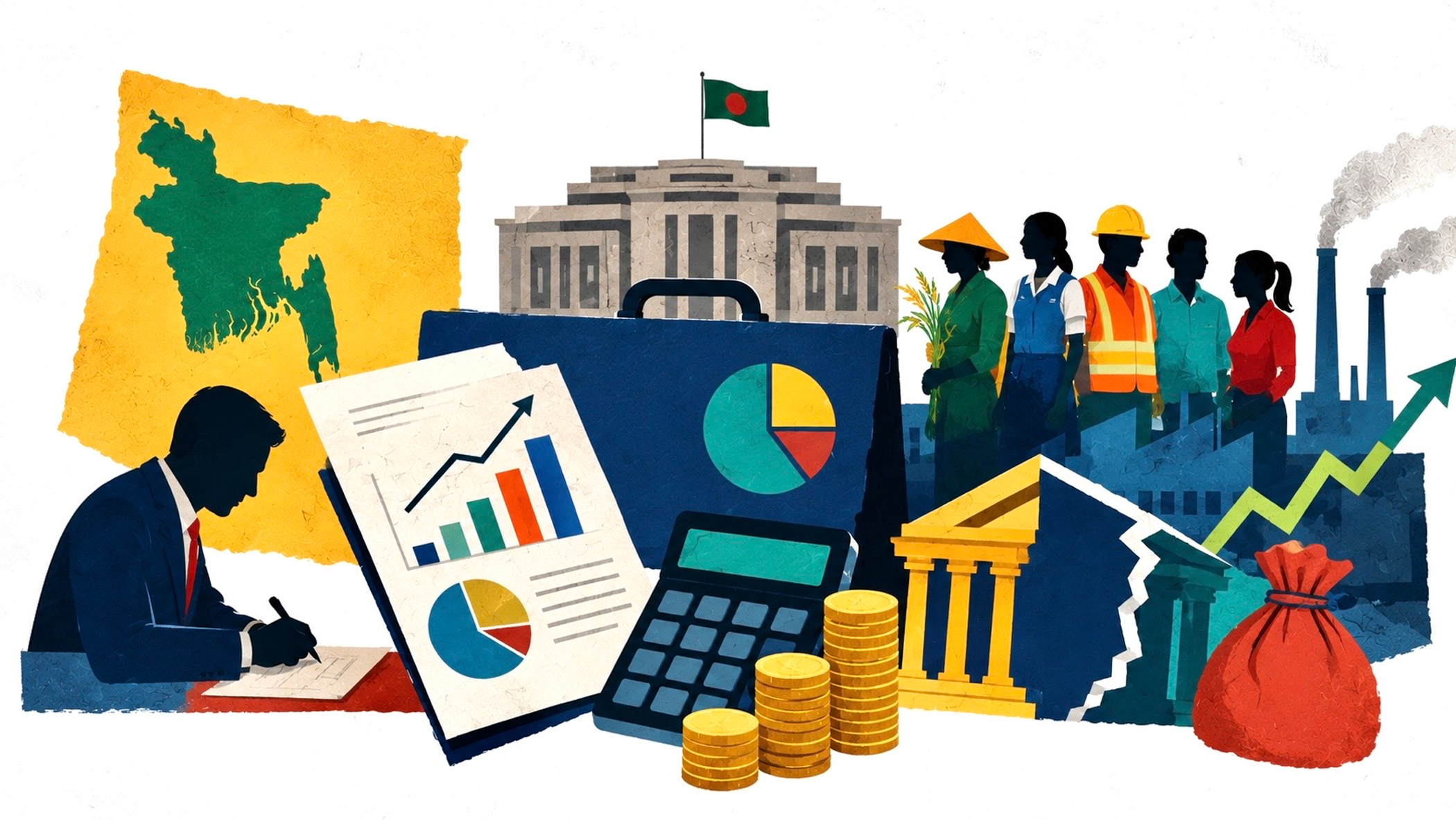
Revenue reform cannot mean imposing more withholding taxes, higher indirect taxes, and additional compliance burdens on formal businesses, as such measures discourage investment and push smaller firms further into informality. The tax base must be broadened through better information systems, fewer discretionary exemptions, stronger property and income taxation, and firmer action against large-scale evasion. The question is not only how much revenue is collected, but from whom and at what cost to production and equity.
The external sector offers some relief, but there isn’t a durable growth strategy. Strong remittance inflows have supported reserves and domestic demand. But remittances can never substitute for export competitiveness, investment, and productivity. Bangladesh remains heavily dependent on RMG, while export diversification has moved slowly. Foreign direct investment remains low, and firms continue to face unreliable energy, costly logistics, customs delays, and regulatory uncertainty. These are longstanding issues, but what is changing is investors’ declining tolerance for promises without implementation.
The policy response should begin with a realistic two-year recovery programme. Inflation control, banking resolution, revenue reform, energy security, export competitiveness, and social protection should be treated as connected parts of one strategy. The government should publish measurable quarterly milestones, identify the institutions responsible, and report progress publicly. Public investment should protect projects with clear economic returns while suspending politically attractive but low-productivity schemes.
Energy price and subsidy reforms may be necessary, but abrupt increases without targeted support could intensify hardship. Bank closures or mergers must protect small depositors. Tax reform should begin with wealthy individuals, property, exemptions, and large-scale evaders before placing further pressure on compliant small businesses. Social protection should also be made more responsive to inflation, unemployment, and external shocks.
Every government supports reform in principle, but becomes resistant to reforms which threaten influential borrowers, protected industries, tax privileges, opaque contracts, or politically allocated expenditure. Bangladesh’s growth problem is therefore not merely technical, but rooted in the distribution of economic power and in the state’s repeated inability to impose discipline on groups that benefit from institutional weakness.
A return to 6 or 7 percent growth remains possible: Bangladesh has a large workforce, a strong entrepreneurial base, an established export sector, and substantial scope for productivity gains. But the old growth model—based on cheap labour, protected markets, weak banks, low taxation, and infrastructure expansion—appears to have reached its limit. The next phase will require better institutions, more competition, export diversification, human-capital investment, and a financial system that rewards productivity over political connections.
Bangladesh must surely pursue higher growth. But is the government prepared to undertake the reforms without which that growth will remain a number in the budget speech? Growth cannot be declared or budgeted into existence. It must be earned through credibility, investment, productivity, and institutional change.
Dr Selim Raihan is professor in the Department of Economics at the University of Dhaka, and executive director at South Asian Network on Economic Modeling (Sanem). He can be reached at [email protected].
Views expressed in this article are the author's own.
 For all latest news, follow The Daily Star's Google News channel.
 Follow The Daily Star Opinion on Facebook for the latest opinions, commentaries, and analyses by experts and professionals. To contribute your article or letter to The Daily Star Opinion, see our guidelines for submission.
Comments