


‘Waterlogging is now more a problem of governance than of rainfall’

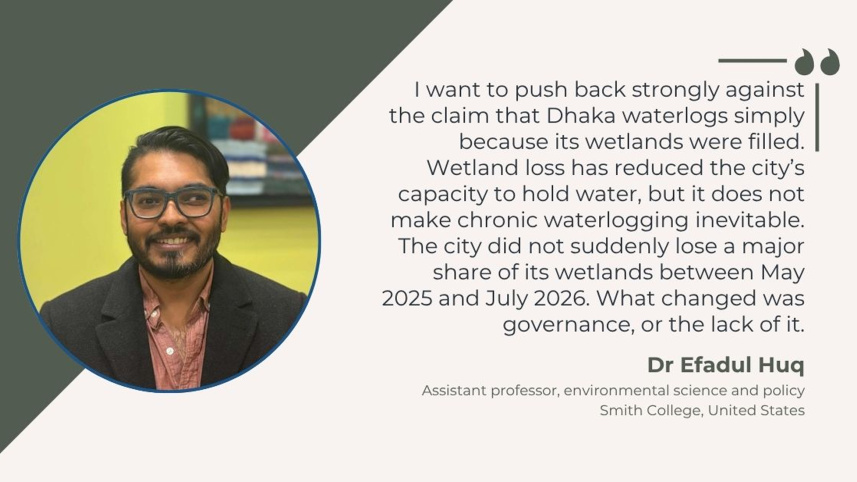
Dr Efadul Huq, assistant professor of environmental science and policy at Smith College in the US, speaks with Marzana Tasnim of The Daily Star about the governance failures behind persistent urban waterlogging, climate resilience, and the future of cities in Bangladesh.
Bangladesh’s weather forecasting capacity has improved considerably over the years. Yet, heavy rain predictions often fail to translate into timely anticipatory action on the ground. Why does this gap persist?

The main problem is that the responsible authorities, such as the city corporations, don’t make the connection between the forecast and the required action. Unless officials are held accountable for the response, or lack thereof, better forecasting will not lead to better preparedness.
How much of the recent severe waterlogging can be attributed to heavy rainfall, and how much to poor urban planning, inadequate drainage capacity, canal encroachment, or weak enforcement?
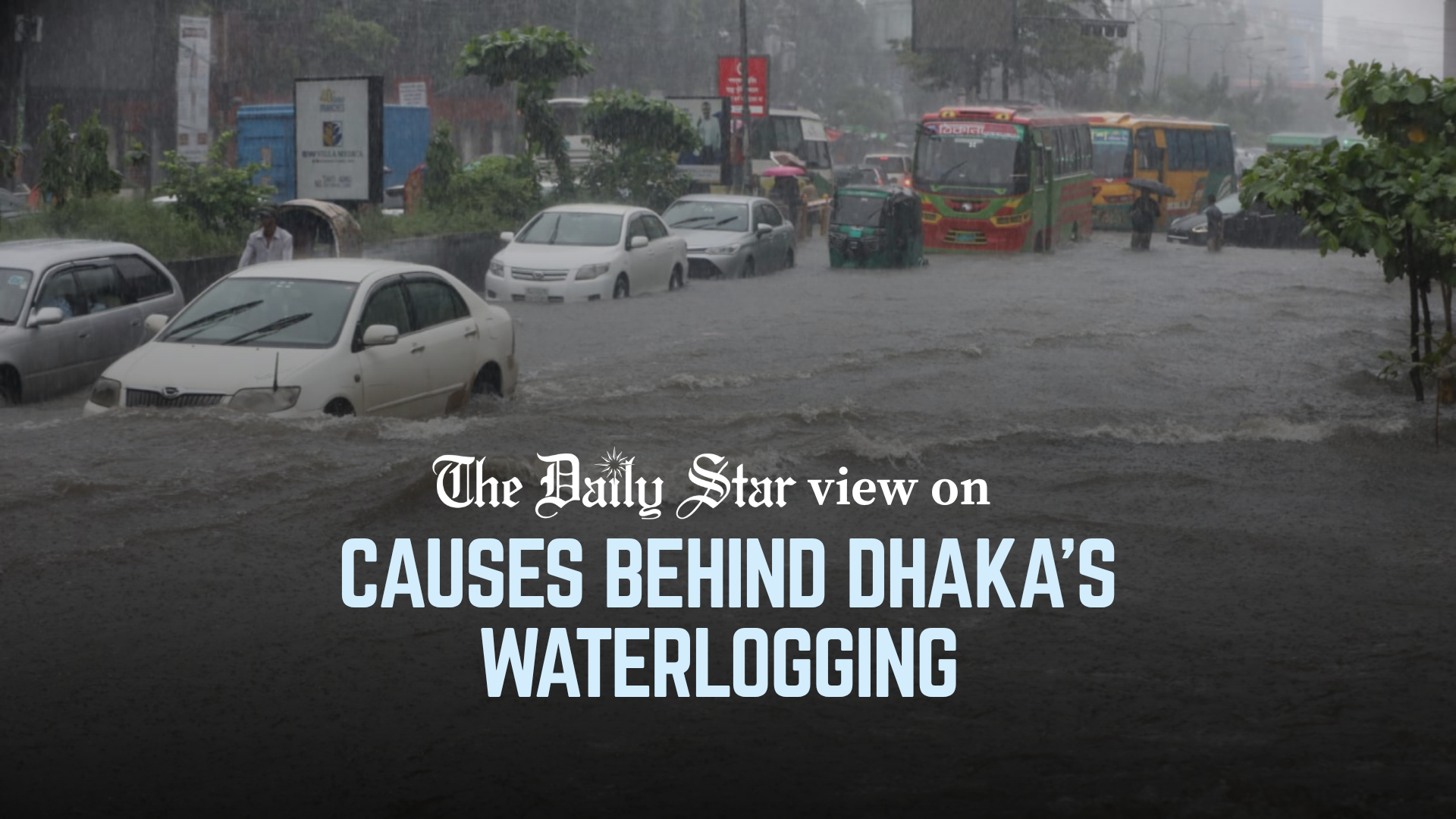
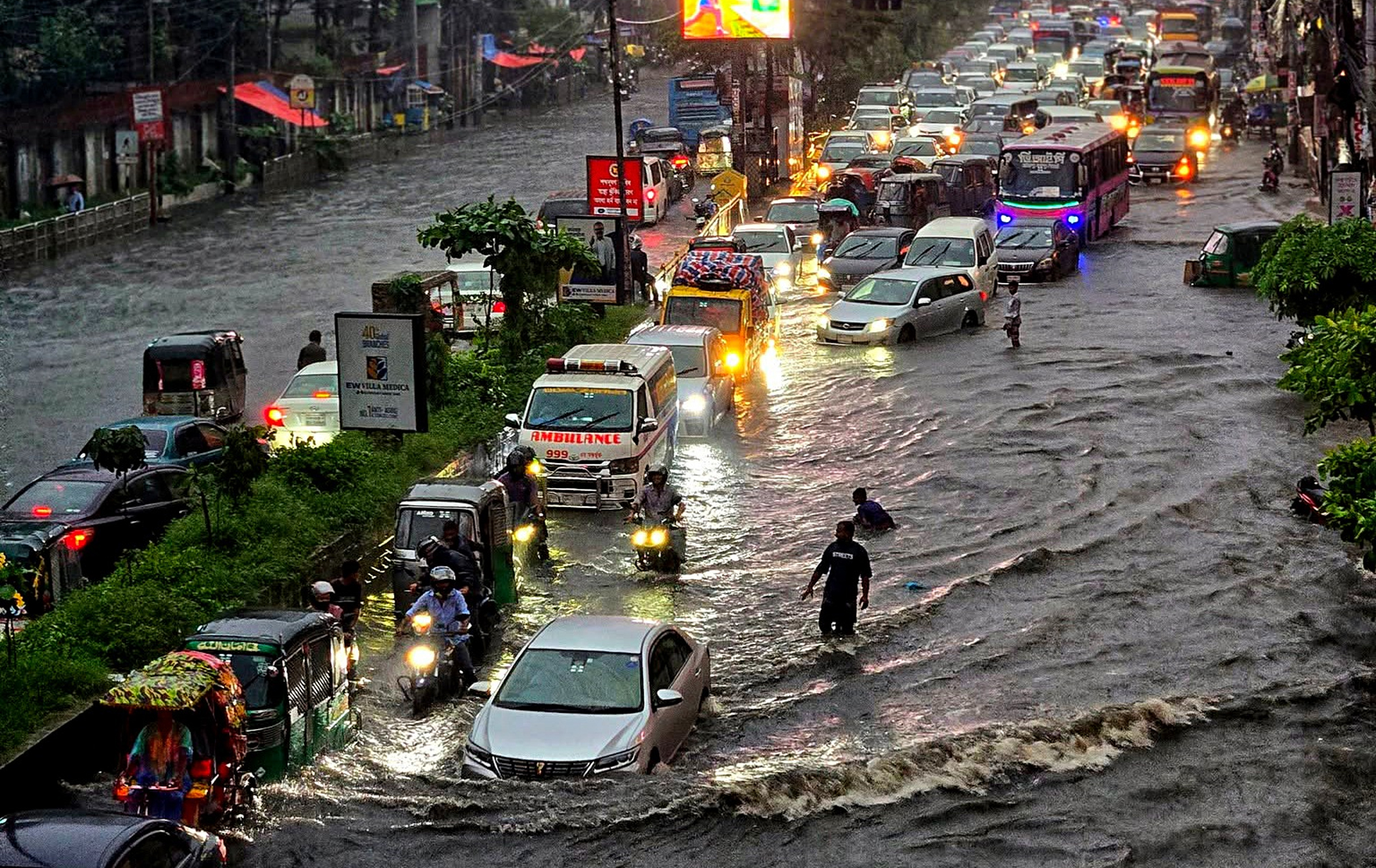
For chronic waterlogging, I would say this is primarily a governance problem. In a genuinely extreme event, some flooding may be unavoidable. But repeated and prolonged waterlogging at the same known hotspots points to failures of maintenance and response. Dhaka received 196 mm of rain in one day in May 2025 and 97 mm on July 12, 2026, yet the smaller rainfall event caused much greater disruption. If inadequate drainage infrastructure were a decisive factor, how did the water drain last year?
I want to push back strongly against the claim that Dhaka waterlogs simply because its wetlands were filled. Wetland loss has reduced the city’s capacity to hold water, but it does not make chronic waterlogging inevitable. The city did not suddenly lose a major share of its wetlands between May 2025 and July 2026. It had essentially the same wetland deficit in both years. What changed was governance, or the lack of it. The broader claim that a city built on wetlands or beside rivers is destined to remain waterlogged is also simply untrue.
Take a look at the Netherlands. It is a low-lying delta where substantial areas were reclaimed from water, and millions of people live below sea level. It manages that vulnerability through clearly assigned responsibilities, continuous maintenance, flood protection, and coordination among public authorities. Wetland loss is a serious structural problem for Bangladesh, but it has become a politically convenient explanation by turning a preventable failure into geographical destiny. Wetland loss does not leave pumps unrepaired, canal mouths blocked, or agencies unprepared despite an advance forecast.
Some canals in Dhaka still connect directly to the surrounding rivers, alongside a wider interconnected network that can still carry water. Those connections must be restored and kept open. Some targeted infrastructure investment will be necessary, but anyone explaining the current crisis mainly through rainfall, wetland loss, or drainage capacity is downplaying the governance failure within the city corporations in the capital.
One recurring criticism during monsoons is that responsibility for preventing waterlogging is divided among multiple agencies, with no single institution accountable for coordinating the overall response. What do you have to say about this fragmentation of governance?
Sure, many agencies are involved, but fragmentation should not become an excuse for inaction. Historically and practically, the city corporation has to take responsibility for the overall coordination. The city mayor’s ministerial status gives the office the political standing to convene the relevant agencies, press them to act, and follow up across institutional boundaries.
Ideally, the entire drainage system would be placed under one unified metropolitan authority. But we don’t need to wait for that restructuring before acting. Under the current arrangement, the city corporation is still best positioned to lead. What is needed is the competence and will to coordinate, rather than allowing each agency to hide behind the question of who owns which drain or canal.
In a genuinely extreme event, some flooding may be unavoidable. But repeated and prolonged waterlogging at the same known hotspots points to failures of maintenance and response. Dhaka received 196 mm of rain in one day in May 2025 and 97 mm on July 12, 2026, yet the smaller rainfall event caused much greater disruption. If inadequate drainage infrastructure were a decisive factor, how did the water drain last year?
Media reports have been highlighting that, despite large investments made in improving the drainage infrastructure, major cities like Dhaka, Chattogram and Khulna experience waterlogging even after a moderate rainfall. Why are these costly projects falling short?
Focusing on infrastructure alone would be misleading. The more immediate problem is the lack of proper operation and maintenance of the existing infrastructure. Canal mouths and outfalls are not regularly cleared. Pumps and sluice gates are not kept functional. The list goes on. That said, Dhaka, Khulna or Chattogram should not be treated as if they face the same problem.
In Khulna, the low-lying geography and still-incomplete drainage investments mean that major infrastructure gaps remain. In Chattogram, rivalry among agencies has produced competing plans and different drainage designs, so institutional conflict is part of the problem. Dhaka is different. Its stormwater and sewerage networks are incomplete, but the city still has considerable capacity to drain water through its existing canals, outfalls, and interconnected channels. Restoration is still possible. The city authorities need to take the upper hand in coordinating the agencies, maintaining these connections, and deciding where targeted infrastructure is actually needed.
So, the lesson here is not that investment produces no result. It is that investment fails when it is not scientific, people-oriented, coordinated, or followed by proper operation and maintenance. We should assess these projects by how quickly water recedes and whose neighbourhoods remain flooded.
Not to downplay the severity of the extreme rainfall events being caused by climate change, but at this stage, is climate change becoming an excuse for our governance failures?
Yes. Climate change should not be used to lower the standard of accountability. But in practice, climate change has become an instrument for avoiding responsibility. Dhaka has always experienced intense monsoon rainfall, and the historical rainfall pattern has not changed so abruptly that it can explain why the same drainage system performed relatively well in 2025 and failed under less rain in 2026. Climate change does not absolve public authorities of maintaining and operating the system they already have.
Should Bangladesh adopt formal trigger mechanisms whereby forecasts above certain thresholds automatically prompt reviews of decisions such as school closures, public transport arrangements, etc?
 For all latest news, follow The Daily Star's Google News channel.
 Sure, formal trigger mechanisms can be introduced. But we should not mistake that for governance. We could, for example, build a waterlogging app tomorrow, but the app alone will not help. Such tools are useful only when public offices are accountable, staffed by competent people, and motivated to act on the information they receive.
Urban waterlogging affects not only people but also street animals or urban wildlife. These impacts rarely feature in urban planning or disaster preparedness. How should cities incorporate the protection of vulnerable human and non-human populations into resilience planning?
At present, there is no meaningful urban safety net for poor people. Informal settlements—the so-called slums—are among the most exposed to various environmental risks, yet they are often left out of infrastructure planning. They need drainage, safe shelters, drinking water, sanitation, transport support, and emergency assistance. You are also right about animals. Flood preparedness has to include urban wildlife, rather than treating animals and other living systems as separate from the city.
For street animals and urban wildlife, community involvement is essential because residents and grassroots groups usually know where animals gather and can respond quickly. City corporations should fund and empower these groups to organise rescue, temporary shelter, feeding, and veterinary support. Citizen-led action can fill some immediate gaps when the government response is weak, as we saw in 2025, but it should complement public responsibility rather than replace it.
If you had the authority to implement just three reforms before the next monsoon season, what would they be?
First, I would return to the 2025 DNCC playbook. The then DNCC administration showed that it could audit known hotspots before the monsoon, clear canal mouths and outfalls, repair pumps and sluice gates, and prepare for forecast rainfall. The condition of these sites and the work completed should be digitally monitored and made public.
Second, I would establish response teams ahead of time that can be deployed before and during heavy rain, rather than assembling an ad hoc response after streets are already flooded. These teams should work under the city corporations and have the authority to act across agency and jurisdictional boundaries.
Third, for the longer term, I would require the agencies to follow a coordinated drainage master plan. That means restoring and connecting canals, drains, outfalls and rivers, and making targeted infrastructure investments where they are actually needed.
Follow The Daily Star Opinion on Facebook for the latest opinions, commentaries, and analyses by experts and professionals. To contribute your article or letter to The Daily Star Opinion, see our guidelines for submission.
Comments