


<i>Jibon Kheya: A tale of care, compassion for farmers</i>
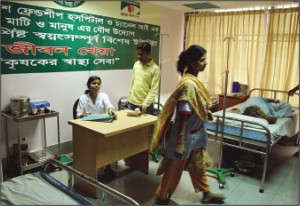
The Jibon Kheya unit at the Japan-Bangladesh Friendship Hospital.Photo: STAR
Fazilat Khatun was lying on a bed at a well-furnished private hospital in the city. From her look one can easily guess she does not know that she is suffering from breast cancer, or what is meant by cancer. Fazilat and her husband are terminal farmers living on khas land beside the slope of a highway at Govinda village of Chandpur. In any other time it would have been a dream for her to get herself to a hospital, let alone a well-equipped one, to receive treatment for this deadly disease. But 'Jibon Kheya', on Satmasjid Road at the Japan-Bangladesh Friendship Hospital (JBFH) on Satmasjid Road in association with 'Hridoye Mati O Manush' of Channel i, has made it possible for her to come to the city. It is a 4-bed unit specially kept for farmers where they can receive free treatment for any disease. "It would have never been possible for us to take her to a doctor when it is hard to manage a morsel of food," said Piyari Begum, Fazilat's daughter. Her family did not consult a doctor or go to the Sadar Hospital after her ailment started to show. "We could do nothing for her because we did not have money. My father was also suffering from breathing difficulties," said Piyari. "About a month ago, some doctors [from JBFH] came to our village to treat free of cost. There Dr Hasina told me that I would have to go to Dhaka for treatment. Returning to Dhaka they called up our village member and he arranged my trip to this hospital," said Fazilat. Fazilat's condition visibly improved after her treatment started at the unit. "When we brought her here it was hard to look at her. Her face showed the suffering she was enduring due to the disease. But after the treatment (two rounds of chemotherapy) her lump has shrunk to half its previous size removing the pains of ailment from her face," said Piyari. Fazilat was released on Friday morning after completing second cycle of chemotherapy. She is back home with 21 days' medicine from the hospital. After that period she will be back for the third cycle of therapy. She is one of the seven patients who have received treatment at the JBFH unit since its opening about six weeks ago. Sometimes local correspondents of Channel i bring these patients to Dhaka. Aditya Shaheen, chief researcher, Mati O Manush, said that it was their dream to address the basic human rights of farmers since 2004 when they started the popular TV programme. "When we visited remote villages we often came across farmers children attacked with skin disease or an old farmer suffering from asthma. It was a common sight that an ailing farmer sitting on the aisle of his field knowing not what to do. These are our findings for a long time," said Shaheen. "We could not bring these things into our programme because there was little scope put up these besides agriculture. So we started thinking about involving an organisation which will work for their health," he said. "In December last year we approached JBFH in this respect and they agreed. After that we started this programme from this January," he added. Dr Bipul Sarkar, clinical in-charge of Jibon Kheya, said that patients are collected during weeklong free treatment camps at district level. "In spite of being an agro-based country we do not have any specific programme for our farmers. We have started this service to fill up this gap," he said. The district level service kicked off on January 18 and it covered around 10 districts including Comilla, Mymensingh, Tangail, Narshingdi, Manikganj, Sirajganj, Chandpur, Munshiganj and Gazipur. The medicare included ECG, blood grouping, medicine, nebuliser (for breathing difficulties) and disease investigation free of cost. The outdoor service is given by specialist doctors. Till now medicines costing around Tk 3.90 lakh have been distributed among the farmers. Masks required for spraying pesticides and oral polio vaccines (OPVs) are also given as part of the preventive care. Besides, every time around 50 students from the area are given training on farmers' primary and emergency health care while a workshop is conducted with 25 farmers to help grow health and occupational safety awareness. For easy access to JBFH there is a plan to set up a hotline that can be reached from all operators of mobile and land phone services. To extend allout medicare to the poor, landless and terminal farmers, teleconference is also being arranged. "We have applied to BTRC for a short code for the hotline and they have allocated us one. Hopefully we will be able to start the service within two weeks after completing some technical matters," said Dr Bipul. "While working at the district level we found that many farmers suffer from complicated diseases which should be treated in the hospital," said the doctor. "Till now we have selected around 27 patients from districts who need treatment at hospital. Around 20 patients are in the waiting list," he said. "We have a plan to expand this service to a 400-bed hospital. On Pahela Baishakh we will select the site for this hospital," he added. Jibon Kheya was inaugurated on February 21 as part of an effort to provide farmers with improved treatment for any disease free of cost.
 For all latest news, follow The Daily Star's Google News channel.
Comments