


BTRC tightens drive tests to improve network checks
The Bangladesh Telecommunication Regulatory Commission (BTRC) has approved a stricter methodology for drive tests to assess the quality of service (QoS) provided by mobile operators to subscribers, aiming to strengthen consumer protection and make network evaluations more accurate.
Under the tests, engineers use vehicles fitted with specialised equipment to measure key indicators such as call quality, data speeds, signal strength, coverage and network latency in real-world user conditions. The findings help BTRC check operators’ compliance with QoS requirements and identify areas needing improvement.

The updated methodology increases the volume of data collected, uses larger files for speed tests, upgrades testing server capacity and revises call-quality measurements to better reflect the country’s 4G-focused mobile networks.
The approval was given at a recent meeting, according to documents.
The revised framework replaces the methodology introduced in 2021 and follows BTRC’s 2025 QoS directives, which require nationwide drive tests. After finding the previous system outdated, the regulator formed a committee that consulted all four mobile operators and received technical input from testing equipment maker Rohde & Schwarz before finalising the changes.
“We issued the updated QoS directives in September 2025. They focus on collecting QoS data down to the upazila and network levels, making the regulations much stricter for mobile network operators than before,” Gen (retd) Iqbal Ahmed, commissioner for engineering and operations at BTRC, told The Daily Star.
“The new methodology clearly sets out how QoS measurements should be carried out and how the results should be verified. These changes will benefit mobile users across the country,” he added.
Bangladesh has four mobile phone operators, with a total of 18.86 crore subscribers as of May, according to BTRC data. Grameenphone having the highest subscriber base of 8.6 crore, followed by Robi Axiata’s 5.82 crore and Banglalink’s 3.78 crore. The state-owned Teletalk has just over 68 lakh users. The updated method comes at a time when many subscribers are suffering from call drops and poor network quality.
MORE SAMPLES, STRONGER TESTING STANDARDS
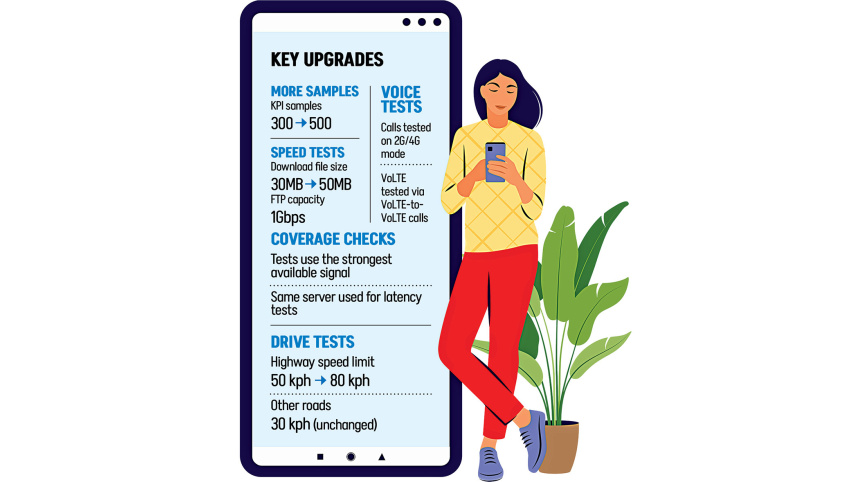
A major change is the increase in the minimum sample size for measuring key performance indicators (KPIs). Operators will now have to collect at least 500 samples for each KPI, compared with 300 earlier. BTRC said the larger sample size would improve reliability but require more extensive field testing.
The regulator has also changed file-transfer testing parameters. The file size used for download speed tests has been increased to 50MB from 30MB to measure sustained network performance rather than short bursts of speed. The upload test will continue using a 10MB file.
To support the larger downloads, the minimum bandwidth requirement for FTP servers has been raised from 300Mbps to at least 1Gbps across four terminals. This is expected to prevent testing infrastructure from limiting results.
BTRC has also updated voice-service testing to match the current network environment. Previously, call setup time for circuit-switched (CS/CSFB) calls was measured using devices set to 2G/3G auto mode. Under the new rules, devices must operate in 2G/4G auto mode, reflecting operators’ largely 4G-based networks.
For VoLTE (Voice over Long-Term Evolution) and future voice technologies, call setup time will be measured only through VoLTE-to-VoLTE calls made during drive tests.
Coverage measurements will now be based on the strongest available network signal detected by testing equipment. To ensure fair comparisons, latency tests for all operators will use the same destination server.
FASTER HIGHWAY TESTS AND WIDER MONITORING
BTRC has revised the way network performance is measured during drive tests. Vehicles conducting tests on highways and expressways will now be allowed to travel at speeds of up to 80 kilometres per hour (kph), compared with the previous limit of 50 kph.
The regulator expects this change to provide a more realistic assessment of mobile network performance for users travelling at highway speeds. The speed limit for tests on other roads will remain unchanged at 30 kph.
Alongside the revised methodology, BTRC has approved recommendations for a more data-driven monitoring system.
The measures include using operators’ network data to automatically identify areas with poor service for targeted inspections. The regulator also plans to develop a third-party web application linked with the existing Rohde & Schwarz platform to automatically report failed calls and VoLTE performance issues.
 For all latest news, follow The Daily Star's Google News channel.
 BTRC will also be able to conduct QoS drive tests anywhere in the country based on consumer complaints or its own initiative, instead of being restricted to pre-planned routes.
Comments