How violence against women is normalised in Bangladesh's chars
On the shifting sandbanks of Bangladesh’s Jamuna River, life is lived on the edge—geographically, economically, and socially. These river islands, known as chars, appear and disappear with the rhythm of the monsoon. Entire communities are built, eroded, and rebuilt again, often many times within a single lifetime. For those who live here, instability is not an exception but a condition of existence. Yet beneath the visible cycles of flood and displacement lies another, less visible crisis—one that is deeply embedded in everyday life and rarely addressed: violence against women.
In May 2019, the University of Portsmouth (UoP), with its partner Grameen Bikash Foundation, led a mixed-methods study focused on displacement-affected Jamuna riverine char communities, gathering local voices, evidence, and experiences of violence following the 2019 floods in Bogra and Sirajganj. The study used mixed methods, with 433 household-level interviews (356 female / 77 male) and 26 in-depth interviews covering 13 villages. It focused on women, although community men were also interviewed. When the main data collection phase had been completed, the study continued to track several char women appointed as ‘displacement narrators’ for up to two years through regular qualitative interviews.

The findings from this research highlighted a critical but often overlooked dimension of environmental crises: the gendered impact. While floods and displacement affect entire communities, they do not do so equally. Women face a “double burden” in such contexts. On one hand, they are responsible for maintaining households under increasingly difficult conditions. On the other, they are more vulnerable to violence as economic and social pressures intensify.
During displacement, additional risks emerge. Women and girls may face threats to their safety when moving between locations or living in temporary shelters. Some families feel they have no choice but to send their daughters to live in different, further away communities to keep them safe.
These dynamics underscore the need to view environmental challenges not only as technical or economic issues but also as deeply social and gendered processes.
The evidence from this research revealed a stark and unsettling reality for char women. Violence is not only widespread but expected and normalised, particularly in the aftermath of environmental shocks such as flooding and displacement. What makes this finding especially troubling is not simply the prevalence of violence, but the way it is woven into the fabric of daily life—accepted, anticipated, and often endured in silence. As Bangladesh’s women-led movement moves into a new governmental phase, focusing on ending all forms of violence against women clearly needs to be a priority.
The evidence from this research revealed a stark and unsettling reality for char women. Violence is not only widespread but expected and normalised, particularly in the aftermath of environmental shocks, such as flooding and displacement. What makes this finding especially troubling is not simply the prevalence of violence, but the way it is woven into the fabric of daily life—accepted, anticipated, and often endured in silence.
Living with uncertainty: The geography of vulnerability
To understand the experiences of women on the chars, it is essential to begin with the landscape itself. The chars are formed by sediment deposits from the Brahmaputra, Ganges, and Meghna river systems. They are fertile but unstable, offering both opportunity and risk. Each year, the monsoon floods bring nutrient-rich soil that supports agriculture, but they also bring destruction—washing away homes, crops, livestock, and livelihoods overnight. Communities on the chars can be extremely isolated and remote, with little chance of escape for women caught in daily cycles of domestic abuse. This frequent violence is exacerbated by the stress caused by sudden displacement. For char dwellers, displacement is not a one-time event but a recurring reality. Many households have been displaced multiple times, with some experiencing relocation more than ten times over their lives. This repeated upheaval creates a constant state of precarity. Families live with the knowledge that everything they have built can be lost. Economic vulnerability compounds this instability. Most char residents rely on subsistence farming or irregular wage labour. Seasonal fluctuations in employment—particularly during monga, the pre-harvest hunger season—can leave households without income for months. In such conditions, even minor shocks can have devastating consequences.
It is within this context of chronic insecurity that patterns of violence against women must be understood.
Violence as “Normal”: Gendered perceptions and realities
One of the most striking findings from the research is the divergence between men’s and women’s perceptions of violence. While women overwhelmingly recognised a wide range of behaviours, physical, psychological, and sexual, as forms of violence, men’s recognition is far more limited. For example, nearly all women surveyed identified marital rape and sexual harassment as forms of violence. In contrast, over 90% of men did not consider most of these behaviours to be violent, with the sole exception of rape by a stranger. This disconnect is critical. It reflects not only a lack of awareness but also a deeply entrenched system of gender norms in which male authority and control are taken for granted.
For women, violence is not an anomaly but a routine part of life. It is anticipated, managed, and often internalised as inevitable. This normalisation shapes how women respond to abuse, frequently by adapting their behaviour to avoid triggering violence rather than seeking to challenge it.
Displacement and the intensification of violence
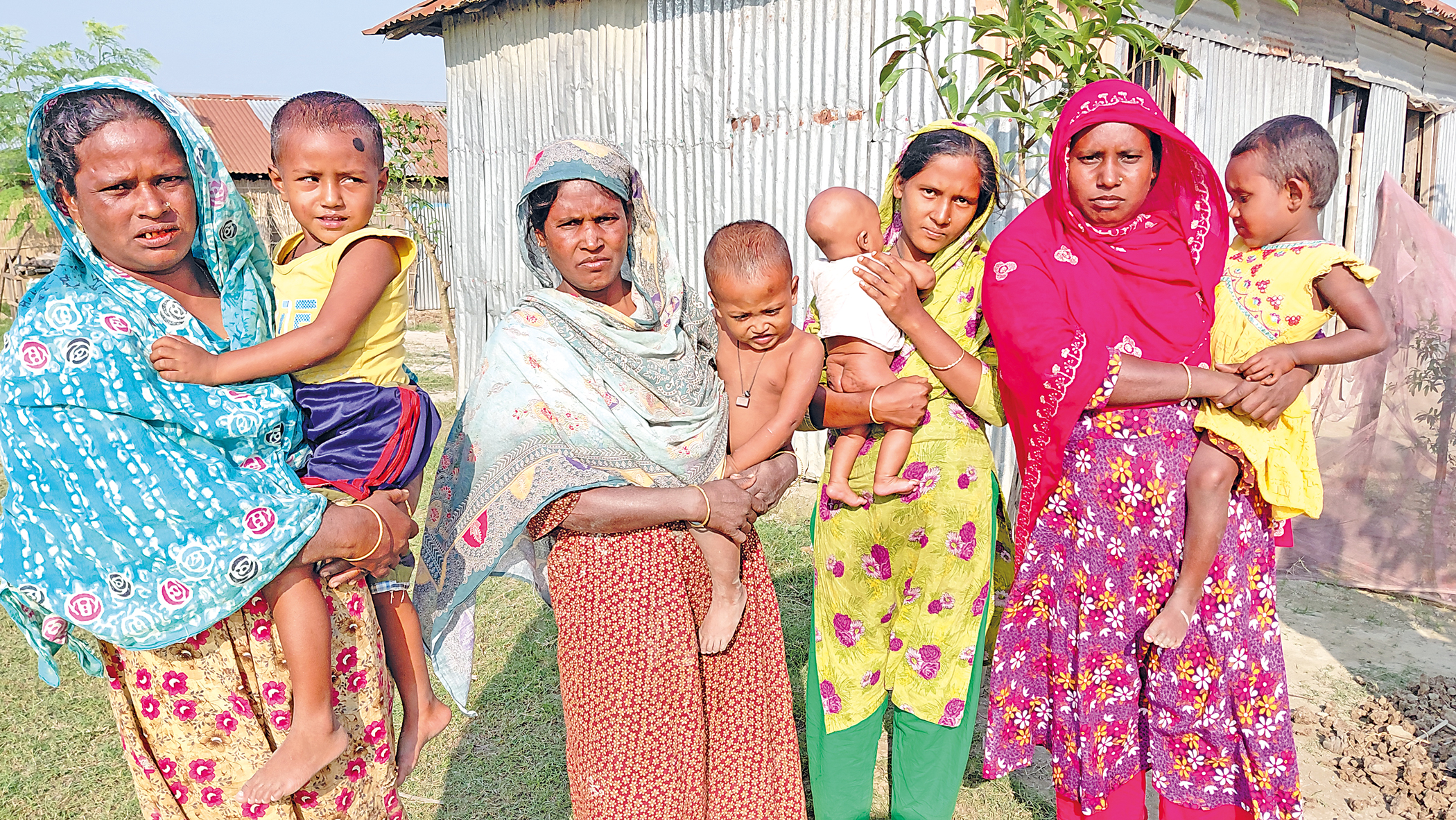
Our interviews highlighted the devastation caused by the floods that year (2019) across our village sites. Following the floods, approximately 500 households across four of our sample villages (Nayapara, Koromjapara, Dhanerpara, Shimulbari, and Chalk Rothinath) had to move to completely different villages (Sherpur and Sujatpur). Nearly all the households in Rajbari and Khas Rajbari villages also had to move within their own char. Narrators also reported that the loss of land and crops due to flooding created a scarcity of food, which caused severe tension.
As floodwaters flowed over homesteads, there was no opportunity to earn income, produce crops, or raise livestock, with households worrying about how they would manage to pay for food, and with no savings for seed, fertiliser, or feed. Many had to sell their livestock and were faced with both low prices and a limited number of buyers. During this time, morbidity rates also increased, with people suffering from dysentery and diarrhoea unable to afford treatment. Over the period, women suffered physical and mental abuse by their husbands, parents-in-law, and, in some cases, by other members of the family. Significantly, while there were no NGOs supporting households through this crisis, some families sent their young and teenage girls to their relatives’ houses for perceived safety reasons and to avoid ‘unexpected harassment’.
What these findings revealed is that environmental shocks, particularly flooding and displacement, act as powerful triggers for increased violence. The research shows that levels of tension and stress rise significantly after such events, with over three-quarters of women reporting heightened stress following floods. The reasons for this are complex but closely tied to economic hardship. When floods destroy crops and livelihoods, men often experience frustration, anxiety, and a loss of status as providers. These pressures can manifest in increased aggression within the household.
One of the most striking findings from the research is the divergence between men’s and women’s perceptions of violence. While women overwhelmingly recognised a wide range of behaviours—physical, psychological, and sexual—as forms of violence, men’s recognition is far more limited. For example, nearly all women surveyed identified marital rape and sexual harassment as forms of violence. In contrast, over 90% of men did not consider most of these behaviours to be violent, with the sole exception being rape by a stranger.
Women consistently identify poverty as the primary driver of violence. As resources become scarce, conflicts over money, food, and survival intensify. In such situations, women often bear the brunt of male frustration.
The data reveals the scale of the problem:
• Around 80% of women reported having been slapped or having had objects thrown at them at some point in their lives.
• Nearly 75% had experienced marital rape.
• Almost 33% had been physically beaten, kicked, or dragged.
These figures are not isolated incidents but part of a broader pattern in which violence intensifies during periods of crisis. One respondent described how her husband’s temper worsened when he had no money, leading her to limit her own speech and behaviour to avoid provoking him: “My husband is usually a good person, but after coming from field work or when there is no money in his pocket, then his temper remains hot and he shows anger even at little things. Then, I am afraid to talk much with him. During the last river erosion, his mood was too bad, there was no money in his hands, and so he had faced severe financial crises to bear the cost due to the river erosion.”
Women’s responses are shaped less by resistance than by constrained adaptation. As one participant noted, “There is no way to return to my father’s home, so I must adapt with this family. I will keep sorrows in my heart and behave well with smiling face.”
While violence remains largely privatised, displacement itself is collectivised. As one woman recalled, “During the movement there was more trouble and loss. We call people beside us to carry the tin roof on the boat… Neighbours helped us otherwise we could not have saved ourselves… This is a common thing in the Chars area.”
Violence is not simply prevalent but “expected and normalised” within everyday life on the chars.
The household as the primary site of violence
Contrary to common assumptions about external threats, most of the violence experienced by women on the chars occurs within the home. Nearly 90% of women in our sample identified their husbands as the primary perpetrators of violence. This reflects a pattern of intimate partner violence (IPV) that is deeply embedded in household dynamics. While some men attributed violence to other family members, women’s accounts consistently pointed to husbands as the main source.
The home, therefore, is not a place of safety but a central site of vulnerability. This is particularly significant in a context where women have limited mobility and few opportunities to seek support outside the household.
For women, violence is not an anomaly but a routine part of life. It is anticipated, managed, and often internalised as inevitable. This normalisation shapes how women respond to abuse, frequently by adapting their behaviour to avoid triggering violence rather than seeking to challenge it.
Life cycles of violence: From early marriage to old age
Violence against women on the chars is not static; it evolves across the life course. Certain stages in a woman’s life are associated with heightened vulnerability. Marriage is one of the most critical junctures. Many girls are married at a young age, often between 10 and 14 years old. Early marriage is sometimes seen as a protective measure, reducing the perceived risk of sexual violence outside the home. However, it often exposes girls to new forms of violence within their marital households.
The early years of marriage can be particularly volatile, as young brides navigate unfamiliar family dynamics and expectations. Violence may intensify during this period, especially if the household experiences economic stress. As women age, their experiences of violence may change. The presence of children can sometimes offer a degree of protection, while shifts in household power dynamics may alter the balance of authority. Nevertheless, the cumulative impact of violence across the life course can be profound.
Silence, adaptation, and the absence of support
Despite the high prevalence of violence, very few women spoke of external support. Only a small minority reported reaching out for help. This is partly due to the lack of available services. At the time of the research, there were virtually no organisations providing support for survivors of violence on the chars. As already highlighted, these are highly isolated communities. Travel to more populous areas, where services may be available, takes significant planning and resources.
However, the reasons go beyond structural constraints. Social norms play a crucial role in shaping women’s responses. Many believe that enduring violence quietly is the most effective way to maintain household stability. Some even consider avoidance strategies, such as staying silent or limiting social interactions, as legitimate ways to reduce conflict. Community networks, while strong in responding to displacement, are less effective in addressing violence. Neighbours may help each other move homes or rebuild after floods, but there is little evidence of collective action to support survivors of abuse.
When women do seek help, they often turn to family members or local leaders, such as religious figures. Yet these avenues rarely challenge the underlying dynamics of violence. Instead, they may reinforce existing norms that prioritise family unity over individual safety.
Towards visibility and accountability
Perhaps the most important lesson from this research is the need to make women’s experiences visible. Violence on the chars persists in part because it remains hidden and normalised within households and is overlooked in broader development agendas. Bringing these issues to light is a crucial first step towards change. It challenges assumptions about what constitutes “normal” behaviour and opens up space for dialogue and action.
At the same time, visibility must be accompanied by accountability. Governments, NGOs, and international organisations all have a role to play in addressing violence against women. This includes not only providing services but also ensuring that programmes do not inadvertently exacerbate existing inequalities.
Women consistently identify poverty as the primary driver of violence. As resources become scarce, conflicts over money, food, and survival intensify. In such situations, women often bear the brunt of male frustration.
Rethinking responses: From silence to structural change
The evidence gathered during our research raises important questions about how violence against women is addressed in contexts of displacement and poverty.
Historically, development interventions in these regions have focused on economic resilience, improving livelihoods, reducing poverty, and enhancing disaster preparedness. While these efforts are essential, they often overlook the social dynamics that shape women’s experiences.
This research suggests that violence against women must be treated as a central concern, not a peripheral issue. This requires a shift in both policy and practice.
First, there is a need to recognise violence as a predictable outcome of environmental and economic stress. Programmes should anticipate increases in violence during and after crises, rather than treating them as isolated incidents.
Second, interventions must engage with the underlying drivers of violence, including gender norms and power relations. This means working not only with women but also with men, addressing the pressures and expectations that contribute to harmful behaviours.
Third, support systems for survivors must be strengthened. This includes creating safe spaces for women to speak out, as well as providing accessible services for those experiencing violence. The data revealed that, in the absence of any external support or safety infrastructure, women rely on limited alterations in their behaviour to mitigate violence. All interviewees were asked a series of questions relating to what they found to be effective as a response to tackling violence. Tellingly, 80% of women and 42% of men believed that ‘doing what the person wants’ was effective at reducing violence, while 45% of men and 35% of women thought not talking to anyone in the hope that the situation might get better was an ‘effective’ or ‘very effective’ response. Similarly, 61% of men and 50% of women thought not socialising outside of the homestead was an effective response.
Clearly, this reveals that responses must be grounded in the realities of char communities. Solutions that work in urban or more stable rural contexts may not be effective in highly mobile, resource-constrained environments.
Perhaps the most important lesson from this research is the need to make women’s experiences visible. Violence on the chars persists in part because it remains hidden and normalised within households and overlooked in broader development agendas. Bringing these issues to light is a crucial first step towards change. It challenges assumptions about what constitutes “normal” behaviour and opens up space for dialogue and action.
Conclusion: Beyond survival
Life on the chars is often framed in terms of resilience, the ability of communities to survive in the face of constant adversity. While this resilience is undeniable, it should not be romanticised.
For many women, survival comes at a high cost. It involves enduring violence, suppressing voices, and navigating a world in which their safety is never guaranteed.
Addressing these challenges requires more than technical solutions. It demands a fundamental rethinking of how we understand and respond to vulnerability. Violence against women is not an inevitable consequence of life on the chars. It is a social problem that can, and must, be addressed.
As climate change intensifies and displacement becomes more common, the experiences of char communities offer important lessons for the future. They remind us that environmental crises are also social crises, and that any meaningful response must place gender justice at its core.
Only by doing so can we move beyond survival towards a future in which women’s lives are not defined by violence, but by dignity, security, and possibility.
Whilst this research goes back to 2019, we know the conditions for women on the chars have not eased. These findings offer lessons for policy and programming in Bangladesh and beyond.
The research findings point to the need to mainstream violence against women and girls (VAWG) approaches within all programmes, and not just within explicitly gender-focused programming. How can this be done? Policy makers and practitioners need to reflect on if, how, and in what ways a programme will positively or negatively impact VAWG. This does not mean a cursory reflection but a deeply embedded and systematic approach, which is reflected upon throughout a programme. As a starting point, a series of critical and reflective questions can be asked through each programmatic phase that considers if and how interventions may positively or negatively impact levels of VAWG. This needs to be undertaken with a political economy analysis of the context, people, systems, and structures within which the programme may operate. Lastly, the voices and experiences of women and girls must be made front and centre. As this research has shown, and will continue to show, the visibility of women and girls can be achieved through real-time longitudinal qualitative research that documents their changing lives.
Tamsin Bradley is a Professor of International Development Studies, University of Portsmouth and Co-Director of the centre for the Advancement of Equality, Gender and Inclusion Studies (AEGISresearch.org), UK.
Kate Conroy is an International MEL and gender equity specialist based in the UK.
Md. Rafiqul Islam is a senior quantitative and mixed-method MEL specialist based in Bangladesh.
Md. Nasir Uddin is Director of the Grameen Bikash Foundation, Bangladesh.
Send your articles for Slow Reads to [email protected]. Check out our submission guidelines for details.
Why Bangladesh must invest in community-led early childhood education

The moral architecture of Bangladesh’s parliament

Why Bangladesh innovates but rarely builds global companies
Beyond groundwater: Rethinking Barind's water crisis

The gods that we build: AI and the future of moral authority

Remembering Mahbub ul Haq: A pioneer of human development ideas

What would make Dhaka a good city?
How Chattogram can end its recurring waterlogging crisis
Why governments fail to communicate with Gen Z