Beyond groundwater: Rethinking Barind's water crisis
The changes in the Barind region are no longer gradual, nor are they a future scenario—they are immediate and visible. Irrigation pumps that once ran through the boro season now stop mid-cycle. Farmers wait anxiously for water that may not come. And inside village homes, submersible pumps hum quietly under "domestic" connections, sustaining crops that official systems no longer can.
When public tubewells were unable to meet demand for irrigation water in Gogram union of Godagari upazila last March, farmer Ramzan Ali* turned to his only available option. "I had no choice," he said. "I used my domestic water line to wet the field for three days. Otherwise, everything would have been lost."
That "domestic line"—a private deep tubewell sanctioned for household use—has increasingly become a fallback source for irrigation. "BMDA regulates water distribution, has introduced rationing of pumping hours, and has restricted new irrigation wells since 2012," he explained. These interventions have been introduced by the Barind Multipurpose Development Authority (BMDA) to conserve the rapidly declining groundwater resources of the high Barind region. While intended to protect the resource, they have also had significant consequences for local livelihoods.
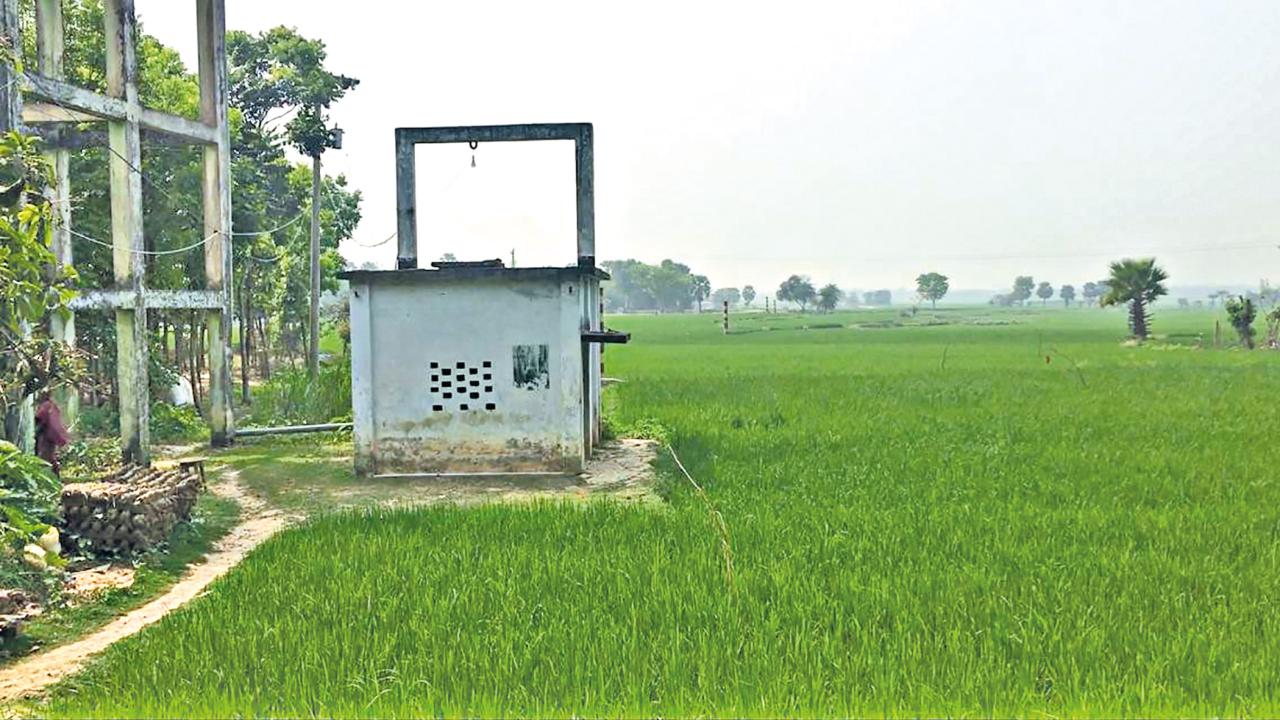
As a result of restricted water access, "some relatively better-off farmers obtain domestic water connections and use 3HP submersible pumps. This practice is common in the area." What is unfolding across the high Barind is not just a groundwater crisis but a deeper question of water governance: what happens when resource conservation policies are designed without fully accounting for how people survive?
When groundwater rules meet daily survival
In recent years, BMDA has tightened groundwater extraction in response to alarming declines in aquifer levels, with drops of 10 to 15 metres in parts of Rajshahi and Naogaon. Public irrigation pumps are now restricted to around 980 hours per boro season, significantly lower than the earlier 1,200–1,400 hours.
On paper, these measures are necessary. On the ground, they are being negotiated in real time.
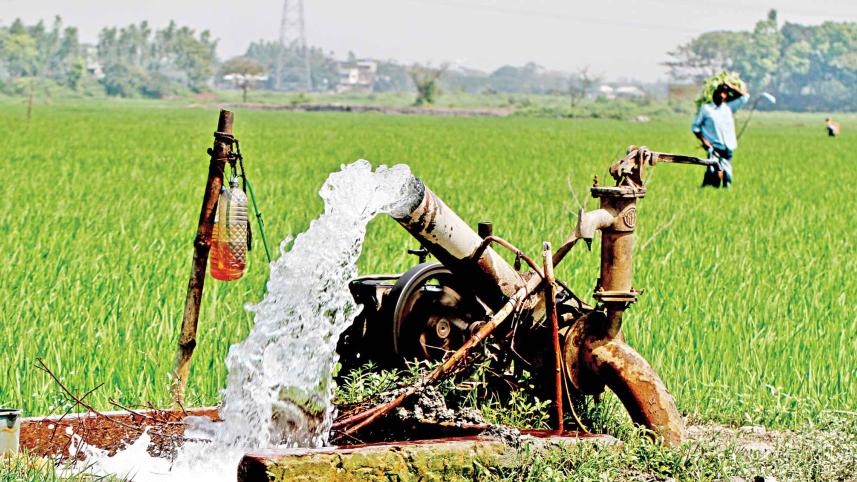
"Public pumps stopped, but farmers didn't stop irrigating," said Saiful Islam*, a BMDA pump operator in Gogram Union Parishad. "Some are installing private submersibles, often within their homes, and using domestic electricity connections. Although penalties have been issued in a few cases, enforcement appears limited."
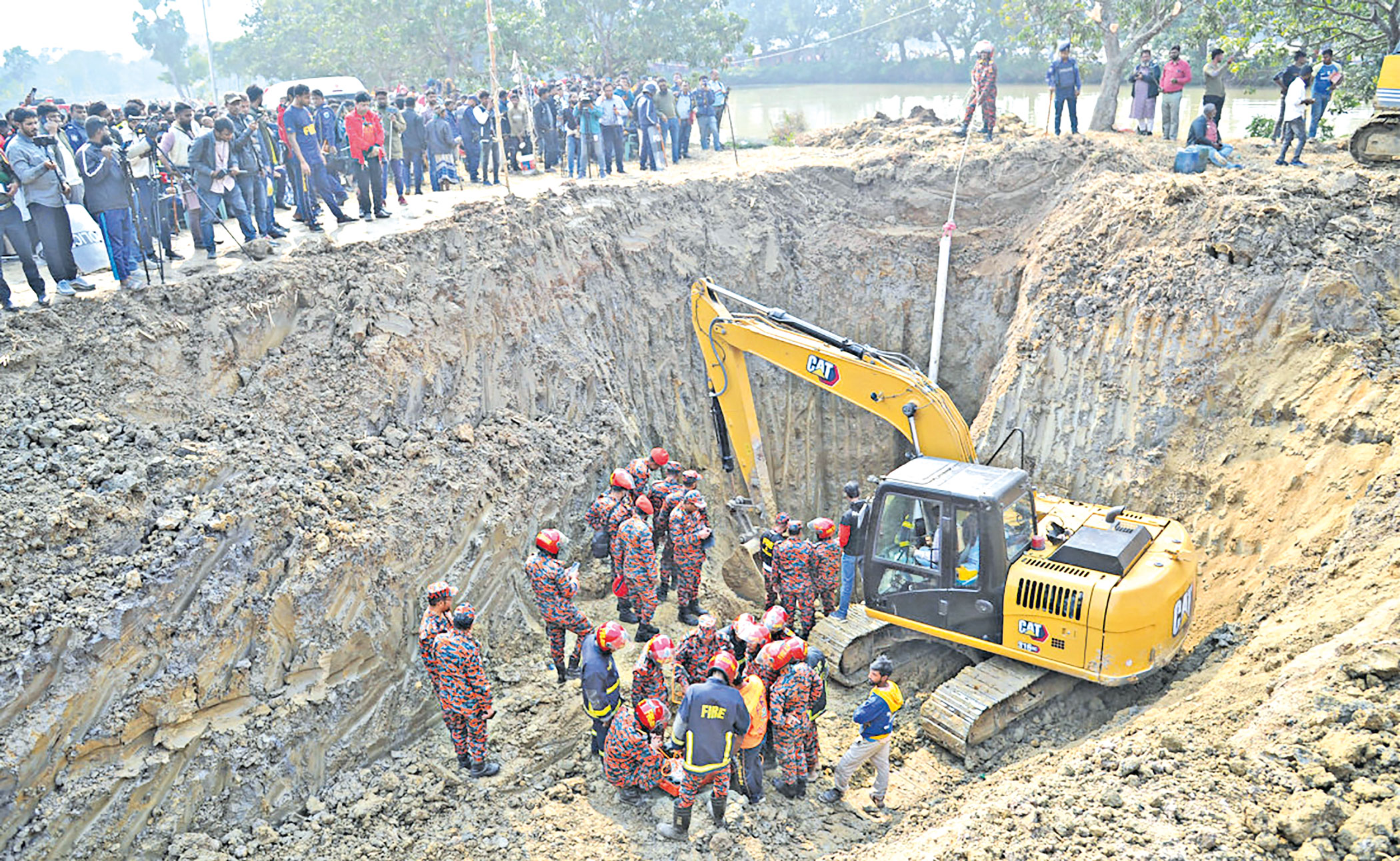
Farmers say they have few alternatives. "We can't depend only on BMDA water anymore," said Monirul Islam*, another farmer from the same union. "When they closed the outlet last year, I used my neighbour's domestic pump to water the field and also to fill my household tank."
These practices are increasingly blurring the distinction between domestic and agricultural water use, creating a grey area between BMDA's irrigation controls and the Bangladesh Rural Electrification Board's domestic electricity permissions.
An official at the BMDA upazila office acknowledged the gap. "If it happens, we aren't aware of it, and if it's used, it's for saving crops. We have nothing to do with it," he said.
Conservation measures are thus coming into conflict with livelihoods and, in effect, being quietly bypassed—not out of defiance, but out of necessity.
From surface water to groundwater dependence
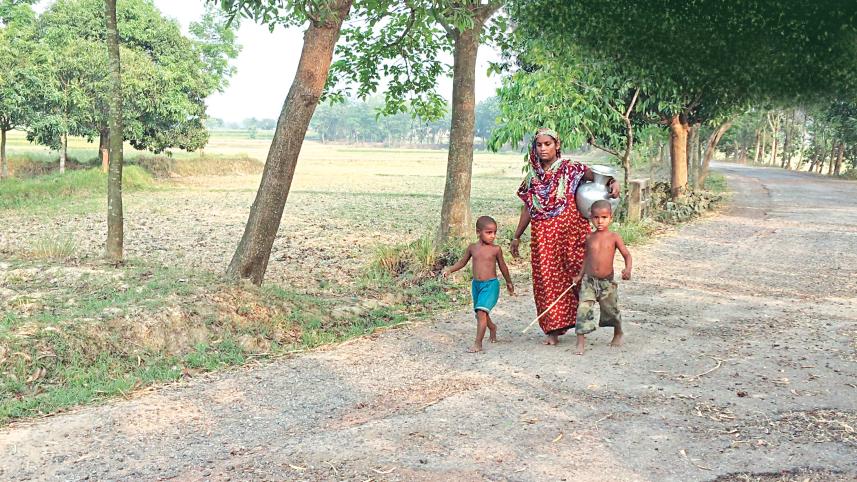
Barind was not always like this. Historically, the region depended on surface water—ponds, beels, and seasonal channels (kharis)—sustained by rainwater, which supported domestic use, livestock, and supplementary irrigation. These were shared resources, deeply embedded in everyday life.
This began to change in the 1980s and 1990s, when recurring droughts pushed a transition towards groundwater. Deep tubewells transformed agriculture, enabling multicropping and expanding boro cultivation.
Groundwater brought reliability, but it also shifted the entire water system. As access to groundwater became easier and increased, reliance on surface water declined. Ponds and wetlands, once central to water management in the region, gradually lost their relevance to agricultural policy and practice, becoming available for other uses, many of which shifted to commercial fisheries. Kharis, too, fell out of use, leading to siltation, neglect, and drying up.
Under national policy frameworks, thousands of government-owned (khas) ponds have been leased out over the years. "Most of the khas ponds are leased out for fish farming," said Mohammad Ahumazzaman, fisheries officer at Godagari upazila. "Only a few are kept open for community use. Even natural wetlands like beels are disappearing. In reality, there are no low-lying areas left."
"Leasing of ponds began in the late 1980s, and at that time no one anticipated that this practice would eventually contribute to the current crisis," said Jahangir Alam Khan, director of DASCOH Foundation.
"Alongside this, groundwater pumping was heavily promoted as an alternative, which initially boosted agricultural productivity."
This shift and fragmentation of the water system went largely unnoticed at the time. But as emerging groundwater conservation efforts aim to restrict agricultural pumping and access, the fragmentation has become increasingly visible and contested, depriving communities of alternative water sources.
The quiet disappearance of the commons
As access to common-resource ponds and wetlands declines and public tubewells restrict pumping, shared water access systems are increasingly fragmented and privatised.
Fish farming is profitable and requires less labour. But for many rural households, the costs are not economic—they are social.
"We can't use ponds even for washing," said Manikjan Begum from Pakri Union Parishad. "The water smells of fish feed and medicine and causes itching." She now depends on a neighbour's tubewell for drinking water, while continuing to use the same fishpond for bathing cattle because "there's no other option."
For women, the impact is often more pronounced.
"My body hurts; I can't walk far," said 65-year-old Agnesh Hembrom, from an indigenous settlement in Pakri Union Parishad. "So I pay my neighbour BDT 120 ($1) a month for two pots of water daily."
As access to public tubewells is rationed, alternative water access has become concentrated among households that can afford private tubewells.
"The current situation has created a divide—those with resources, money, and land can install pumps for their domestic needs, while those without resources suffer the most," said Jahangir Alam Khan, director of DASCOH Foundation.
Water conservation policies often assume that users can adjust to new systems. But in Barind, adaptation is not equally accessible. Monirul Islam's* observation—"We can't depend only on BMDA water anymore"—reflects a broader reality: farmers are being pushed towards self-financed solutions.
"Over the years, more farmers have installed their own deep tubewells," said a farmer in Matikata Union Parishad. "Those who can't afford it buy water from neighbours."
This individualisation of water access is reshaping rural economies. For smallholders, it means rising costs. For landless labourers, it means fewer employment opportunities as irrigation becomes uncertain. For tenant farmers, who lack the authority to shift their cropping choices in response to changing irrigation systems, adjusting to new policies comes at the cost of their returns and tenancy contracts. For indigenous communities, it means further marginalisation. Conservation, without consideration for livelihoods, risks deepening inequality.
When policies collide
At the core of Barind's crisis is not just scarcity but sectoral fragmentation.
Water is governed across sectors—irrigation, fisheries, land, and energy—each operating independently. But water systems do not follow administrative or sectoral boundaries.
"When a pond is converted into a fishery, it is often no longer available for household or irrigation needs. Yet managing water sustainably in the region requires considering both surface water and groundwater together. Instead, policies across the fisheries, agriculture, water, land, and energy sectors often pursue separate priorities, creating competing demands on interconnected water resources rather than managing them as a shared system," said Shreya Chakraborty, country focal point and regional researcher at the International Water Management Institute Bangladesh, who led a recent study on the Barind with the Global Centre on Adaptation and BRAC.
We've turned every drop into a commodity—for crops, for fish, for households. Unless policy catches up with people's realities, adaptation will mean extraction under another name.
The recent declaration of 25 upazilas as water-stressed areas reflects growing recognition of scarcity. It restricts new irrigation tubewells while prioritising drinking water, promoting crop diversification, and protecting access to water bodies.
Yet the same contradictions persist. Domestic tubewells remain permissible and unmonitored. Surface water continues to be leased and commercialised. Livestock water needs remain largely unaddressed. In effect, groundwater is restricted, but contradictions among the mandates of different sectors governing water resources undermine both water resource management efforts and sustainable livelihoods for Barind's communities.
Towards integrated water futures
Barind's crisis is often framed as a groundwater problem. But it is, more fundamentally, a water systems problem. Surface water and groundwater continue to be treated as separate, siloed systems, despite their deep interconnectedness.
"Policies to conserve groundwater focus only on agricultural water management but tend to overlook the connections between irrigation, fisheries, domestic water, and alternative livelihoods," said Shreya Chakraborty. "Water futures in the Barind need to take an integrated watershed approach that looks at water resources as a unified, connected system, rather than as a sectorally and physically siloed resource."
This is where conjunctive water use and water accounting become critical—managing surface and groundwater together as a single system. Yet in the Barind, the two remain disconnected: groundwater is regulated, while surface water is commercialised. The link between them needs to be redrawn in both policy and implementation.
When resource conservation is divorced from access and use, several latent conflicts surface—between sustainable resources and sustainable livelihoods, between water managers and water users, between surface water and groundwater, between farmers and fishers, between resource-rich farmers and smallholders or the landless, and between sectors. These fragmentations create conflicts that further hinder the realisation of a holistic, water-secure future for the region.
Bangladesh's National Adaptation Plan (2023–2050) identifies Barind as a climate hotspot. The Water Rules (2018) outline a comprehensive governance framework, but implementation remains fragmented. "Despite the policy's holistic intent, line departments and stakeholders continue to work in a sectoral manner, making initiatives siloed," said Professor Chowdhury Sarwar Jahan of the University of Rajshahi.
Drawing on decades of experience, he pointed to a deeper challenge. "They can only be convinced to take ownership if they see results. We need to make them dream."Reflecting on the region's transformation, he added, "We've turned every drop into a commodity—for crops, for fish, for households. Unless policy catches up with people's realities, adaptation will mean extraction under another name."
The story of Barind is not just about water scarcity. It is about a system in transition. A region that once relied on surface water shifted to groundwater-led growth. Now, that model is under strain. The next phase will depend on whether these systems can be reconnected. The real challenge is not only how to conserve water, but also how to govern it as a shared resource. Until then, farmers will continue to shoulder the costs of a fragmented water system.
* Names changed to protect identities.
Tanmoy Bhaduri is a communications specialist at the International Water Management Institute.
Send your articles for Slow Reads to [email protected]. Check out our submission guidelines for details.
Remembering Mahbub ul Haq: A pioneer of human development ideas
What would make Dhaka a good city?
How Chattogram can end its recurring waterlogging crisis
Why governments fail to communicate with Gen Z

How Bangladesh can stop the next data breach
Salinity and the unseen health burden in coastal Bangladesh
Dhaka: How a city was planned to drown
Can Bangladesh’s 250 million tree pledge succeed?
Bonolata Sen's Natore: A topographic reading