


July uprising survivors: The wounds that nothing can heal


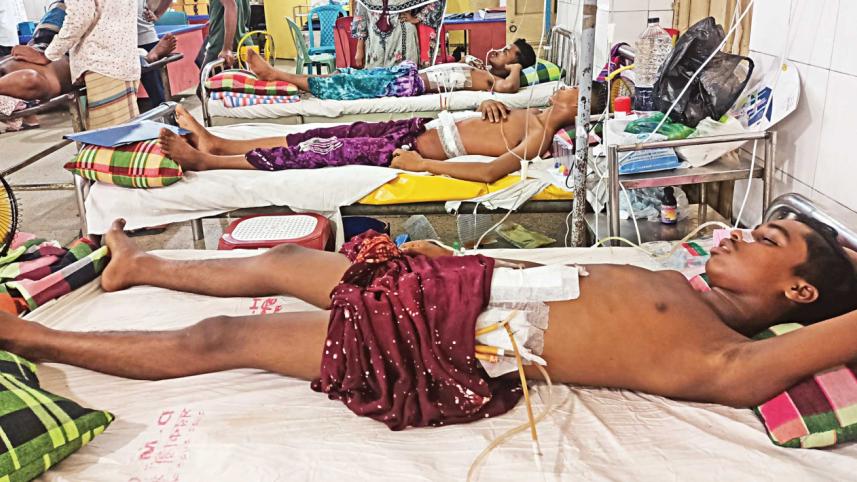
On August 5, 2024, then a 16-year-old ninth-grader Al Amin Hossain joined thousands of protesters outside BRAC University. A bullet shattered his left knee. He was taken to the National Institute of Traumatology and Orthopaedic Rehabilitation (NITOR), where doctors amputated his left leg above the knee five days later.
Now 18, Al Amin has completed his SSC examinations and walks with an artificial limb provided by BRAC.

“I wanted to continue my education and establish myself,” he said.
“Whenever I think about July, my whole body shivers. Sometimes I wake up from nightmares.”
But life has changed completely. Once an active teenager who played football and cricket, he now watches his friends from the sidelines. Even walking around Hatirjheel with them becomes painful after prolonged use of his prosthetic limb.
“The memories are equally painful. Whenever I think about July, my whole body shivers. Sometimes I wake up from nightmares,” he said.
Al Amin underwent psychiatric treatment twice after the shooting. Like many injured protesters, he received Tk 500,000 in government compensation and a monthly allowance of Tk 20,000. But he said money could not restore the life he lost.
Nearly two years after the July 2024 mass uprising that ended the Awami League government’s 15-year rule, many survivors of police gunfire are fighting another battle: disability, trauma and an uncertain future.
Although many have received compensation and allowances, they say rehabilitation, specialised treatment and justice remain out of reach.
The uprising began as student protests demanding reforms to the government job quota system before turning into a nationwide movement. After 36 days of protests, then prime minister Sheikh Hasina fled the country on August 5, 2024.
According to an official gazette, the government recognised 843 people as martyrs of the uprising and 14,370 others as injured. A United Nations fact-finding report, however, estimated that more than 1,400 people may have been killed between July 1 and August 15 during the unrest.
The government has divided injured protesters into three categories.
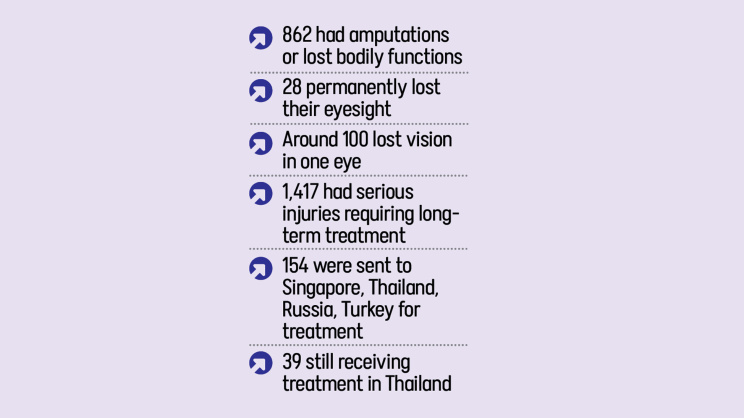
Those in category ‘A’ suffered the most severe injuries causing lifelong disabilities, including loss of eyesight, amputation or permanent loss of major bodily functions. They receive Tk 20,000 monthly and Tk 500,000 as one-time assistance. A total of 990 people are in this category.
Category ‘B’ includes 1,417 people with serious injuries requiring long-term treatment. They receive Tk 15,000 monthly and Tk 300,000 as one-time assistance.
Category ‘C’ covers 11,963 people with comparatively less severe injuries. They receive Tk 10,000 monthly and Tk 100,000 as one-time assistance.
Government data shows 502 people suffered eye injuries during the uprising. Of them, 28 permanently lost their eyesight, around 100 lost vision in one eye, and others continue to suffer complications.
Specialist medical teams from the United States, United Kingdom, France, Thailand, Singapore and China visited Bangladesh to provide consultations and assist treatment at NITOR, the National Institute of Ophthalmology, Combined Military Hospital and Bangladesh Medical University. However, many patients eventually had to travel abroad as advanced treatment was unavailable locally.
According to the July Uprising Directorate, 154 seriously injured people have been sent to Singapore, Thailand, Russia and Turkey for advanced treatment. Of them, 39 are still receiving treatment in Thailand, said Dr Md Zahirul Islam, deputy secretary of the July Mass Uprising Wing under the Ministry of Liberation War Affairs.
“Those sent abroad for treatment suffered serious injuries. Many required life-saving care. Some needed ICU support, while others had extensive bullet injuries across their bodies,” he told The Daily Star.
Many injured protesters said compensation helped them survive but did not address their long-term needs. They demanded specialised treatment, rehabilitation, employment opportunities and justice for those responsible for the shootings.
 For all latest news, follow The Daily Star's Google News channel.
 For 30-year-old Sagar Mia, a laser-cutting shop worker from Bhola, the scars are in his eyes.
On July 19, 2024, after leaving work in Vatara, Sagar joined demonstrations on Link Road in Middle Badda. Police shotgun pellets struck his eyes, face and legs.
After four eye surgeries at the National Institute of Ophthalmology and examinations by visiting Chinese specialists, Sagar became completely blind in his left eye, while vision in his right eye continued to deteriorate.
“I think we received treatment, but not the proper treatment we needed. If we had received timely care, perhaps my condition would not have become this severe,” he said.
Sagar alleged that seriously injured protesters did not receive adequate treatment until after the political transition in early August.
His monthly allowance of Tk 20,000 is now his family’s main source of income. His wife, Rima Begum, stopped working due to a respiratory illness, while their daughter lives with her grandparents in Nasirnagar, Brahmanbaria.
Sagar said his Tk 500,000 government compensation and Tk 100,000 from the July Foundation were spent during his lengthy hospital stay.
For Narsingdi Government College student Mozammel Haque, 22, education was supposed to lift his family out of poverty.
On July 18, 2024, he joined protests in Narsingdi. Around 4:30pm, police shotgun pellets struck both his eyes, chest and head. He later lost vision in his left eye and developed blurred vision in his right.
Despite six surgeries and examinations by medical teams from England, Nepal, China and Singapore, doctors told his family his eyesight could not be restored. A plan to send him to Singapore for treatment never materialised.
“I wanted to study, get a good job and support my family. Now I depend on others just to survive,” Mozammel said.
He sat for two final-year BA examinations with the help of a scribe but said passing under such circumstances was nearly impossible.
Mozammel received Tk 500,000 from the government, Tk 100,000 from the July Foundation and the monthly Tk 20,000 allowance.
Unable to move independently, he married last year hoping his wife could help care for him. His father, Nur Mohammad Nida, who works at an RFL factory in Ghorashal, is nearing retirement.
“He was supposed to become the family’s main support. Now he himself needs support,” his mother Mariam Begum said, urging the government to prioritise rehabilitation alongside financial assistance.
Rajib Mia, 35, continues to carry shotgun pellets inside his body.
On August 5, 2024, after Sheikh Hasina fled the country, Rajib joined a victory procession in Uttara when police opened fire. Pellets struck his eyes, head, chest and legs.
Nearly two years later, five pellets remain lodged in his left eye, while others are still embedded across his body. Doctors told him his eyesight could not be restored. A visiting Chinese medical team recommended a corneal transplant, but a suitable donor has yet to be found.
“We risked our lives during the movement and helped remove the Awami League government. Now our importance has diminished,” he said. “We still need proper specialised treatment, rehabilitation for those permanently disabled and justice.”
Dr Zahirul said the government has instructed medical colleges, district hospitals and upazila health complexes to provide free treatment to July uprising victims. They have also received health cards to access medical services.
Patients requiring specialised care are being referred to institutions including NITOR, the National Institute of Ophthalmology and Bangladesh Medical University.
“More than 5,000 injured people are still under treatment and follow-up care,” he said, adding that many victims require long-term support as bullets could not be removed from all parts of their bodies.
“Many of them will not fully recover. They continue to suffer from pain and physical complications and require ongoing treatment and therapy,” he added.
A central medical board has been formed to review severely injured patients and recommend further treatment, including referrals to specialised facilities. The board includes representatives from Bangladesh Medical University, Dhaka Medical College Hospital, National Institute of Ophthalmology, National Institute of Neurosciences, Combined Military Hospital and NITOR.


Comments