


Evidence to action: Economic and policy pathways for a safer lead-acid battery circular economy in Bangladesh
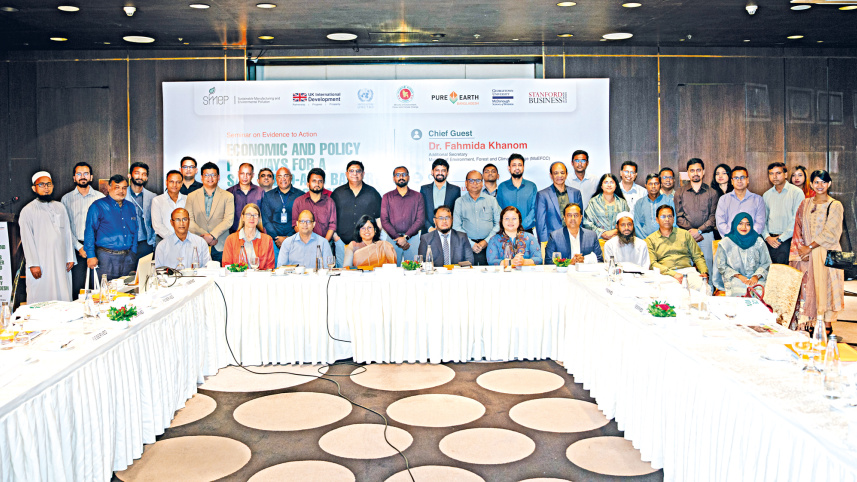
The Ministry of Environment, Forest and Climate Change, in collaboration with Pure Earth Bangladesh, and with support from the UK International Development and the United Nations Trade and Development (UNCTAD), under the Sustainable Manufacturing and Environmental Pollution (SMEP) Programme, held a dissemination seminar on 20 June 2026. The discussion brought together government officials, development partners, researchers, and industry stakeholders to explore how the lead-acid battery sector can transition toward a safer, circular economy. The emerging theme from the research presentations at the seminar is that battery durability is directly proportional to the need for frequent replacement, higher recycling volumes, greater emissions from informal lead recycling and an increased risk of associated public health risks. Improving battery lifespans can therefore help significantly reduce pollution at the source, besides safer recycling practices, traceability and stronger market incentives for formal operators.

Mitali Das
Country Director, Bangladesh
Pure Earth

Initiated in 2023, the project ‘Development of Business Models and Policy Interventions to Reduce Informal Recycling of Lead Acid Batteries in Bangladesh’ addresses a critical global challenge, as lead poisoning affects 800 million children worldwide. Bangladesh is the world’s third most lead-affected country, losing an estimated 20 million IQ points annually, while national survey data show that 38% of children under five have elevated blood lead levels. This results in an estimated annual economic loss of USD 29 billion, equivalent to nearly 6–9% of GDP. A major source of exposure is the informal recycling of lead-acid batteries serving the rapidly growing electric three-wheeler sector, which also causes an estimated USD 91 million in annual tax losses. Weak regulatory enforcement has further fuelled informal recycling, contributing to a 4–5 percentage point increase in terminated pregnancies near lead-emitting sites. Building a safer circular economy requires formalising three-wheeler registration, introducing battery traceability, and implementing fixed smelting fees to incentivise qualified recyclers. Stronger environmental regulation must be complemented by public health surveillance to ensure sustainable consumer protection.

Amrita Kundu
Professor
McDonough School of Business
Georgetown University
Bangladesh’s 2015 Import Policy Order strengthened enforcement of eight-digit HS codes and required Bangladesh Standards and Testing Institute (BSTI) quality certification, effectively raising tariffs on imported electric three-wheeler lead-acid batteries to 89%. While this reduced imports and expanded domestic manufacturing, it also increased demand for recycled lead from small, poorly regulated recycling facilities that release significant amounts of lead into the environment.
Linking 252 battery recycling and lead-smelting sites from the Toxic Sites Identification Program (TSIP) with nationally representative health data, the study found that after the import barrier was introduced, women living within 5 km of these lead-emitting sites experienced a 4.2 percentage point increase in terminated pregnancies—from 16% to 20.2%—compared with women living farther away. The study also found evidence that adverse health effects may extend up to 13 km from these facilities. Since a single electric three-wheeler uses five batteries containing over 100 kg of lead, strengthening environmental regulation across the battery value chain is essential to reduce recycling-related lead emissions from the current 10–20% to below 1%, highlighting the need to align trade policy with environmental regulation and public health surveillance.

Erica Plambeck
Professor
Graduate School of Business Stanford University
Bangladesh’s growing use of lead-acid batteries, particularly in electric three-wheelers, has created a large inventory of lead that requires careful management. Easy bikes contain around 125 kg of lead, while smaller vehicles contain about 100 kg, making responsible recycling increasingly important. Research highlighted a “lemons market” in which consumers lack reliable information on battery quality and lifespan. More than 1,000 undercover visits to 261 battery dealers in greater Dhaka found that 80% of retailers provided inconsistent information, making it difficult for consumers to identify longer-lasting batteries. Informal recycling remains a major challenge because it wastes valuable lead and releases 15–20% of lead into the environment during smelting. Formal facilities also generate emissions, but effective monitoring and pollution-control measures can substantially reduce them. Stronger economic incentives, improved monitoring, and more efficient collection systems are needed to direct used batteries to low-emission recycling facilities. Research involving 1,300 electric vehicle owners also showed that long-duration loans increase trust in high-quality batteries and encourage adoption of longer-lasting products. Key recommendations include increasing tariffs on lead imports, reducing tariffs on durable lead-free batteries, introducing a fixed smelting fee, strengthening RFID-based battery traceability, and improving monitoring of lead flows.

AKM Niamul Haque
Executive Director,
Rahimafrooz
Accumulators Battery Manufacturers & Exporters Association of Bangladesh (ABMEAB)
Reducing lead pollution requires limiting the flow of used batteries to informal recyclers while strengthening incentives for formal collection and recycling systems. Providing incentives to manufacturers based on the quantity of used batteries collected and returned through formal channels may be a more effective solution. This would help ensure environmentally sound recycling and improve resource recovery. In addition, stronger monitoring systems and recognised digital tracking tools can enhance accountability.
There is also growing concern over imported lithium batteries. Some are marketed as having a 10-year lifespan despite already being used for several years before import, leaving consumers with a much shorter service life. Requiring BSTI certification for imported lithium batteries would help ensure consumers receive products that meet expected quality standards. Public awareness of correct battery configurations is equally important, as improper charging can reduce an expected 1.5-year battery lifespan to just six months. New technologies, such as sodium-based batteries, could provide consumers with longer-lasting alternatives.

Md. Atik Ullah
Assistant Director, Standards Wing
Bangladesh Standards Testing Institution (BSTI)
The relevant technical committee at the Bangladesh Standards and Testing Institution (BSTI) has successfully formulated over 40 distinct standards covering lead-acid, lithium, sodium, and nickel-cadmium-based batteries. Under the Ministry of Industries, mandatory licensing is now strictly enforced across 328 separate items. Notably, electric vehicle (EV) lead-acid batteries were incorporated into the mandatory certification framework in 2023. Furthermore, within the current Import Policy Order, 14 out of 79 specific products fall under the electrical category, which strictly regulates imported lead-acid options. To ensure greater transparency, comprehensive lithium battery standards are undergoing finalisation through a statutory regulatory order (SRO). Concurrently, an advanced QR-code tracking system is actively being integrated to authenticate regulatory legal approvals, enhancing consumer confidence.

Iftekhar Alam Bhuiyan
Deputy Commissioner of Customs
National Board of Revenue (NBR)
Effective monitoring of lead-acid battery recycling can be strengthened through existing VAT reporting systems. Since registered battery manufacturers already submit information on raw material use and production outputs to VAT authorities, these records can help track whether batteries are being collected and recycled within the formal sector. Although such a system may not capture every battery or fully cover informal operations, it can provide a practical mechanism for improving oversight and accountability. Furthermore, lead-related health impacts, including pregnancy complications and other health consequences, cost Bangladesh approximately Tk 29 billion every year. Therefore, investments in incentives, monitoring systems, and safer recycling practices should be viewed as worthwhile and cost-effective. If evidence shows that these measures are delivering results, securing funding for scaling up interventions should be achievable.

Dr. Fahmida Khanom
Acting Secretary
Ministry of Environment, Forest and Climate Change (MoEFCC)
Addressing lead pollution requires coordinated action across government, development partners, industry, and communities. District administrations have been requested to identify and monitor informal lead-acid battery recycling and smelting facilities, while a comprehensive national strategy and action plan on lead pollution is being placed before the Cabinet. The plan addresses major sources of lead exposure, including batteries, food, consumer products, and environmental contamination; with responsibilities assigned across multiple ministries.
The forthcoming Basel Convention technical guideline on waste lead-acid batteries is expected to strengthen national efforts on traceability, collection, transport, recycling, and monitoring. Consumer awareness, battery traceability, long-term financing, and QR-code-based information systems will further improve accountability across the supply chain. With a proposed USD 1.3 million grant for lead poisoning remediation, collaboration with organisations such as Pure Earth and local NGOs offers a strong opportunity to strengthen monitoring, promote practical incentives, and accelerate action against informal recycling and lead exposure.

Dr. Md. Lutfor Rahman
Director General
Department of Environment (DoE)
Lead pollution from lead-acid batteries poses significant environmental, public health, and economic challenges. Bangladesh’s battery sector is essential for transport, energy storage, telecommunications, and livelihoods, but rapid growth has increased risks where collection, recycling, and smelting occur informally. Strengthening regulatory frameworks, including the 2015–2018 Import Policy Order revisions, remains essential. Priority actions include identifying lead-emitting sites, strengthening enforcement against illegal smelting, shifting used batteries to formal recycling channels, and establishing market-based traceability systems. Achieving a safe circular economy will require coordinated action among agencies such as the NBR and BSTI to align fiscal measures, product standards, and public health surveillance with evidence-based policymaking.
 For all latest news, follow The Daily Star's Google News channel.
Prof. Quazi Ahmed Zaki
Director
Institute of Epidemiology, Disease Control and Research (IEDCR)
The persistent demand for lead-acid batteries is often driven by short-term commercial gains, making stronger legislation and safer alternatives essential. Revising regulatory frameworks, including the Import Policy Order, can encourage adoption of lithium and sodium-based batteries. At the same time, robust surveillance is needed to better understand the public health impacts of lead exposure. Recent investigations illustrate the urgency of the problem: illegal smelting has caused livestock deaths in multiple districts, while residents living within 400 metres of affected sites recorded average blood lead levels above 6.5 µg/dL, nearly double the public health reference level of 3.5 µg/dL. Additional risks also arise from lead-based inks used in paper packaging. Targeted public awareness and health education campaigns should therefore complement regulatory reforms.

Sabrina Rahman
Senior Assistant Secretary
Ministry of Environment, Forest and Climate Change (MoEFCC)
The rapid growth of the lead-acid battery sector presents severe environmental and public health challenges, as informal recycling releases toxic emissions into the soil, air, and water. These unsafe practices cause acute poisoning in livestock and elevate human blood lead levels, resulting in chronic health burdens, multi-organ issues, and cognitive damage in children. Furthermore, informal smelters outcompete formal recyclers by offering higher purchase prices while evading standard compliance costs. To constructively address this crisis, providing similar financial incentives and subsidies to formal recyclers will encourage responsible battery collection and eliminate the informal market. Implementing robust traceability mechanisms alongside these balanced economic incentives will successfully secure a safer, well-governed circular economy that protects communities and safeguards future generations. This discussion aimed to deepen the understanding of the challenges around lead-acid batteries and help identify actionable solutions that can support evidence-based policymaking in the years to come.

Mohammed Solaiman Haider
Director, Dhaka Laboratory
Department of Environment (DoE)
We have to consider all the externalities and ground realities when implementing traceability, a public inventory, and life-cycle analysis of lead-acid batteries. Analysing these factors is certainly a matter of time. We also need to engage with formal recyclers and manufacturers to assess mismanagement of lead-acid batteries during collection and recycling, as formal recyclers too often source lead from informal smelters. End users and retailers are inclined to sell used batteries to informal recyclers as they pay more. We have to consider these factors and prepare a model to reduce lead pollution. I would also recommend developing an SOP for manufacturers to ensure cleaner production and a better environmental management system that will stipulate the usage of inventory systems and battery traceability.

Dr. Mahbubur Rahman
Assistant Professor
Institute of Epidemiology Disease Control and Research (IEDCR)
Bangladesh recently conducted a nationwide Multiple Indicator Cluster Survey incorporating blood lead level testing for children under five and pregnant mothers. Coherence between the Ministry of Environment and the Ministry of Health could help align these results with known lead-emitting sites, creating a clearer nationwide picture. Additionally, formal surveillance at Used Lead-Acid Battery (ULAB) locations is necessary to monitor both environmental impact and public exposure. Collaborating with entities like the Institute of Epidemiology, Disease Control and Research (IEDCR) ensures a swift response when new high-risk sites are identified. Furthermore, the widespread use of lead batteries in solar panels; particularly within Forcibly Displaced Myanmar National (FDMN) camps, requires urgent source-identification assessments. Finally, while market traceability is vital, providing incentives equally across the industry instead of providing it to one or two giants in the industry prevents pushing smaller players toward informal practices.

Abu Sayeed Nishan
Senior Reporter
Somoy Television
Informal lead-acid battery recycling operations often relocate within a few months, making them difficult to track through one-time surveys alone. Therefore, while district- and upazila-level databases are an important starting point, their effectiveness will depend on continuous monitoring and regular updates. In addition, some informal recycling activities may operate within facilities registered for other purposes, creating further challenges for detection and oversight. As a result, stronger enforcement of existing laws should complement data collection efforts. Regular inspections, timely follow-up actions, and clear accountability mechanisms can help improve compliance and discourage illegal practices. Furthermore, sustained monitoring can help identify emerging hotspots and support faster responses.
Recommendations
- Governance and enforcement (Coordination, monitoring, tariffs)
- Strengthen coordination among environmental, health, customs, standards, police, and local government authorities to integrate lead pollution control with public health surveillance and enforcement.
- Develop and maintain an integrated national database of lead-emitting sites, battery manufacturers, recyclers, traders, and battery flows to support evidence-based regulation and enforcement.
- Review import and export tariff policies on lead and used lead-acid batteries to encourage environmentally sound recycling, discourage informal recycling, and support responsible lead resource management.
Circular Economy and Recycling
- Establish a nationwide battery traceability and public registry system using digital technologies to monitor battery production, ownership, collection, recycling, and end-of-life management.
- Introduce a Pre-EPR framework and strengthen Extended Producer Responsibility by requiring manufacturers to source lead from qualified low-emission recycling facilities and ensuring responsible battery lifecycle management.
- Strengthen formal lead recycling through certification, emissions monitoring, compliance audits, and investment in environmentally sound recycling infrastructure.
Market and Product Reforms
- Establish minimum battery durability, quality, and charging standards to extend battery life, reduce waste generation, and improve consumer confidence.
- Introduce financial incentives, deposit-refund schemes, affordable financing, and market-based mechanisms that promote formal battery collection and recycling while reducing the competitiveness of informal smelting.
- Support the development and adoption of new battery technologies through strengthened standards, appropriate trade policies, investment in innovation, and environmentally sound recycling systems.
Public Health and Awareness
- Expand public awareness and consumer education on battery quality, durability, charging practices, recycling, and the health risks of lead exposure to encourage informed consumer choices.
Comments