


More than a place of prayer Juma in Old Dhaka
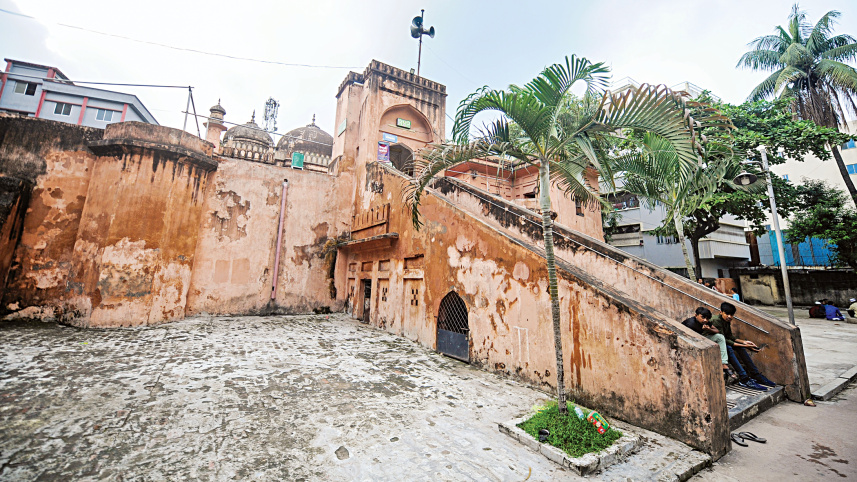
Fridays in Old Dhaka begin with a distinctive rhythm, building toward Juma prayer. During Juma, the atmosphere becomes layered: sacred inside, restless outside. For a brief hour, the city feels choreographed -- devotion anchoring the centre while commerce circles its edges.
It is a moment when Old Dhaka reveals itself -- faith and everyday life stitched together, inseparable, moving in unison. Thirty minutes before the prayer, the rush has its own ritual: someone fumbling for a clean panjabi, shopkeepers squeezing in one last sale before pulling down the shutters.

As the azan (prayer call) echoes across the rooftops, the streets rearrange themselves. Men stream into the mosques, shoes line the gates, and the atmosphere inside feels equal parts prayer and reunion. The courtyards fill quickly as worshippers stand shoulder to shoulder, the khatib’s sermon carrying through the hushed hall, broken only by the rhythm of prayer.
After Juma, the atmosphere changes. Young men gather for adda at the gates, laughter spilling into the streets. Shops reopen one by one, rickshaws jostle back into heavier traffic, and women begin their own Friday rhythm-- trays of biryani and sherbet carried across courtyards, relatives visited, gossip exchanged over steaming tea. Friday afternoon in Puran Dhaka belongs to everyone in its own way, stitched together by prayer, adda, food, and family.
In 1610, Islam Khan Chishti moved Bengal’s capital to Jahangirnagar, present-day Dhaka. From then on, governors, commanders, judges, and merchants each left behind a mosque, sometimes bearing their own names, sometimes those of their wives or daughters, and sometimes funded entirely by local businessmen.
These were not merely architectural feats; the rhythm of the city organised itself around them. By the British era, Puran Dhaka already had hundreds of mosques woven into its lanes and courtyards. They remain today, still calling the faithful to prayer five times a day and still teaching the Quran to five-year-olds in small rooms beside the main prayer hall.
To understand what the mosque means here, come during Shab-e-Barat, when people travel from across Dhaka to visit the older mosques. Lalbagh Shahi Mosque, for example, draws crowds far larger than on a typical Friday.
Walk through Old Dhaka, and each mosque feels like a chapter in the city’s memory. Binat Bibi Mosque, built in 1457, still stands as a testament to pre-Mughal architecture and the early spread of Islam in the region. Chawkbazar Shahi Mosque rises above the bazar, inseparable from the scent of kababs and jilapi. Lalbagh Fort Mosque reflects Mughal elegance. Lalbagh Shahi Mosque dominates the skyline with its sky-blue minaret, while Khan Mohammad Mridha Mosque, perched on a raised platform, is wrapped in legend as the Mosque of the Jinn. Kasaituli Mosque, once among Dhaka’s finest, now struggles to preserve its fading mosaics, yet still tells the story of a neighbourhood once known for its vibrant theatre and generosity.
Each was born of private generosity -- a father’s love, a governor’s pride, a businessman’s devotion -- and each survives through the care of its community. Together, they remain living institutions, binding the city’s rituals, its families, and its Fridays. In Puran Dhaka, the mosque is never just stone and dome. It is the heartbeat of the lane.
 For all latest news, follow The Daily Star's Google News channel.


Comments