


Women built the RMG might. Now they are losing ground

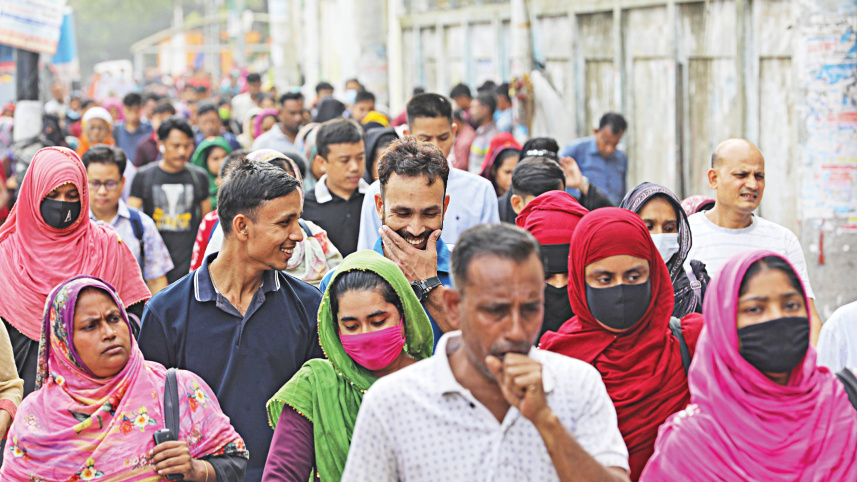
When Nasima got a text from her employer during the Eid holidays, she expected another routine message. Instead, it told her she had been fired.
“I still do not know what my fault was,” said Nasima, 35, who spent her working life as a machine operator before being let go from one of seven Al-Muslim Group factories in Savar that laid off 1,868 workers.

She says most of those dismissed were women around her age. “I also have a male relative who works at the same factory, but he was not dismissed.”
The Daily Star could not independently verify the claim. When contacted, Rajib Hossain, assistant general manager at Al-Muslim Group, could not provide any data to that end. The company last month said the layoffs complied with labour law and that all dues were paid.
For Nasima, it matters little. She has since returned to her home district of Gaibandha. “At my age, where can I find another job?”
She was part of an industry where women, who once built it, now often see the axe more frequently than men.
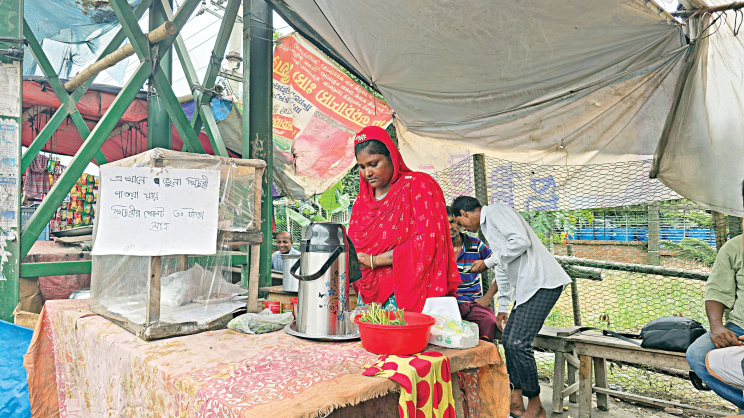
THE DECLINE OF WOMEN IN RMG
For decades, Bangladesh’s ready-made garment industry was one of the world’s most celebrated stories of female economic empowerment, pulling millions of women into paid work and reshaping families, villages and the national economy.
Women made up roughly 80 percent of Bangladesh’s garment workforce between 1980 and 1994, according to the Bangladesh Garment Manufacturers and Exporters Association (BGMEA) data.
The figure fell to 70 percent by 2005 and to around 53 percent in both 2021 and 2023 -- a trajectory confirmed separately by studies from the Ethical Trading Initiative, GIZ and BRAC University, and from the Bangladesh Institute of Development Studies (BIDS).
BIDS Research Director Kazi Iqbal, who co-authored the BIDS study, said total RMG employment grew about 58 percent between 2014 and 2023. Male employment grew 78 percent, against 57 percent for women, even as the absolute number of female workers kept rising.
“The total number of female workers is increasing in the manufacturing sector as the industry grows,” Kazi said.
Still, the study found roles traditionally held by women, such as machine operators and helpers, are gradually disappearing through mechanisation, with the drop in female representation sharper in some product categories than others.
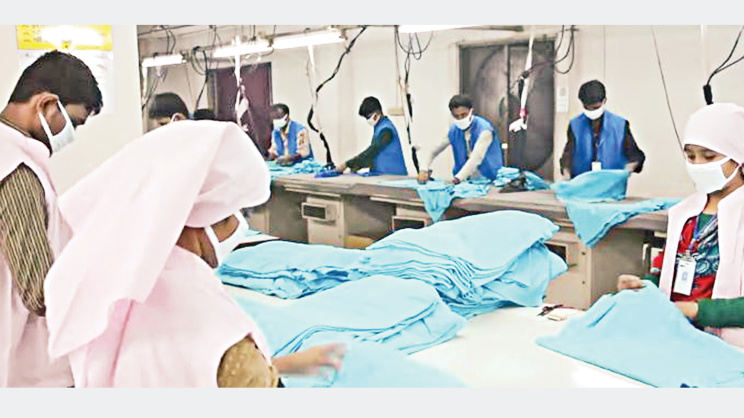
AUTOMATION, SKILL GAP, AND PRO-MEN PERCEPTION
Kazi pointed to two forces behind the shift: a skills mismatch created by new machinery, and safety concerns that discourage employers from putting women on night shifts.
“Some technologies require greater skills to operate, which female workers lack. Moreover, when a machine runs 24 hours, including the night shift, female workers are less preferred for safety reasons,” he said.
The BIDS official also linked it to wages. Factories once favoured women because they could be paid less than men for the same task; that calculus changed once the RMG minimum wage rose to Tk 12,500. “The demand for female workers diminished with the increase in the minimum wage.”
The skills gap he describes shows up clearly in the data. The 2022 FSG report found nearly a third of female workers have no or incomplete primary education, against 18 percent of male workers, and that men can operate a wider range of machinery, including the overlock, flat lock and button hole -- equipment increasingly central to automated lines.
Women have rarely been trained to close that gap, the report found, and continue to face gender-related perceptions that limit their advancement.
They hold under 15 percent of supervisory roles and under 5 percent of managerial roles, reflecting a widespread belief among owners and workers alike that men work faster and produce more, the report states.
 For all latest news, follow The Daily Star's Google News channel.
 Atonu Rabbani, research director at BIDS’ General Economics Division, said closures and automation are narrowing opportunities for women as employers seek newer technical skills.
Syed Sultan Uddin Ahmmed, executive director of the Bangladesh Institute of Labour Studies (BILS), traced the automation shift further back, to around 2013, saying it has resurfaced as an issue now only because of the recent wave of layoffs.
Each new machine, he said, effectively replaced around eight workers, and was introduced without retraining. “Ironically, women could have operated these machines just as well, if not better.”
HARSH, ABUSIVE WORKING CONDITIONS
He described two other forces alongside automation. First, factories closing outright amid political uncertainty, banking and loan problems, and falling international orders -- circumstances he said some businesses are also exploiting.
Second, older women, especially those with children, are giving up and returning to their villages as living conditions near factories grow harder to sustain.
The wage gap compounds the skills gap. A 2023 study by the South Asian Network on Economic Modeling (Sanem) and Microfinance Opportunities found median monthly earnings, excluding overtime, of Tk 9,669 for women and Tk 10,928 for men across major hubs including Dhaka, Gazipur, Narayanganj, Savar and Chattogram.
Both figures fall well below the Tk 19,200 to Tk 26,000 living wage estimated by the Global Living Wage Coalition.
The FSG report put the gap wider still, at 25 percent, and found women remit 53 percent of their income to family elsewhere, against 36 percent for men, leaving them with little in savings of their own.
Working conditions add to the pressure to leave. The FSG report described 12-hour days with limited breaks, hot and cramped floors packed with hundreds of workers, and recurring headaches, respiratory problems and skin allergies among workers, none of whom are covered by employer health insurance.
Toilets are not segregated by gender on every floor and are insufficient for the number of workers on each floor, it found, while menstrual hygiene facilities are inadequate and on-site childcare is frequently understaffed.
A 2026 report by the International Corporate Accountability Roundtable (Icar) also found that the shortfall persists, despite a legal requirement that factories employing 40 or more women provide daycare.
Many centres, it said, function as a compliance formality rather than meaningful support.
Verbal abuse from supervisors trying to speed up production is common, the FSG report found, and the toll it takes is a major reason women leave the sector years earlier than men do.
Regular harassment makes it harder for women to continue. The Icar report found 80 percent of women workers had experienced or witnessed sexual violence or harassment at work, alongside widespread psychological abuse.
Akhirun Islam, 19, who left school a year ago after her father’s gambling addiction strained the family’s finances, says she has to tolerate the abuse because she has no other option.
“The men I work with often look at me in ways that make me uncomfortable. Some have touched me inappropriately,” she said. “I need this job. I do not enjoy being here, but I cannot afford to leave.”
Tamanna Akter, who joined the industry as a teenager nearly 25 years ago, has watched the shift first-hand. “Back then, many more women used to join garment factories. Women still come, but not as many as before.”
She believes younger women increasingly see garment work as a last resort. “Most people come here only when they have no alternative.” She still earns less than the men she has worked alongside for years.
“My father has passed away. I have to support my mother and younger sister. If I only had myself to think about, I would have left this job long ago,” she added.
Age appears to be its own barrier. Amena Khatun, 45, has spent months searching for work without success, recently standing in a queue at a factory in Gazipur’s Bhogra Bypass area that’s hiring on an emergency basis.
“They did not hire me because I am too old. I have contacted at least five factories in the last few days, but have not got a job anywhere despite having work experience. Now it feels like I might never get a job again,” she said.
Selim Raihan, executive director at Sanem, citing patterns his organisation’s research has long observed, said, “This [decline in women’s participation] is not simply a result of automation; it reflects a combination of structural changes in the industry and persistent gender biases in the labour market.”
Employers increasingly want digital and technical skills that middle-aged women have had fewer chances to acquire, he said, given historical inequalities in training and promotion, and older women face particular difficulty in recruitment and restructuring.
THE UNEMPLOYMENT FACTOR
Not everyone, however, reads the numbers the same way. BGMEA president Mahmud Hasan Khan offered a different explanation for the shrinking female share.
“As unemployment has risen in other sectors, more men are entering the garment industry and taking jobs that were traditionally held by women,” he said, adding that the association is still investigating other contributing factors.
He disputed that harassment remains widespread. “It is extremely difficult to take action if no complaints are made. Given our social and cultural norms, many women are reluctant to report harassment even when it occurs.”
He said member factories are regularly monitored, with complaint boxes and routine questioning by buyers and third-party auditors, and rejected the suggestion that women are disproportionately targeted in layoffs.
“When orders decline, and factory owners believe layoffs are necessary to avoid losses, they are legally entitled to reduce their workforce. I am not aware of any discrimination based on gender in those decisions,” he added.
CONSEQUENCES IN WAITING
The stakes, several economists said, extend beyond the factory floor.
“If women’s participation continues to decline in such a large sector, it will have broader consequences for household incomes, consumption and the overall economy,” BIDS’ Atonu said.
“When women lose employment opportunities, they also lose economic independence,” said Tania Haque, professor of Women and Gender Studies at Dhaka University.
Moshrefa Mishu, president of the Garments Sramik Unity Forum, said workers’ conditions have not improved in proportion to the industry’s growth, with women remaining among its lowest-paid despite being its backbone.
BILS’ Sultan called for a government task force requiring factories to notify authorities before cutting jobs, and for an assessment of whether layoffs are genuinely necessary. “The decline in women’s participation in the garment workforce is becoming a national crisis, yet it is not even being discussed in parliament.”
He also pointed to a policy gap, saying large industrial groups draw support when they falter, while small and medium factories face harder bank pressure with less of a safety net when they close.
Sanem’s Selim called the RMG sector the single most important driver of women’s economic empowerment in Bangladesh over four decades, crediting it with reducing poverty, raising household incomes, improving children’s education and increasing women’s decision-making power at home.
Losing ground now, he warned, risks reversing those gains at a time when the country needs a more productive, skilled workforce to stay competitive.
He argued that policy should prepare women for the transition ahead of displacement -- through reskilling, technical education, pathways into supervisory roles, and stronger enforcement against discriminatory hiring -- alongside affordable childcare, safe transport and protections for displaced workers.
Our Gazipur correspondent Monjurul Haque has contributed to the report.
Comments