


A growing herd in a shrinking forest

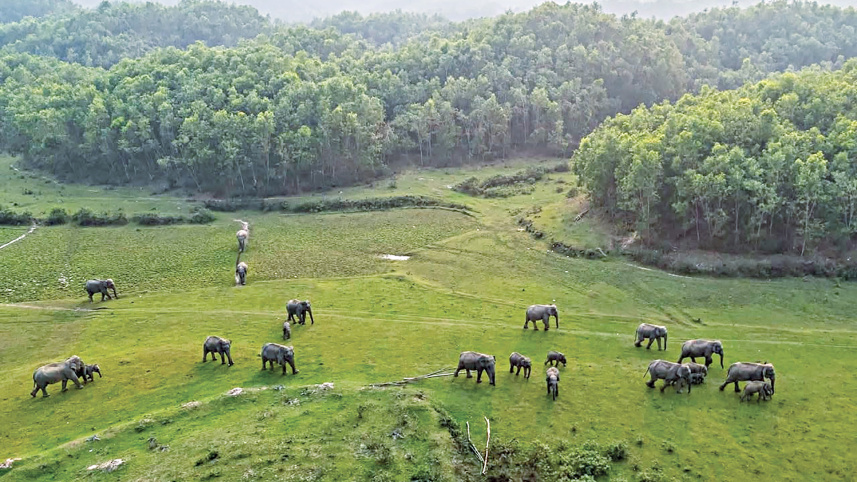
As elephant numbers grow in the forests of the Mymensingh region, shrinking habitats, blocked migration routes and escalating human-elephant conflict are threatening the future of one of Bangladesh’s last remaining transboundary elephant populations.
Nearly 40 elephant calves aged between one and five years have been recorded in the region over the past six years, pushing the northern elephant population to around 140, according to Muhammad Abdullah Al Amin, wildlife ranger of the Wildlife Management and Nature Conservation Division in Sherpur.

He said officials had recorded around 15 calves, ranging from newborns to three months old, during the current breeding season alone.
Md Suman Miah, range officer of the Balijuri Range, said around 10 calves were born during his two-year tenure. Meanwhile, Prof Dr Mostafa Feeroz of Jahangirnagar University’s Department of Zoology estimated that at least 11 calves were added to the Sherpur herd last year.
The growing population, however, is now competing for space in a rapidly shrinking forest landscape.
According to Kazi Mohammad Nurul Karim, divisional forest officer of Mymensingh, the forest belt stretching across Mymensingh, Sherpur, Jamalpur and Netrakona once covered more than 71,000 acres. Over the years, nearly 29,700 acres, or about 40 percent of the area, have been encroached upon and converted into settlements, cropland and other human uses, he said.
Experts say an adult elephant requires around 200 to 250 kilogrammes of vegetation and about 150 litres of water a day.
They say shrinking forests have drastically reduced the availability of food and shelter, forcing elephants out of their natural habitats and into villages and croplands in search of food. This has led to a steady rise in encounters between people and elephants across the northern region.
Forest Department data show that between 2000 and 2015, at least 78 people and 19 elephants were killed in such conflicts in northern Bangladesh.
The losses have continued over the past decade. According to the Mymensingh Forest Division, 35 elephants have died since 2014, most of them from electrocution, across the Balijuri, Rangtia, Madhutila, Mymensingh Sadar and Durgapur ranges.
TRAPPED BETWEEN BORDERS AND PEOPLE
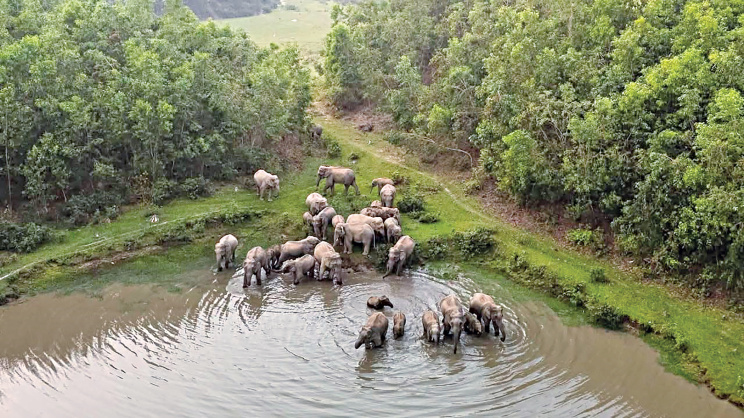
Researchers say one of the main drivers of the growing conflict is the disruption of cross-border elephant movement.
According to Prof Feeroz, who is also a member of the IUCN Asian Elephant Specialist Group, the behaviour of the northern elephant population has changed significantly over the past few years.
“Before 2019, elephants generally crossed into Bangladesh during the harvest season and stayed for only about two months before returning to India’s Meghalaya Hills. Now, many remain in Bangladesh throughout most of the year,” he said.
He attributed the behavioural shift to barriers erected along the border that have disrupted the animals’ traditional migratory routes.
“The increasing elephant population will eventually put pressure on available food resources unless more suitable mixed forests are restored,” he added.
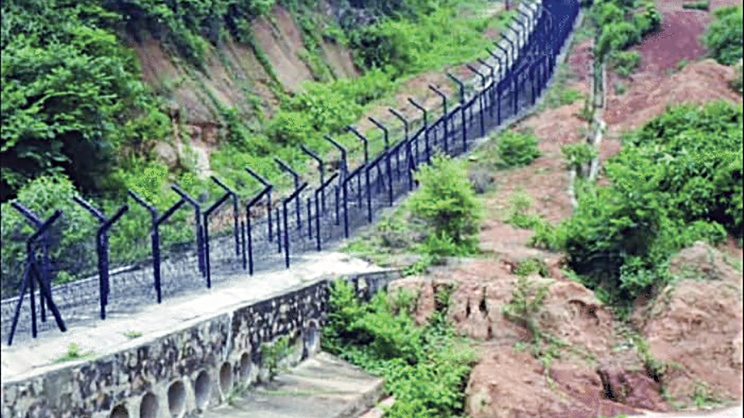
Prof MA Aziz of Jahangirnagar University’s Department of Zoology, who has studied Asian elephants for decades, said the 50-kilometre-long permanent barbed-wire fence constructed along the Bangladesh-India border in 2007, separating India’s Meghalaya state from Sherpur and Jamalpur districts, fundamentally altered elephant movement in the northern region.
Aziz said elephants repeatedly damaged sections of the fence while trying to cross the border. In response, Indian authorities installed 44 gates along the fence, each about three kilometres apart, to facilitate elephant movement.
According to him, elephants regularly used nine of the gates, made moderate use of seven others and occasionally crossed through the remaining 28.
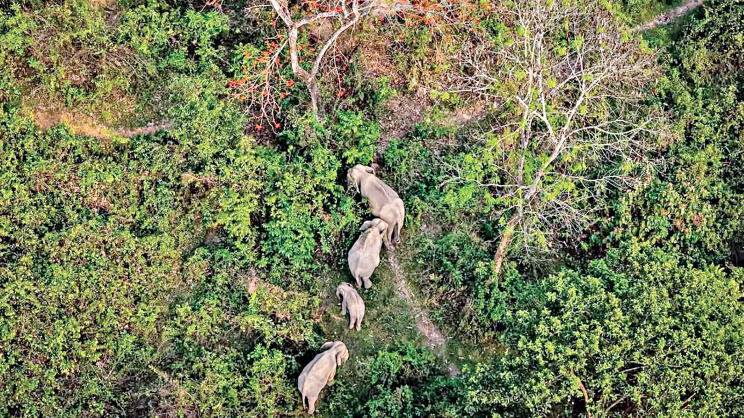
“However, soon after the gates were installed, they were usually kept closed and opened by the Indian Border Security Force (BSF) only when herds of elephants from Meghalaya repeatedly tried to cross into Bangladesh. The gates were closed again after the elephants had crossed. Consequently, elephants in Bangladesh could hardly return to India through their traditional migratory routes,” he said.
 For all latest news, follow The Daily Star's Google News channel.
 As a result, elephants have increasingly moved through Jhenaigati, Sreebardi, Nalitabari and Bakshiganj upazilas, areas where they were rarely seen before the fence was built, Prof Aziz said.
The altered movement pattern has brought elephants into more frequent contact with border communities, leading to more crop raids and fatalities, he added.
Aziz said the conflict peaks during the country’s three major paddy-growing seasons -- December to January, March to May, and July to August -- with the Aman harvest suffering the greatest losses because elephants are strongly attracted to ripening paddy.
Jhenaigati records the highest number of human-elephant conflicts, followed by Sreebardi and Nalitabari, he said, adding that adult males, both humans and elephants, account for most fatalities.
CONSTANT DISTURBANCE
Recent field observations suggest that human disturbance is further compounding the challenges faced by the northern elephant population.
A two-month field survey in Sherpur, led by conservationist Auritro Satar with support from local survey teams and members of the Elephant Response Team, found that people repeatedly disturbed the herd with fire, spears, stones and firecrackers, disrupting its feeding, resting and movement.
The observations also challenged the widespread perception that elephants are naturally aggressive. Researchers found the herd generally calm and tolerant of nearby human presence. Defensive behaviour was observed mainly after disturbances caused by explosive devices, electric fencing or large crowds.
The elephants rarely showed aggression unless they were provoked, the survey team noted.
Sujoy Malakar, president of the Sherpur Bird Conservation Society, said the growing presence of social media content creators around elephant habitats has become another source of disturbance.
“We have recently seen a sharp increase in the number of content creators chasing elephants to produce videos. Their activities seriously disturb the animals and should be dealt with strictly,” he said.
CAN THE TIDE BE TURNED?
To improve elephant habitats, the Forest Department, with technical support from the International Union for Conservation of Nature, launched a large-scale afforestation programme across the northern forest belt in 2018.
According to wildlife ranger Muhammad Abdullah Al Amin, plantations have since been established on about 700 acres of degraded forest land in Nalitabari, Sreebardi and Jhenaigati upazilas of Sherpur; Bakshiganj in Jamalpur; Haluaghat and Dhobaura in Mymensingh; and Durgapur in Netrakona.
The plantations primarily consist of indigenous tree species, including bahera, amloki, haritaki, shimul, udal, jackfruit and elephant apple, that provide food for elephants while helping restore natural forest ecosystems.
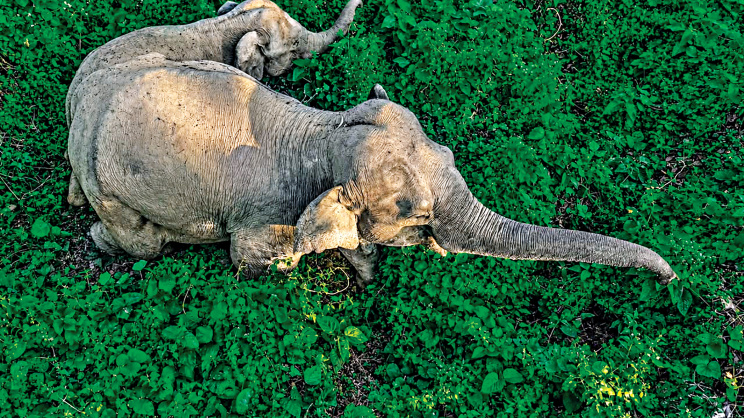
“Within two years of the plantation, elephants started feeding in those restored areas,” the ranger said.
The Forest Department has also expanded community-based initiatives to reduce encounters between people and elephants.
DFO Kazi Mohammad Nurul Karim said a six-member Elephant Conservation Committee has been formed to monitor elephant movement and raise awareness among local communities.
He said 530 trained volunteers working in 53 Elephant Response Teams now operate across the northern border region, helping guide elephants safely back into nearby forests whenever they stray into villages.
“They have been provided with training and necessary equipment, including searchlights, binoculars, T-shirts and protective footwear,” he said.
Despite these initiatives, conservationists say long-term success will depend on restoring both habitats and cross-border connectivity.
Prof Feeroz also called for Bangladesh and India to negotiate the removal of barriers obstructing elephant movement across the border, in keeping with the principles of the Siem Reap Declaration 2025, an agreement signed by 13 Asian elephant range countries early last year to strengthen regional cooperation for elephant conservation.
“The elephants have always moved across this landscape. Conservation efforts will remain incomplete unless their transboundary migration routes are restored,” he said.
Prof Aziz called for immediate and long-term interventions, including encouraging farmers in high-conflict areas to cultivate crops less attractive to elephants, restoring degraded forests with native species, restricting livestock grazing inside forests and protecting remaining forest patches as core elephant habitats.
He said social forestry plantations could also serve as buffer zones between forests and nearby settlements.
“Building trust and collaboration between the Forest Department and local communities is essential for reducing conflict and restoring elephant habitats,” he said.
He also stressed the need for bilateral action.
“Bangladesh and India must work together to identify, restore, and protect elephant corridors and ensure the animals can move safely across the border,” Prof Aziz said.
Comments