


The price of convenience


Every day, Safia Khan, a 30-year-old corporate professional in Dhaka’s bustling Mirpur neighbourhood, moves through a world saturated with plastic.
A few taps on a food delivery app bring breakfast to her door, sealed in layers of low-cost polythene and packed in a single-use plastic container. On her way to work, she buys bottled water from a roadside vendor. Lunch arrives in disposable packaging from a nearby restaurant. Later, as post-lunch drowsiness collides with mounting deadlines, she grabs a takeaway coffee in a plastic-lined cup.

Meanwhile, an online shopping parcel arrives at her office wrapped in bubble wrap, and an evening grocery stop adds another handful of thin plastic bags. By the time she returns home, her kitchen bin is filled with the accumulated traces of dozens of small conveniences.
Safia knows plastic does not simply disappear. She has read reports about microplastics contaminating rivers, food systems and even the human body. Yet, like millions of Bangladeshis, she finds avoiding plastic almost impossible.
“I feel guilty whenever I throw these things away,” she says. “But everything around us is designed for convenience. If you want to avoid plastic, you have to plan constantly. Most days, life simply moves too fast.”
Her experience reflects the central paradox of Bangladesh’s plastic crisis. For years, pollution was framed largely as a problem of public awareness: if people understood the consequences, they would change their behaviour.
Yet a growing body of research points to a more complex reality. Bangladeshis increasingly recognise the risks, but remain embedded in an economic and social system that rewards convenience while penalising sustainable choices. Researchers argue that the challenge is no longer awareness, but infrastructure, policy design and enforcement.
CONCERN WITHOUT ALTERNATIVES
This disconnect is evident in a 2024 study, People’s Attitudes Regarding Plastics and Microplastics Pollution: Perceptions, Behaviors, and Policy Implications, published in Marine Policy. Surveying 420 residents across Bangladesh’s coastal and urban-adjacent regions, the researchers examined public understanding of plastic pollution and attitudes towards policy responses.
The study found a striking gap between awareness and technical knowledge. Around 66 percent of respondents had never encountered the term microplastics, while only 22 percent were familiar with the concept.
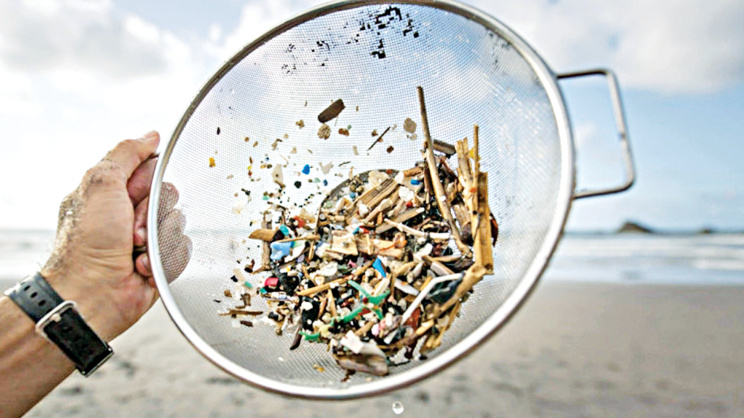
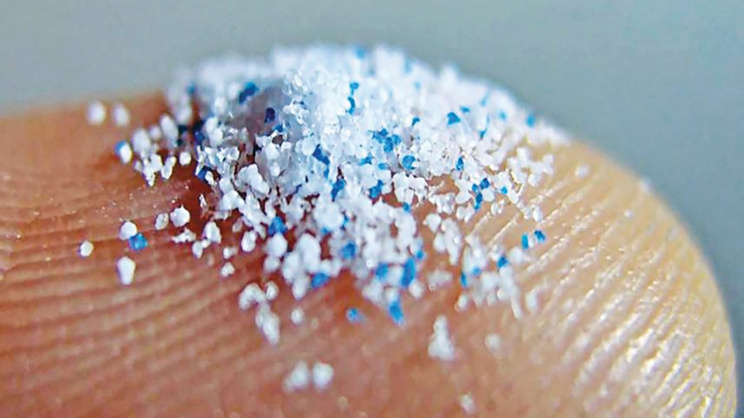
Once researchers explained how larger plastic waste breaks down into microscopic particles that persist in ecosystems and enter food chains, concern rose sharply. More than 68 percent of respondents expressed alarm that microplastics may already have entered the human body through food and water.
Crucially, respondents attributed continued plastic use not to indifference, but to practical constraints. Many cited forgetfulness and the lack of affordable alternatives in local markets, while nearly half believed existing environmental regulations were inadequate to address the scale of the problem.
Advocate Syed Mahbubul Alam, secretary of the Centre for Laws and Policy Affairs (CLPA), argues that broader economic shifts are reinforcing this dependence.
“Locally produced, unpackaged goods -- such as fresh milk, yoghurt and puffed rice -- once distributed through indigenous, plastic-free networks, are being replaced by industrially packaged alternatives, even in rural areas,” Alam says.
“Without state support for local markets, dependence on industrial food systems grows, and with it the risk of microplastic exposure. Consumers are not choosing plastic; structural change is choosing it for them. Awareness alone cannot break this cycle.”
DEEPLY EMBEDDED CONTAMINATION
Individual choices tell only part of the story. Scientific evidence shows the consequences are already deeply embedded in Bangladesh’s environment.
A 2025 systematic review of 56 peer-reviewed studies published between 2019 and 2024 found widespread microplastic contamination across rivers, soils, food systems and urban environments.
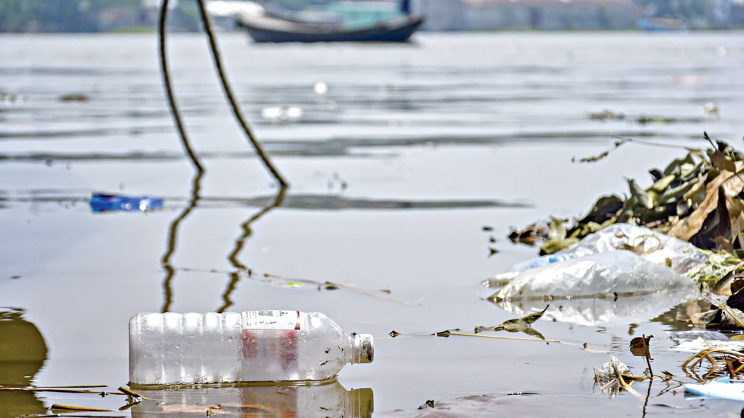
In the Buriganga River, concentrations ranged from 4.33 to 43.67 particles per litre. Sediments across the Ganges–Meghna river system contained more than 3,300 particles per kilogramme. Near the Amin Bazar landfill, surface water recorded concentrations of up to 2,090 particles per litre, raising concerns about groundwater contamination.
Microplastics have also been detected in street dust, sea salt, powdered and liquid milk, flour, and the digestive tracts of hilsa, one of Bangladesh’s most important dietary staples.
 For all latest news, follow The Daily Star's Google News channel.
 Synthetic fibres, largely linked to textile effluent, were among the most common pollutants, alongside polyethylene and polypropylene from packaging materials.
The findings suggest that microplastics are no longer confined to waste dumps or polluted rivers. They have become woven into the country’s ecosystems and, increasingly, into the human food chain.
THE LIMITS OF REGULATION
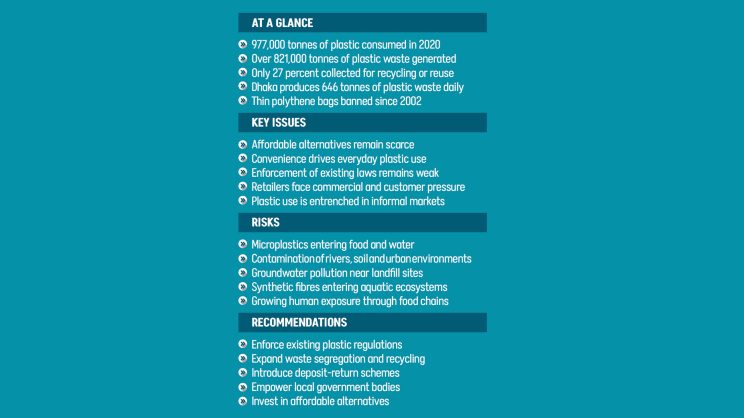
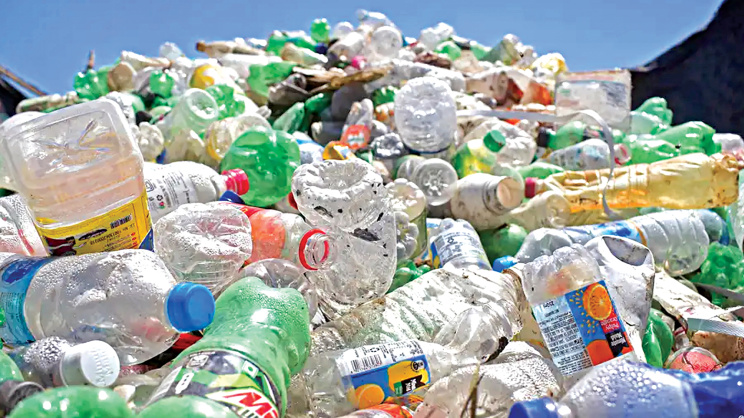
The scale of contamination mirrors Bangladesh’s growing dependence on plastic. According to the 2025 review, the country consumed approximately 977,000 tonnes of plastic in 2020, generating more than 821,000 tonnes of waste. Only about 27 percent was collected for recycling or reuse; the rest ended up in landfills, waterways and the wider environment.
Dhaka alone produces an estimated 646 tonnes of plastic waste every day, driven largely by e-commerce, courier services and app-based food delivery.
The trend is particularly striking given Bangladesh’s pioneering role in environmental regulation. In 2002, it became the first country in the world to ban thin polythene shopping bags. Over time, however, enforcement steadily weakened.
A 2026 nationwide study by the Environment and Social Development Organisation (ESDO), titled Beyond the Ban: Unpacking Polythene Dependency in Bangladesh, offers insight into why the ban has failed to achieve its intended impact.
Using a mixed-methods approach, researchers surveyed nearly 2,000 consumers and retailers across urban, peri-urban and rural Bangladesh.
The findings reveal a persistent gap between policy and practice. More than 63 percent of retailers knew thin polythene bags were banned, yet continued distributing them because of commercial pressures and customer demand. Half reported using more than 50 bags each day, while only 2 percent said they used none.
The study also identifies what researchers describe as a “curriculum gap”. Although education improves awareness of environmental harm, it rarely equips people with the behavioural understanding or civic knowledge needed to translate awareness into action.
As a result, educated consumers such as Safia remain dependent on plastic, not because they dismiss the risks, but because affordability, availability and habit continue to shape everyday choices.
Around 55 percent of retailers said they would switch to environmentally friendly alternatives if they were affordable and readily available.
In rural and informal markets, however, polythene remains deeply entrenched because it is cheap, durable and well suited to low-margin trade.
ENFORCEMENT AND ECONOMIC DESIGN
For Alam, the core failure lies not in legislation, but in enforcement.
“Under current law, most offences require direct observation by mobile courts during enforcement drives,” he says. “Officials from the Department of Environment cannot impose administrative fines on the spot, while citizens have no direct standing to bring cases before environmental courts. The legal framework exists, but its enforcement remains weak.”
He argues that environmental officers should be given powers to issue administrative penalties, while local government institutions should be authorised to act directly against offenders.
“City corporations, municipalities and union parishads must be empowered to enforce the law,” Alam says. “Without action at the source, the plastic lifecycle will always outpace regulation.”
“A small refundable deposit on plastic bottles could create an immediate incentive for collection and recycling,” he says. “Without economic signals that reward better choices, meaningful reductions will remain largely theoretical.”
BEYOND AWARENESS CAMPAIGNS
For years, environmental campaigns have focused on persuading individuals to change their behaviour. Increasingly, however, policy experts argue that awareness alone cannot deliver lasting change when affordable alternatives remain out of reach.
The Marine Policy study found strong public support for structural reforms, including mandatory waste segregation, expanded recycling systems and Extended Producer Responsibility (EPR), under which producers are required to finance the collection and management of post-consumer waste throughout a product’s lifecycle.
Shahriar Hossain, general secretary of ESDO, argues that meaningful reform must begin with education, but not end there.
“Environmental education should move beyond raising awareness to explaining the health and ecological consequences of plastic pollution, while equipping people with practical alternatives,” Hossain says. “The principles of the 5Rs -- Refuse, Reduce, Reuse, Repurpose and Recycle -- along with circular economy concepts and waste management practices, should be introduced from an early stage of schooling, supported by teacher training and institutional practice.”
Beyond education, he calls for enforceable policy targets, tighter regulation of supply chains and a just transition for workers whose livelihoods depend on the plastics economy.
“These reforms must be matched by investment in affordable alternatives, research and innovation, and sustained public support,” Hossain says. “At the same time, false solutions, including incineration and forms of plastic recycling that generate secondary microplastics, must be avoided.”



Comments