


Why don't more women make it to the C-suite?

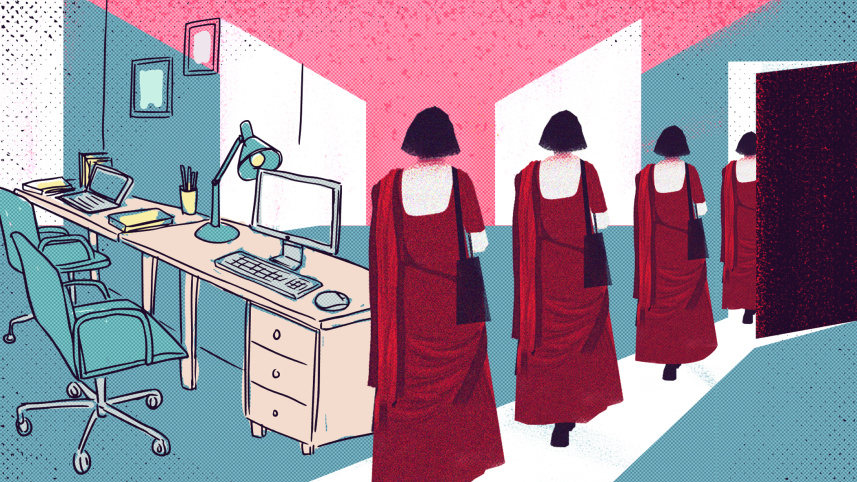
I have followed Indra Nooyi’s career for years. To me, it feels like a dream to become the CEO of a top global company, and that too as a woman from South Asia. Nooyi, who had moved from India to the US in the late 1970s for higher studies, served as PepsiCo’s first woman CEO between 2006 and 2018. Recently, she returned to discussions for her remarks during an interview, in which she said she could never have become a “CEO in any other country, including India.” That remark set off a storm. Commentators called it disingenuous, pointing to women now leading Indian banks and businesses; others defended her memory of 1970s India.
I am not joining the debate over whether she hurt her motherland or not. But the “any other” phrase includes my country, and it leads me to ask: was she right about Bangladesh?

Nooyi worked so relentlessly that her bosses stopped reviewing her work. Then came the mentors, all white men, she said, who believed in her more than she believed in herself. When critics magnified her every misstep as the first woman of colour running a Fortune 50 company, her board backed her, which is sponsorship, in corporate language. Capability, mentorship, and sponsorship: three factors collaborated, taking Nooyi to the top of the top.
But in our part of the world, a fourth factor weighs as heavily as the other three, and it is not found in any boardroom. It is found at home, where all of society’s expectations of a woman quietly collect.
Half of Bangladesh’s population are women, yet women’s labour force participation is barely half of men’s—38 percent versus 80 percent, per the 2024 Labour Force Statistics. The pass rate among girls in the 2025 SSC exam was 71 percent, while that of boys was 66 percent. However, women barely make up even 40 percent of university students, per the 2024 Bangladesh Education Statistics, while 96.6 percent of working women are in the informal sector.
In 2024, women held 19 percent of listed-company board seats, but most seats belong to women of owning families—shareholders, not chosen leaders. Female independent directors, invited for expertise alone, are barely 6 percent, per the International Finance Corporation’s 2025 report, and even that happened due to a compulsory rule. The number of women CEOs is even fewer.
So why do we lose our brightest women in the middle of their careers? Lack of quality or of courage are not the reasons why. As per UN Women’s 2021 time-use survey on Bangladesh, at home, women spent 7.3 times more hours on unpaid household and care work than men per day. At work, mid-career decides the difficult project, the regional role, the seat. Our women do find mentors, as advice comes easily. What few find is a sponsor: someone willing to spend their own credibility to put her name forward. That is the point at which our Indra Nooyis go missing.
Yet, Bangladeshi women have kept showing up. My mother’s generation powered the economy invisibly by keeping homes and raising every worker. Women working in the RMG sector stepped into the formal economy and built our export engine. My generation pushed into top management. And my daughter’s generation is dreaming of going past the border.
And the ceiling all of us have been pushing against has begun to crack. Rupali Chowdhury, elected president of the Foreign Investors’ Chamber of Commerce and Industry (FICCI) for the fourth time, became the first female managing director of a multinational company in Bangladesh in 2008. Shwapna Bhowmick is head of regions—Bangladesh and India—at Marks & Spencer. Last month, Mir Nadia Nivin became the first woman to chair the Insurance Development and Regulatory Authority. Far beyond the famous names, nearly 28 lakh SMEs—one in four—are led by women, employing 84 lakh people, per Bangladesh Bureau of Statistics data from 2020. Yet, these are cracks, not open doors.
Getting our daughters to the top of the top is how a sustainable trillion-dollar Bangladeshi economy will be built. Equal hands at home, mentors who push, and sponsors who back—the nudge that turns potential into growth. Indra Nooyi may have been right about the US, where her merit was met with support. But our daughters should not have to fly so far to find the same. My mother ran her home so that I could reach a boardroom; the next generation must have every opportunity to reach their full potential from right here in Bangladesh.
Shamima Akhter is a corporate affairs and communications expert. Views expressed in this article are the author’s own.
Views expressed in this article are the author's own.
Follow The Daily Star Opinion on Facebook for the latest opinions, commentaries, and analyses by experts and professionals. To contribute your article or letter to The Daily Star Opinion, see our guidelines for submission.
 For all latest news, follow The Daily Star's Google News channel.


Comments