


The many nuances behind Bangladesh’s 0.1 rise in total fertility

Bangladesh became a global success story by bringing down its fertility rate over the decades. But that success is now being questioned over a single decimal point. The 2025 Multiple Indicator Cluster Survey (MICS) puts the total fertility rate (TFR) at 2.4 children per woman. This is the TFR’s first real movement in over 10 years, after sitting at exactly 2.3 in both the 2012-13 and 2019 surveys. Meanwhile, longer-running international estimates put Bangladesh closer to 2.1, near replacement level. Both cannot be equally precise indicators of the same reality, and the gap between them is where the debate sits.
First, we should understand what a move from 2.3 to 2.4 really means. Although the public conversation has treated it as a settled fact, it is ultimately a survey estimate, and every survey estimate carries some margin of error. MICS 2025 was large-scale and careful, covering nearly 63,000 households and 64,000 women. But even a well-run survey cannot say with total certainty that the “true” number moved rather than stayed flat. A change that held steady across three surveys, shifting once, is more convincing than a single odd reading.

The lower 2.1 estimate comes from a model built on past data, so it moves slowly and smooths out short-term bumps a fresh survey like the MICS can pick up immediately. The honest reading is that the 2.4 finding is a real signal worth taking seriously, but not yet proof that Bangladesh’s long fertility decline has reversed. The country also has more than 17.5 crore people, with a very large number of young women in or entering their childbearing years. Even a small rise, multiplied across crores of women over several years, adds up to a meaningful number of extra births and delays population stabilisation.
The explanation dominating the media this year is a contraceptive supply crisis, and the facts are genuinely worrying.
Government records show sharp falls in the supplies of condoms, pills, injectables, and long-acting methods since 2019, worsening after a major procurement programme lapsed in mid-2024. This should show up in the numbers, and it does, although more mildly than the supply figures suggest. MICS 2025 shows contraceptive use among married girls and women (ages 15 to 49) falling from 62.7 percent in 2019 to 58.2 percent, and the share of those whose need for modern family planning is actually being met slipping from 77.4 percent to 73.5 percent. However, set against how severe the supply collapse has been, this is a fairly modest shift, making it difficult to see the contraceptive crisis alone as the main force behind the TFR rise.
Furthermore, contraceptive use and fertility don’t always move together. In 2022, the Bangladesh Demographic and Heath Survey found contraceptive use had risen slightly from the previous round, yet the TFR had remained at 2.3. Simply counting how many women use some method of contraception does not capture how consistently they use it. Earlier research shows roughly four in ten women who take up contraception in one method give it up within a year, rising to more than half within two years. This leaves gaps which a one-time survey cannot pick up on. Therefore, a modest fall in the headline number may understate how much effective protection has weakened, particularly among younger couples.
A more convincing—and overlooked—explanation sits elsewhere in the same MICS: early marriage and early childbearing among teenage girls.
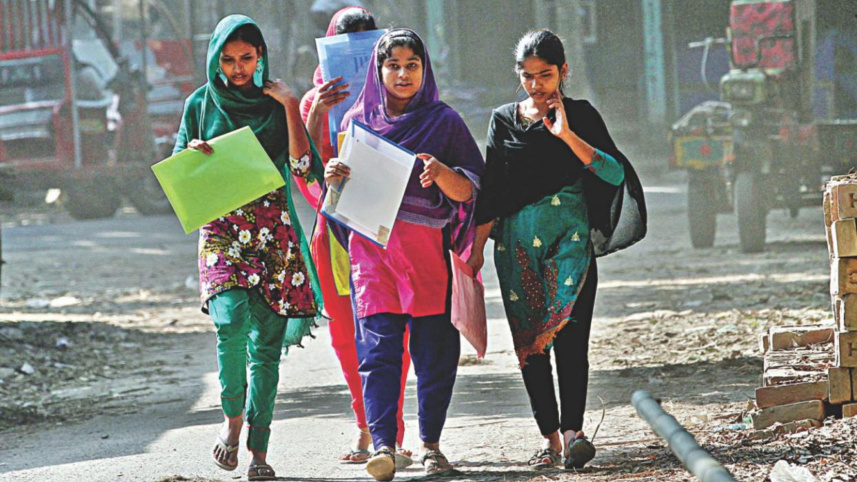
The share of girls aged 15 to 19 who are currently married rose from 32.9 percent in 2019 to 38.9 percent in 2025, a striking six-point jump in just six years. Alongside this, the adolescent birth rate (births per thousand girls aged 15 to 19), climbed from 83 to 92, reversing a decade of no change. Contraceptive access plays a smaller role here than among older married women, since social expectations to “prove fertility” soon after marriage often override any wish to delay a first pregnancy, even where services are available—which explains the notable shift from the decade of flat adolescent fertility that preceded it.
The TFR is built by adding up birth rates across seven age groups, so a rise in any one group mechanically pushes the total up. Doing the arithmetic, the nine-point jump in the teenage rate alone explains roughly half of the entire 0.1 TFR rise, before any other age group is considered. That said, the adolescent figure rests on fewer recorded births than the national headline number, since teenage childbearing is rarer, so it still carries more statistical noise even though the overall direction looks solid.
Interestingly, a related, longer-term measure moved the other way. The share of women aged 20 to 24 who were married before turning 18 actually fell, from 51.4 percent to 47.2 percent, and the share of those who had a child before 18 also fell slightly. So, fewer girls overall married or gave birth, but among today’s teenagers, marriage and first births seem to be happening closer together than before. This matters because the TFR is sensitive to timing, not only to completed family size. If births happen earlier, that alone can push the number up, even if completed family size stays the same. Regional patterns support this reading.
Rajshahi has the lowest overall TFR, yet the second-highest teenage birth rate; Rangpur shows a similar pattern. Sylhet, by contrast, combines an average TFR with the lowest teenage birth rate and the lowest rate of child marriage in the country. Wherever fertility looks elevated, it lines up more with early childbearing than with contraceptive shortages spread evenly across age groups, as a pure supply-crisis story would predict. One possibility is that some of the rise reflects pregnancies delayed by Covid now catching up, a rebound rather than a lasting change in family size. Only closer analysis of birth timing would confirm or rule this out.
None of this means the contraceptive supply problem should be ignored. Fixing it is worth doing on its own health merits, whatever it turns out to mean for the TFR. But it should not be mistaken for the driving cause behind the whole fertility story, or be treated as a TFR policy by itself.
The more urgent and puzzling problem is that teenage marriage is rising even as child marriage in the broader sense keeps slowly declining—a genuine contradiction that deserves its own investigation.
Statisticians should treat the 2.4 TFR as provisional until checked against future, comparable surveys using the same age groups and definitions. And policymakers should worry less about restocking contraceptive shelves and more about the newly visible fact that more girls aged 15 to 19 are married today than at any point in the last three MICS. That is the number that should concern Bangladesh, less so than the one making headlines currently.
Dr Nuruzzaman Khan is senior research fellow at the Melbourne School of Population and Global Health under the University of Melbourne in Australia. He can be reached at [email protected].
Views expressed in this article are the author's own.
Follow The Daily Star Opinion on Facebook for the latest opinions, commentaries, and analyses by experts and professionals. To contribute your article or letter to The Daily Star Opinion, see our guidelines for submission.
 For all latest news, follow The Daily Star's Google News channel.


Comments