


An architecture for modern learning

Dr Sharif Nafe As-Saber
Vice Chancellor
Stamford University Bangladesh

Our objective is to equip students with contemporary technical skills and high-quality academic training, while simultaneously instilling strong moral values and environmental consciousness. This ensures they enter the job market not only as highly capable professionals but also as responsible citizens.
As Bangladesh’s higher education landscape continues to evolve and adapt to new challenges, universities are reimagining their campuses as more than just spaces for teaching. The focus has shifted to become hubs of innovation, sustainability, student well-being, and industry collaboration. In this interview, Dr Sharif Nafe As-Saber, Vice Chancellor of Stamford University Bangladesh, shares the philosophy behind the university’s new campus, its efforts to integrate smart learning technologies, research and innovation, investments in sustainability initiatives.
The Daily Star (TDS): What was the core philosophy behind developing your permanent campus?
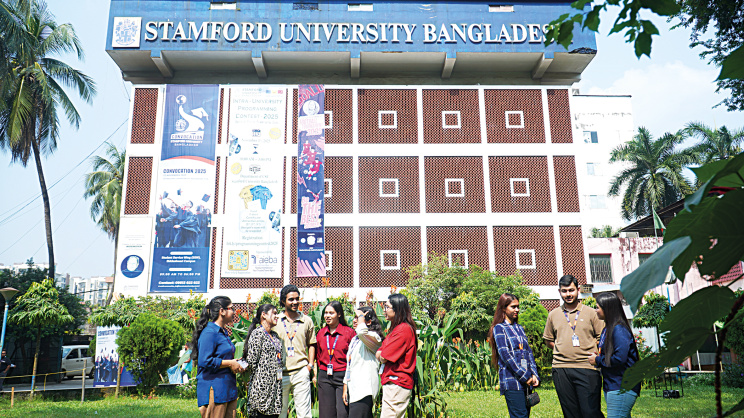
Dr Sharif Nafe As-Saber (SNAS): Academic institutions should possess an identity and ambience that directly reflect their vision and mission. Our permanent campus is being built as a modern facility designed to integrate all academic faculties, advanced laboratories, student spaces, and teaching resources into a unified, cohesive platform. The design is inspired by the classical ambience of iconic centers of learning, such as the Library of Alexandria. Environmental responsibility is central to this vision. We are developing this as a green campus. Last month, the Agriculture Secretary visited our campus, aligning with our regular tree plantation initiatives designed to systematically expand our green cover.
TDS: How have your classrooms, labs, and libraries evolved to incorporate smart technologies and modern learning practices for 21st-century education?
SNAS: Modern higher education is inseparable from advanced technological facilities. To meet 21st-century standards, we recently upgraded our IT infrastructure and partnered with new service providers. We are investing in Artificial Intelligence (AI). Through funding from the European Union, we are establishing a state-of-the-art Multi-Sensory Learning Center. The equipment and specialized facilities for this center are being provided by the EU, a major milestone for our institution.
TDS: What specific facilities, such have been established on campus to nurture student innovation and entrepreneurship?
SNAS: Research and innovation are core priorities at Stamford University. Our Department of Microbiology is highly regarded, holding a top ranking position among private universities in Bangladesh. Stamford University Research Center (SARC) supports both scientific research and projects in business management, English, and social sciences. We are actively developing our incubation center and have established strong collaborative partnerships with national institutions like the Bangladesh Atomic Energy Commission and the Bangladesh Council of Scientific and Industrial Research (BCSIR).
We maintain active academic ties with several global institutions, including Federation University Australia, Tampere University in Finland, the University of Bergen in Norway, and Peking University in China, as well as institutions in South Korea and Russia.
Interview conducted by Nusrat Jahan Esa.
 For all latest news, follow The Daily Star's Google News channel.
Comments