


Women’s role in July uprising being erased
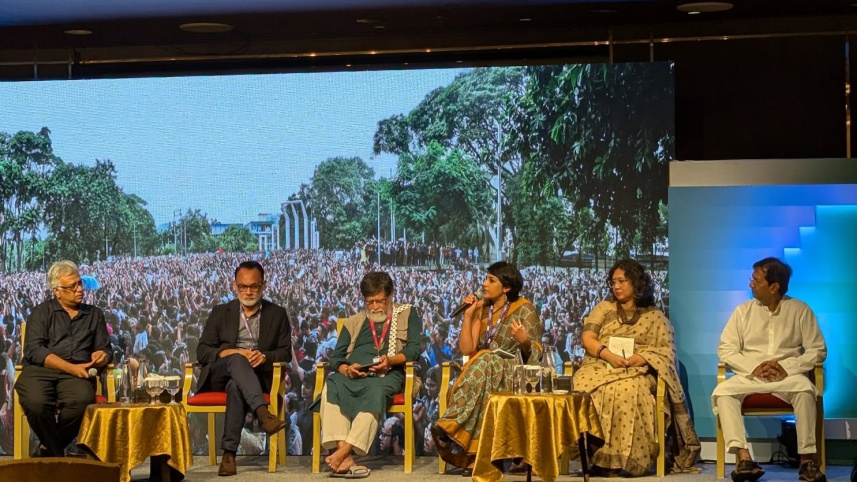
Women’s massive contribution to the July uprising in 2024, much like in the Language Movement of 1952 and the Liberation War of 1971, is gradually being erased, said Mirza Taslima Sultana, a professor of Jahangirnagar University.
Speaking at a session titled “Revisiting July: Reflection and the Way Forward” yesterday, on the first day of the Bengal Delta Conference 2026, she said women have been sidelined since August 5, 2024, despite their active role in the movement.

“Women were in the movement, but they were not seen or called upon later. On August 5, our students went to Channel 24, but there was not a single girl among them,” said Taslima, also a member of the University Teachers’ Network.
She noted a glaring absence of female student representatives on television talk shows post-uprising. Pointing to a prevailing misogynistic mindset, she said it is alarming that women are currently being judged more on their attire than their merit or work.
Prof Navin Murshid of Colgate University’s political science department shed light on the disparity between the movement’s aspirations and the current reality. “We were floating on a tide of development, but now we understand how battered our political institutions and society are,” she said.
Expressing frustration over the lack of subsequent reforms, she said only the faces have changed while the system remains untouched.
Noting that the public’s greatest need post-uprising was “democratic education”, she added, “We don’t know how to be democratic. We just spend our time holding elections.”
Sajjad Sharif, executive editor of Prothom Alo, said the interim government had failed to protect the “window of free speech” that opened following the movement. He alleged that the interim government had, in many cases, indulged extremism, which have created divisions in society.
Rezwan Rahman, chairperson of advisory board at It’s Humanity Foundation (IHF), presented research data on those injured during the July Uprising.
He said the injured, who were highly optimistic in August 2024, became deeply frustrated by March 2025 due to the lack of systemic change and failure to ensure basic rights.
Photojournalist Shahidul Alam mentioned the failure to conduct an impartial investigation into the July incidents as a major governmental failure. Sharing his personal experience of torture, he reminded the audience that silence only empowers oppressive regimes.
The speakers agreed that “mob culture” has emerged as a major problem in Bangladesh. They observed that a genuine democratic transition requires not just political reforms, but also tolerance and civic awareness.
Prof Asif Shahan of Dhaka University’s Development Studies Department moderated the session.
 For all latest news, follow The Daily Star's Google News channel.
Comments