


July trials: Retributive justice must be avoided
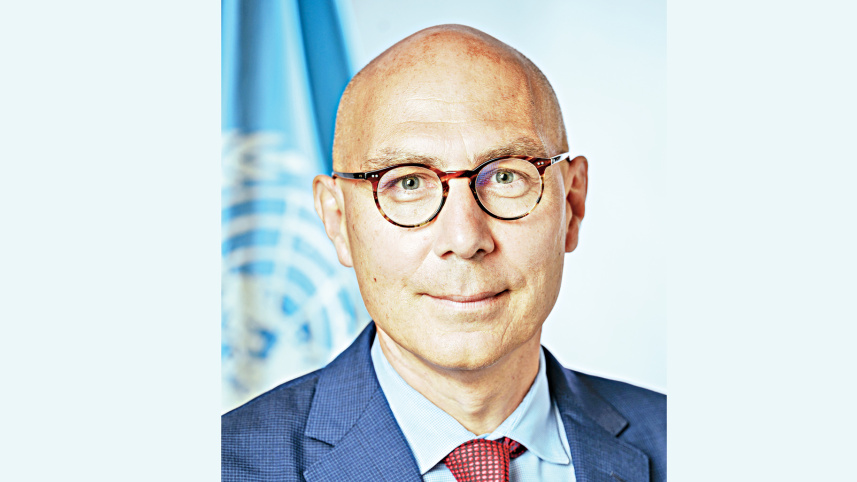
UN Human Rights Commissioner Volker Türk has said that those responsible for the human rights violations and crimes committed during the July uprising should be held accountable and emphasised that this accountability should adhere to international human rights law.
He made the call in a video message at an event organised by the Office of the United Nations High Commissioner for Human Rights (OHCHR), marking the first anniversary of the July uprising at the InterContinental Dhaka yesterday.

The OHCHR's Fact-Finding Mission, in its investigation, had found more than 1,400 people were killed and thousands were injured, the vast majority of whom were shot by security forces under the Awami League regime during last year's mass uprising.
Türk began by saying he honours the memory of those killed and the thousands more who suffered life-changing injuries. "These protests by the people were a powerful expression of a determination to move away from the spiralling inequalities and human rights violations of the past towards a more just and inclusive society.
"The UN Fact-Finding Mission found that the former government and its security and intelligence services engaged in a coordinated strategy to hold on to power at all costs, and it made a detailed series of recommendations to ensure accountability and justice, which are essential in themselves and vital to national healing."
He welcomed efforts by the interim government to move those recommendations forward and said today was an important moment of reflection on how that could be achieved.
Türk said there needs to be accountability for these human rights violations and crimes, and that accountability needs to be in line with fair trial guarantees rooted in international human rights law. "It must not repeat past cycles of retributive justice, including the use of the death penalty."
A comprehensive approach to transitional justice is needed, he said, including truth-seeking and reparations for past abuses. "This begins with a national dialogue involving victims, families, and ordinary citizens."
He stressed that Bangladesh needs legal and institutional reforms, including in the security sector, so that "this can never happen again".
"The repressive laws and institutions that enabled these violations must either be dismantled or completely overhauled. Today, as we remember the protesters who paid the ultimate price for their dream of a different future for the country, it is a moment to recommit to fundamental change."
The UN rights chief assured that his office is fully prepared and ready to support the government and the people of Bangladesh to achieve that vision.
Earlier this month, the UN Human Rights Office opened a mission in Gulshan.
At the event, rights activist Barrister Sara Hossain highlighted some positive developments since the interim government took office.
These include the formation of a commission to investigate enforced disappearances, probes into past harassment cases, and a more open environment for public discourse.
However, she also noted that while constitutional reform is widely discussed, there's less focus on police and judiciary reforms.
The Supreme Court lawyer expressed concern about the present state of the judiciary, finding it unchanged from the previous regime.
"We see people aren't getting bail in time. We are seeing that anyone can file any case, and those are being accepted."
She agreed that one could be sued for crimes against humanity, but she questioned how one could face a case for flattering ruling party leaders.
She also questioned why there is no adequate women's representation in the reform commission. "We need transitional justice, but we should do it in a way that is not discriminatory."
Although the Digital Security Act has been revoked, she said people were still being arrested in the name of "hurting religious sentiment".
 For all latest news, follow The Daily Star's Google News channel.
 "Authorities are still using the Special Powers Act and arresting children under the Anti-Terrorism Act."
Comments