


Pias Majid: The poet of the moonlight conference
Pias Majid, born in 1984, is a gentle yet prominent voice among Bangladesh’s poets of the 2000s generation. He offers his readers tales of those employed to plant moss, of a moonlit pond, and of the scent of sunrise fading before a horde of salt. Just like a true successor of Jibanananda Das, he narrates the anecdote of someone who dies silently and does not wish to be present at any moonlit conference. On the other hand, Pias tells about terrible jealousy of the ropes of living.
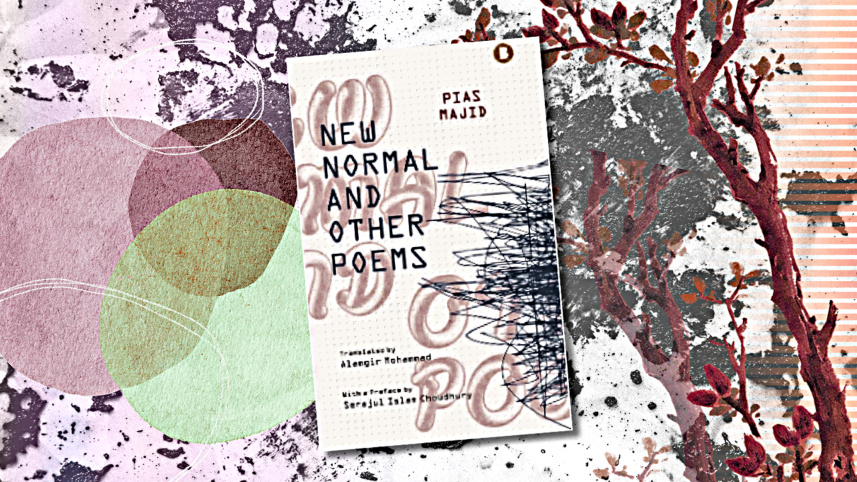
New Normal and Other Poems is a collection of poems by Pias Majid, translated into English by Alamgir Mohammad. Alamgir Mohammad, Assistant Professor of Bangladesh Army International University of Science and Technology of Cumilla, endeavoured to decipher the imageries and symbolisms of Majid’s poems and retain all those that remain after a language gets ‘lost in translation’. Professor Emeritus Serajul Islam Choudhury has penned a worthy preface of the book.

Personally I began reading Majid’s poems from 2006 when he was just a university student. 20 years passed by and he is still steady in his offerings to the Muse—the muse of poetry. Who is this muse, his “lady love”, who he can never reach as the path to her is a “shaky bridge” of the poet’s language?
New Normal and Other Poems mostly connotes a number of small but profound poems which seem like the faint songs of rustling leaves from a distant forest. For example, in “An Afternoon in the Naval”, the poet takes us away to the coastline of the azure seas:
From the blue strings of the sea,
you saw the sea birds flying.
You are tied up fast
to some held-up fog.
Suppose, in your chest
you carry the lives of many ships—
Their speed and destination have crossed away.
While browsing through this aptly translated collection of poems, any reader may feel a pang in their heart after reading metaphors that sway like grass. Like the whirling dance of the Sufis, the cycle of seasons shroud the woman’s words which she probably wished to tell him (from “Your Words”).
I, however, won’t deny the gradual changes Majid seems to undergo in his decades-long relationship with poetry. Poems in his earlier Bangla collections, like Nach Protimar Laash (Banglayan Books, 2009) or Marble Fol er Mousum (Oitijjhya, 2022), read like an impressionist painting with vibrant colours. On the other hand, his contemporary poems exhibit an association with today’s gadget driven world. The lines “In future we even wish to/ live-stream our deaths” from the poem “New Normal” may seem too simple but are striking. Sometimes his poems reminded me of paintings by Marc Chagal where “Our ancient love metamorphosed into ghosts-wearing the clothes of green” (“On a Late-Autumn Morning”). For that, kudos to the competence of Alamgir Mohammad as a translator.
Pias Majid uses a milieu of metaphors from Bangla folktales like “Chander Maa Buri”. “The Flickering Flame” reminded me of the late poet Shamsur Rehman’s autobiographical recollection of a childhood in old Dhaka. It is in this poem that the lines “The boats from the underworld/ that lost their sails in the sky” may make you recollect the much sung lines of Tagore song: “Dariye achho tumi amar/ gaaner opare/ batash bohe mori mori/ ar bendhe rekho na tori!” I wondered if these boats from the underworld depicted the river of the underworld in Greek mythology which Orpheus had to cross to get back his Euridyce.
Throughout the collection, the poet sometimes behaves sarcastically out of sheer jealousy towards his beloved when the woman leaves him for the land of yellow clothes and returns in the guise of a crocodile’s daughter (“Poem on Love”). Again the poet comes into very casual, everyday metaphors like storing “every bit of the evening’s sweetness” in the “pen drive” (“Aesthetics”). He seems also to get a bit philosophical as he stands in the race of life “as both a winner and a loser” (“Parlor”).
Pias opens up a kaleidoscope of all sorts of human emotions in his poems: melancholy, nostalgia, anger, frustration, humor and what not? For example, it was hard to resist my laughter after reading: “Those who cannot sleep at night/ fall asleep in the seminar” from the poem “Sleeping in the Seminar”.
This poet, in his early 40s, allows us to know that how every roar of the mud is the grace of soil and Alamgir Mohammad’s sharpness of both translation and trans-creation is bound to marvel any reader. The whole book seems to be too spontaneous and effortless as if penned in any original language.
With the advent of time, modern technology shapes our memoirs, nostalgia and human feelings in a different way. For example, in ‘It’s Not Suicidal,’ the poet narrates that how:
“After the death of our acquaintances, we open our messenger unconsciously: We try to recall our last conversation.”
Those who know this poet personally, are well aware of his passion for travel. This is why too smoothly he murmurs his travelogue of the Jainta hills in Sylhet where on the other side of the hill, not another country but Chandrabati of his locality husks rice (Jainta). Pias also tells us about tasting kebabs in one Kaba House near the grave of Ghalib in Delhi (Kebabi Poetry). Despite all the wanderings, the poet is finally the son from the banks of Gomti river:
 For all latest news, follow The Daily Star's Google News channel.
 “Like the devastating flood of 1988
dipping in your unruly water-
if I must die, let it be.” (Gomti).
Some of the poems in this collection, however, are impeccable:
‘You won’t open the door-
fearing this, I never
go to your home.’
His poems offer some real pangs like in Japanese Haikus or Tankas:
‘Suddenly, while laughing,
you hand over
a lifetime’s worth
Of tender tears!’
Finally I must utter a paragraph on his ‘November Rain.’
‘’Going to Mymensingh, I heard /you were to Jamalpur/ Reaching Jamalpur, I heard you had come to Melandah/Going to Melandah/finding no one/suddenly I went to Sherpur/from Sherpur to Dhaka, returning in failure, I came to realise-‘
These very lines remind us of late author Shahidul Zahir’s short-story ‘Kothai Pabo Tare?’ The name was actually borrowed by Zahir from Gagan Harkara’s widely acclaimed song. And then? Yes, our young poet and the star-crossed lover comes to realise : ‘on both sides of the roads, the fragrant flowers of going and returning,/ yours and mine-/had bloomed in full scent.’
As if there is nothing more to say and the curtains are drawn, the full stop is punctuated. As we have already understood the parallel journey of two souls who will never meet with each other but melancholy of their unrequited love still blooms in total fragrance. The last line reminded me of an Iranian movie where a young woman ultimately grows old simply through waiting for her lover each and every day in the same orange colored dress on a busy road of Tehran. Is she a mad woman or has lost her total sanity? Gradually the color of her dress gets faded, her face shows wrinkles and her hair grows white but her silent waiting never comes to an end. We never know the other part of the story. Has her beloved got married? Does he have kids now? Does he not feel for her? But this woman endures and waits- she waits with no expectation. She is neither violent, nor does she scream or yell at anybody. Her patient waiting is her only recognition or acknowledgement and no further reward is required. The movie began with the sentence: ‘In the name of love!’
The book possesses a good number of quotable lines. I, however, end with the following two lines:
‘We are disconnected by love,
yet we two ended up together.’
Audity Falguni is a writer, translator, poet and essayist. A law graduate from Dhaka University, Audity has served in a number of national and international NGOs, the UN, publishing houses and several newspapers. She has so far authored about 50 books, including short story collections, translations, collections of poems and essays, books for children and others. She has so far won four literary awards including the prestigious Prothom Alo Best Book Award in the Creative Writing category in 2011.
Comments