


Classified loan accounts double to nearly 46 lakh as retail defaults surge
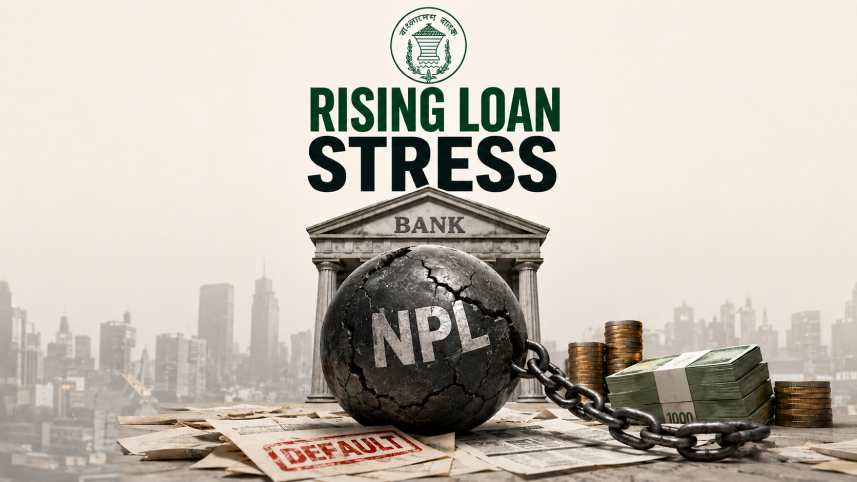
The number of classified loan accounts in the banking sector more than doubled in a year, reaching a staggering 45.83 lakh in March 2026, and the most dramatic surge was seen in retail loan accounts, according to the latest Bangladesh Bank (BB) report.
The number of accounts with classified loans of up to Tk 1 crore rose to 45.43 lakh at the end of March this year, marking a sharp rise from 21.63 lakh accounts a year earlier.

“This indicates a mass retail-level deterioration, which can stem from the rising cost of living and household indebtedness, a slowdown in SME activity, and weak repayment capacity in agricultural and small-trading segments,” said the BB in its report, "Banking Sector Update," published on July 23.
“Although high-value defaults create larger monetary shocks, the explosion in small-account defaults is a warning sign of widespread financial stress,” it added.
The central bank said overall nonperforming loans (NPLs) as a share of total outstanding loans increased to 32.7 percent in March this year from 24.6 percent a year ago and termed the rising NPL ratio alarming.
“Islamic banks and state-owned banks are particularly vulnerable, signaling weak credit discipline and possible governance issues. Foreign banks, in contrast, maintain very low default levels, reflecting stricter risk management,” the report said.
The BB said that, except for foreign banks and new banks that began operations in 2016 or later, classified loans at all banks — state-owned, private, and Islamic — rose between March 2025 and March 2026.
The report said that industry-wise classified loans show that the cottage industry exhibits the highest vulnerability, with a classified loan ratio of 52.8 percent, reflecting severe repayment stress among the smallest business entities.
The combined CMSME and informal sectors represent 21.4 percent of total loans but account for 34.2 percent of classified loans, indicating disproportionate credit quality concerns in these segments.
However, the large industry segment remains the dominant source of credit risk as it accounts for 58.7 percent of total loans and 39 percent of classified loans. This makes the large industry segment the biggest contributor to the banking sector's NPLs, the BB said.
Md Mahiul Islam, deputy managing director and head of retail banking at BRAC Bank, said the lack of proper credit risk appraisal might be one reason for the spike in classified loans for loan amounts of up to Tk 1 crore. A portion could be consumer and credit card loans. Here, high inflation and the erosion of purchasing power may be a factor.
“But our situation is better because we conduct credit appraisal based on customer’s risk appetite and regularly monitor clients,” he said, adding that the ratio of NPLs to retail and SME loans at BRAC Bank is less than 3 percent.
The BB said classified loan ratios increased across all industries, with trade, agriculture, and industry facing the highest risks between March 2025 and March this year.
Some 44.5 percent of total loans were concentrated in the industry sector as term loans and working capital, and the industry sector accounted for roughly 32 percent of the NPLs.
Of the total loans, the trade and commerce sector accounted for 32 percent. The sector's classified loans accounted for 43.8 percent of its total loans.
“This indicates deep-rooted stress in the real economy, possibly due to global economic challenges and weak financial discipline,” said the BB.
The central bank report said the banking crisis is primarily driven by “willful defaulters” and large corporate groups rather than small individual borrowers.
“This pattern may suggest weaknesses in credit appraisal and monitoring systems for high-value loans or the impact of sectoral and macroeconomic shocks affecting large borrowers.”
 For all latest news, follow The Daily Star's Google News channel.
Comments