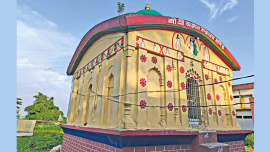
Republic of the footpath
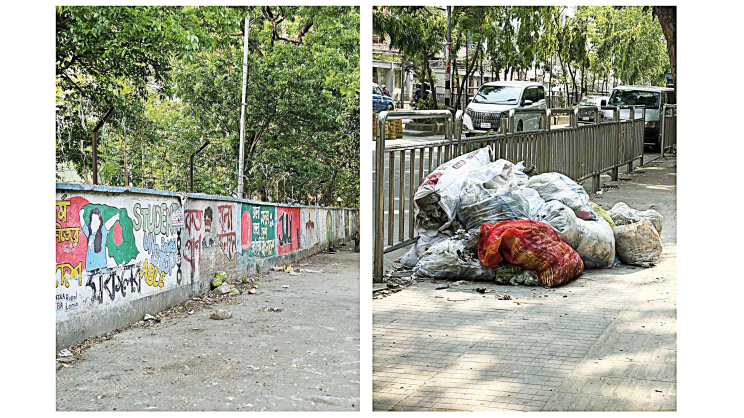
A few weeks ago, I was walking home from the office in Gulshan—I still prefer to walk whenever I can—when I noticed a young boy riding a bicycle, with an older man a few steps behind him, keeping a careful eye on the child. His grandfather, I guessed. I walk that stretch often and had long stopped noticing it. That afternoon, following the two of them, I saw this street for the first time in a long while. Construction debris across the footpath. A loose electric cable. Broken tiles that a small wheel could not cross. For me, an adult, none of this was anything. For a child and an old man, each was a negotiation, until the footpath left them no choice and they stepped down into the moving traffic and walked there instead. They reached the Gulshan Society park in the end, where the boy could finally ride free—”well filtered”, duly admitted. But between their home and that gate, the city had offered them almost nothing. And the little it did offer, it offered to someone like me: an able-bodied man.
I have carried two questions from that short walk, and I have come to believe they are the same question. How do we move through our city? How do we appear in it, on foot, in the open, among others? And when we arrive somewhere, is that “somewhere” genuinely open to everyone, whatever their age, gender, class, or body?

For the last few years, my colleagues at the Bengal Institute—young urban professionals among them—and I have been trying to answer these questions on foot. This April, ten of us spent a month walking three connected streets in Mohammadpur—a market road, a residential alley, and a tree-lined pedestrian lane—watching how people used them and asking the people themselves. We called the study “The Making of Publicness”. Of each street, we asked three simple questions: Is it safe? Is it comfortable? Is it inclusive—open to everyone? These words sound too plain for a planning report. But they are the exact difference between a space you merely pass through and a space you can belong in.
What publicness means
Let me say plainly what I mean by publicness, because it is the idea our planning most needs and least uses. Publicness is the “quality of a space” that lets us appear to one another as members of a shared world—to walk, sit, wait, talk, sell, loiter, be seen—without permission and without payment. It is where a crowd of strangers becomes a public. Streets, footpaths, squares, parks, and riverbanks.
Professor Kazi Khaleed Ashraf calls the love of a city found on foot metrophilia: “Our most intimate engagement with the city,” he writes, “is in walking.” Against it he sets phallophilia—our infatuation with the tall, the erect, the standalone: the flyover, the tower, the project that cares almost nothing for the life at its feet. Dhaka has become a phallophilic city. And the sidewalk, which Prof. Ashraf calls “the supreme mark of the civility of a city”, has become the clearest measure of how little we think of the pedestrian and their humanity.
Urbanist Jane Jacobs said it bluntly: streets and their sidewalks are a city’s most vital organs. If public space is the heart, the street and the footpath are the skeleton that holds it in place. Break the skeleton, and the organs fail, however grand they look on a plan.
We do not even have a comfortable word in Bangla for all this. Gonoporishor comes close, but it does not carry the warmth and intimacy of the thing itself: the adda under a tree, the pond-side evening, the lane where children play within sight of home. And we are drifting from that warmth. Fewer and fewer places remain where we simply are, together, with no transaction to justify our presence. And if we do not educate ourselves about it, the failure does not stay out on the street—it settles into our sensibility, and in the end it shapes even the democracy we hope to become.
A budget is a confession
In the Annual Development Programme for 2026–27—the list of approved, funded projects—the Roads and Highways Division alone carries 102 projects, and the Local Government Division, which builds most of our urban infrastructure, carries 196. Search either list for the pedestrian, and there is nothing. “Footpath” appears only as the tail of an engineering phrase—”internal roads, drains and footpath”—never the thing a project is actually for. The single purely pedestrian item in the entire funded programme is an underpass at an airport, built not to welcome the walker but to move them out of the way of vehicles. What passes for a “park” is mostly a hi-tech park, an industrial park, or a safari park. The few genuine public spaces I could find—a neighbourhood park at Sher-e-Bangla Nagar, another at Farmgate, and a modest study to green the bank of the Turag—sit almost entirely in the wishlist: the register of things we have imagined but chosen not to fund. The car gets the budget; the public realm gets the wish.
And consider who we are building for. Roughly one Bangladeshi in ten is over sixty today; by 2050, it will be more than one in five. The able-bodied adult who steps so easily over the debris—me, perhaps you—is the elderly walker of tomorrow. And more than a million persons with disabilities already live in this city, in a public realm so built around the able-bodied that most of them cannot come out into it at all. Publicness is the right to appear, and we have quietly denied it to a million of our own.
The city already walks
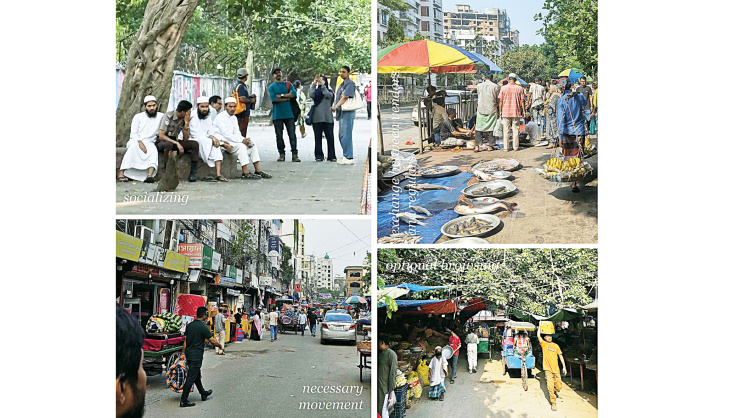
Here is the irony at the centre of it. Dhaka does not need to be persuaded to walk—it is already walking. Some 62 percent of all daily trips in this city are made on foot. That does not mean we built a walkable city. It means people are reclaiming it through daily “negotiation”. Walking holds the single largest share of any mode, used disproportionately by the poor, by women, and by the old. A survey across six areas of Dhaka found that 44 percent had no footpath at all, and that 82 percent of those that existed were in poor condition.
In our field survey in Mohammadpur, on the market street adjacent to the Town Hall, seventy percent of users told us they preferred to walk it, even as three in four complained of congestion and 85 percent said it was impossible for a person with a disability: no ramp, no even surface, no crossing. On the residential alley, sixty percent rated it poor for walking, and eighty percent said it was unsafe for a child to play there alone. And on the Aurangajeb Road pedestrian lane, people gave their highest marks for one reason above the rest: the great canopy of trees that shades it. Ninety-four percent named those trees. How we prefer comfort above all—and how rarely anyone has asked us about it.
One finding ran through all three streets, and it is the most troubling. By day, the market street feels safe not because of policing or lighting but because it is “full”—what Jacobs called eyes upon the street; eight in ten of its users called it safe, with no formal security in sight. But that safety disappears with the crowd. On the connecting streets, people feel less safe as the light fades. Four in ten are uneasy by evening. Six in ten, by night. Not one person called it fully safe. And those they named as missing were, every time, the same: the women, the children, the elderly—those for whom the street was never made safe enough to stay. A city where half its people cannot comfortably walk after sunset is a city of selective belonging, and the selection is made by gender, by age, and by body.
The publicness we already make and the poverty we carry
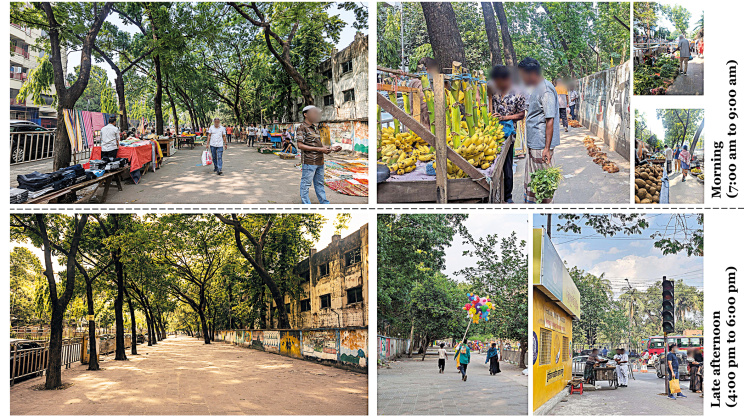
However, Dhaka is not empty of public life. It is full of it. We simply make it ourselves, informally, out of streets built for other things. Each morning, that pedestrian lane becomes a vegetable market: three of every four people passing stop and stay. By afternoon, barely one in fifteen does. The same pavement, two different publics—made and unmade by the people themselves. William H. Whyte, watching the plazas of New York for years, found that what draws people to a space, above all, is other people. Our streets prove him right daily: the truest gathering places we found were not the shops but the tong and the bot-tola, where people come not to buy but to be near one another.
And these spaces, we found, are not really separate. The market road, the alley, the shaded lane—we set out to study them one by one and found they work as a single connected public realm, a territory the neighbourhood moves through as one body. The people who use it do not experience three places; they experience a route, a daily sequence stitched together by the street itself. This is the deepest reason walking and publicness cannot be divided. Connectivity—the humble, continuous footpath—is the skeleton on which public life is hung.
Look at where our streets are genuinely inclusive—the morning market that fills with women, the lane where children play within sight of home, the platform under the tree where every kind of person gathers—and you will find, every single time, that these are the spaces people made for themselves. Meanwhile, the wide, formal, well-connected node we might have designed for everyone welcomed, in practice, almost exclusively. The messy, self-made places welcomed all.
And when we asked people what they wanted, no one asked for a new space at all. They asked for the ones they already had, but wished for some basic amenities—a lamp, a bench, an even surface, a safe crossing.
 For all latest news, follow The Daily Star's Google News channel.
 Here, then, is a poverty we never speak of: the sheer scarcity of good, safe, welcoming places simply to be. It is a poverty we are manufacturing and handing forward—a childhood with no lane to play in (forget the playground; it is already a fantasy), an old age with no bench to rest on, a public life shrunk to the size of a mall’s food court, or an indoor children’s play zone rented by the hour for the upper middle class or those who can afford it.
Not a budget, but the will
Safety and comfort are the state’s responsibility. They require more lighting to keep lanes open after dark, seating, crossings, even surfaces that wheelchairs can navigate, proper drainage, and trees left standing for their shade. These are matters of maintenance and protection—the ordinary duties a city owes anyone walking in it. We do not need any grand ideas: a lamp, seating, a ramp, a safe crossing, and shade are not beyond the wit of a nation that can build a metro.
Inclusiveness—the third factor, and the one we most misunderstand—cannot be installed. It is what appears, on its own, when a space is made by the very people who use it.
So what do we truly need? A larger budget? I do not think so. We already have the spaces—the lanes, the riverbanks, the leftover grounds, the markets, and the streets. What we lack is the will: the will to provide the safety and comfort that only the state can, and then the will to step back and let our own people make the rest their own. Policy should be the facilitator, not the master. Light the lane, pave it, keep it safe; then trust the neighbourhood to fill it with life. It is an almost embarrassingly simple arrangement, and perhaps that is why we distrust it—we have been trained to believe that anything worth doing must be large, expensive, and erect.
Only weeks ago, the Supreme Court of India declared the right to walk a fundamental right, ruling that pedestrians must take priority over vehicles—a judgment born from the death of a five-year-old on his way to school. Our failure, the court said, is that “wheels eclipsed our imagination.” Sweden reached the same conclusion decades ago and made it a system: responsibility for a safe street rests with those who design it, not only with the person walking on it. That is the conversation we have never honestly had. Until a name can be attached to the broken tile, or to dysfunctional streets, our wishlists will keep skipping the pedestrian.
Want to deal with Dhaka’s traffic too? Make this city walkable and bikeable. For short journeys, footpaths and bike lanes are the cheapest solutions we have. Let our children and senior citizens walk and stroll. Because a city is not measured by how its powerful arrive, but by how its weakest can walk.
Arfar Razi, a planner, geographer, and Fulbright Scholar, was a member of the Pedestrian Advisory Council of the City of Austin, USA. He coordinates the Academic Programme at the Bengal Institute for Architecture, Landscapes and Settlements. Several analyses and visual materials presented here were collectively developed during “The Making of Publicness” workshop 2026, organised by the Bengal Institute with participation from diverse contributors.

The dreams of girls in a Bangladesh river char
Can Bangladesh bring back the Chakaria Sundarbans?
Who protects women in Bangladesh's gig economy?
Bangladesh’s climate-displaced / From lost homes to life in Dhaka’s slums
Buried by development: The human cost of river dredging in Dumuria
Char contracts: Surviving river erosion without the state

When extreme heat becomes a death trap for Bangladesh’s workers
The slow disappearance of Kuakata’s Rakhines
The cost of conservation in the Sundarbans