


Fuel import bill jumps 85% amid Middle East conflict

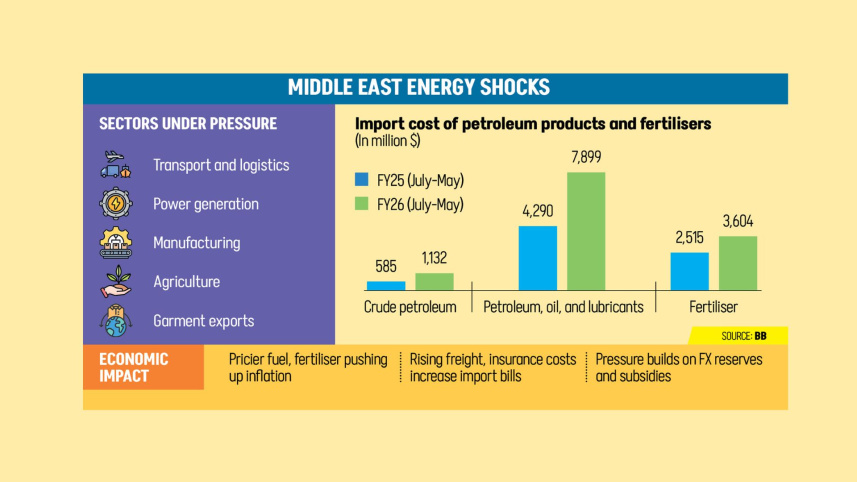
Bangladesh spent 85 percent more on fuel imports in the first 11 months of the recently concluded fiscal year 2025-26 as higher global energy prices due mainly to the war in the Middle East pushed up the country’s import bill.
The cost of importing crude oil rose 93 percent year-on-year to $1.13 billion in the July-May period. Spending on petroleum products, oil and lubricants climbed 84 percent to $7.89 billion over the same period, according to Bangladesh Bank (BB) data.

The latest data on import volumes are not publicly available. However, the Bangladesh Petroleum Corporation (BPC) had projected the country’s fuel oil demand at 74 lakh tonnes for the last fiscal year.
Bangladesh imports about 95 percent of the petroleum products it consumes each year and nearly one-third of its gas. Around 60-65 percent of its crude oil and 55-60 percent of its liquefied natural gas (LNG) come from the Middle East, according to a World Bank report published in June.
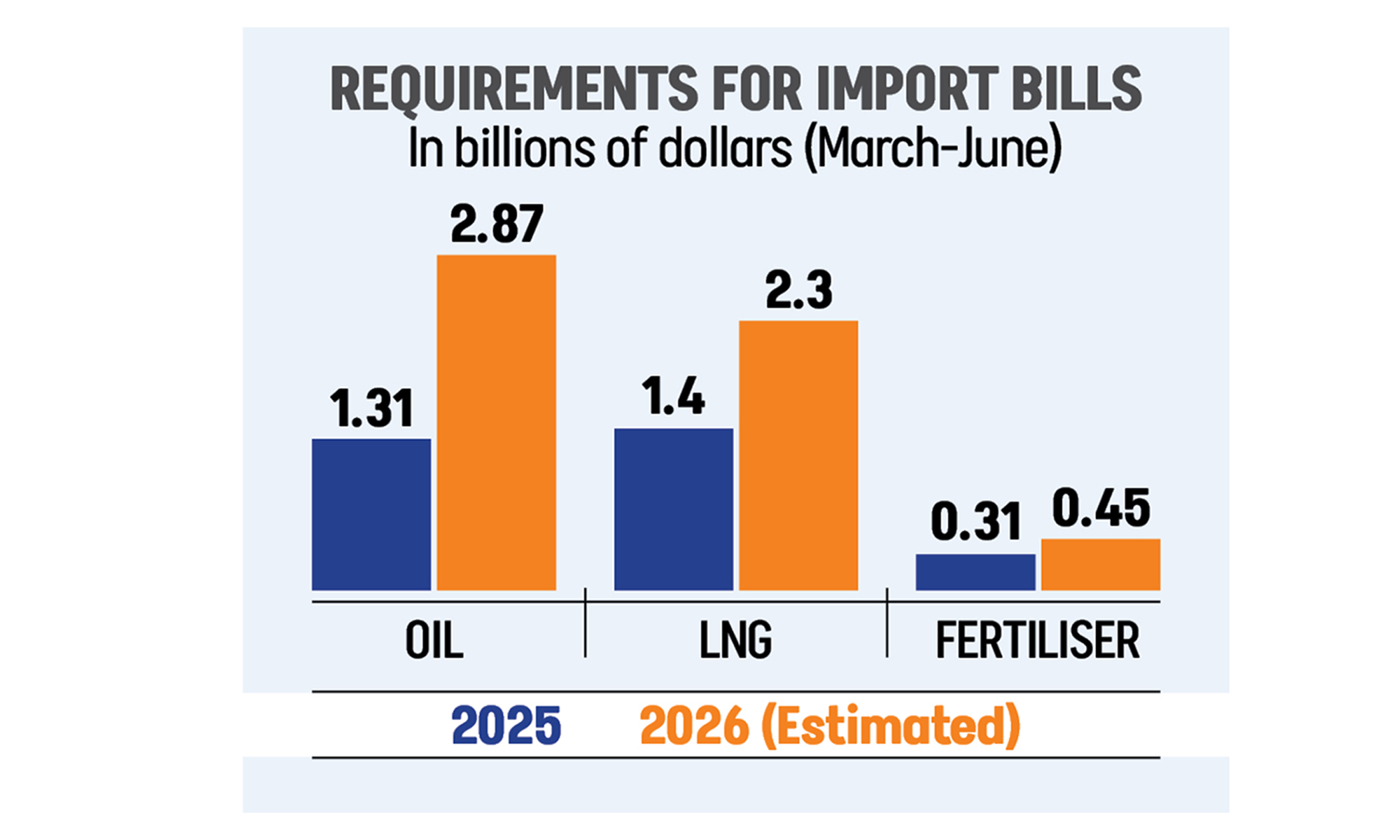
Saudi Arabia, the United Arab Emirates and Qatar supply most of the country’s fuel.
The rise in import costs has added to concerns as renewed conflict in the Middle East in early July has pushed oil prices higher and raised fears over energy supplies.
“The renewed conflict could affect Bangladesh through several interconnected channels,” said Selim Raihan, executive director of the South Asian Network on Economic Modeling (Sanem).
Those are higher fuel and fertiliser prices, rising freight and insurance costs, possible shipping disruptions, weaker export demand, and pressure on remittance flows from the Middle East, said the economist.
He said the result could be a larger import bill, renewed inflation, greater pressure on foreign-exchange reserves, and weaker household purchasing power.
A Sanem research suggests that a combined shock from higher energy prices, freight disruptions, weaker exports and lower remittances could reduce the country’s GDP by around 3 percent, cut exports by nearly 6 percent and lower real wages by more than 2 percent, while pushing consumer prices up by more than 6 percent.
“These are scenario estimates rather than forecasts,” said the Sanem executive director, adding, “They show the scale of Bangladesh’s exposure.”
In its June report, the World Bank said that the conflict has already disrupted energy markets. Five of state-owned Petrobangla’s six LNG supply contracts had been declared force majeure, while spot LNG prices had risen to $24-$28 per MMBtu (metric million British thermal unit), more than double previous levels.
The multilateral bank projected Bangladesh’s energy subsidies would rise to 2.8 percent of GDP in FY26, with the total subsidy bill reaching between $2.5 billion and $4.8 billion, up from about $1.5 billion to $2.5 billion in recent years.
That would leave less room for social spending and emergency support.
“These pressures are also contributing to disruptions in power generation, domestic fertiliser production, and industrial activity,” said the World Bank, which has approved $350 million to strengthen Bangladesh’s energy security.
Last month, Finance Minister Amir Khosru Mahmud Chowdhury told parliament that subsidies for oil, gas, electricity and fertiliser alone would require an additional Tk 42,600 crore in FY26 because of the war in the Middle East.
Apart from the increased subsidy pressure, the rise in oil prices is affecting Bangladesh through three main channels -- higher inflation, increased costs for industry and agriculture, and greater pressure on the balance of payments (BoP).
“The greatest pressure is likely to fall on transport and logistics, power and gas, energy-intensive manufacturing, construction, fertiliser-dependent agriculture, food processing, and export-oriented sectors such as RMG,” said Selim, who is also an economics professor at Dhaka University.
 For all latest news, follow The Daily Star's Google News channel.
He said, “Higher diesel, gas, electricity, fertiliser, and shipping costs would raise production costs across the economy and could quickly pass through to food and consumer prices.”
Fertiliser imports have also become more expensive as the war has disrupted production and supplies.
Bangladesh spent $3.60 billion on fertiliser imports during July-May of FY26, up 43 percent from a year earlier, adding to pressure on the country’s external balance.
The World Bank said Bangladesh’s farming sector depends heavily on fertiliser, using nearly 392 kilograms per hectare, more than twice the global average.
That makes food production highly vulnerable to disruptions in global fertiliser supplies and price swings.
The country depends heavily on imported urea, diammonium phosphate, triple super phosphate and muriate of potash. Domestic urea production also relies on a stable supply of gas, the report said.
The conflict has already disrupted that system. Five of the country’s six urea plants have been shut because of gas shortages, while urea prices have risen by about 30 percent. Prices could double if disruptions continue, the report added.
Meanwhile, Selim said the government should secure enough fuel and fertiliser, diversify suppliers and shipping routes, build strategic reserves and ensure enough foreign currency for essential imports.
He said support should be targeted and temporary, focusing on public transport, irrigation, small farmers, essential food supply chains and vulnerable households.
At the same time, he said the crisis should be used to speed up investment in renewable energy, reduce transmission losses, improve industrial energy efficiency and cut long-term dependence on imported fossil fuels.
Comments