


Rewiring Economies from East to West through QR Code
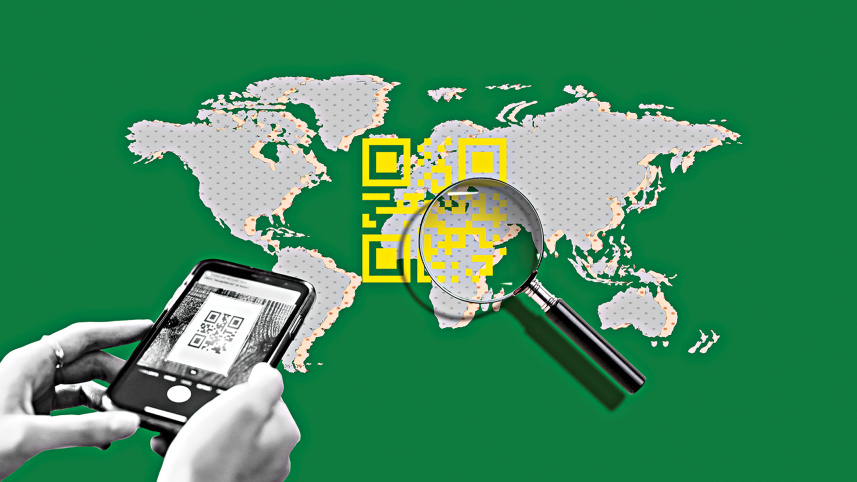
As countries race toward cashless economies, the success of China’s Alipay, India’s UPI, Brazil’s Pix and Thailand’s PromptPay reveals a common lesson: digital payment infrastructure matters more than any individual app. For Bangladesh, the implications could be profound.
In New Delhi when a tea seller serves dozens of customers only few reach for cash. Many pull out their phones, scan a QR code taped to a weathered kettle and make the payment. Thousands of kilometres away in Shanghai, commuters emerge from a metro station without touching a wallet. In São Paulo, a street vendor selling fruit receives payment instantly through a printed QR code hanging from a cart. Similar scenes now play out millions of times every day across Asia and Latin America.

Just a decade ago, cash dominated daily transactions. Card payment infrastructure was often expensive or inaccessible for small businesses. Digital payments were largely confined to banks, large retailers and affluent urban consumers. The Quick Response, or QR, code was never designed to change finance. Developed by the Japanese company Denso Wave in 1994 to track automotive components, it was originally intended to improve efficiency in manufacturing. Yet three decades later, QR codes have become a foundation of modern commerce. They have enabled digital payments to spread far beyond shopping malls and corporate chains into local grocery stores, roadside stalls, taxis, farmers’ markets and informal businesses.
From China’s Alipay and WeChat Pay to India’s Unified Payments Interface (UPI), Brazil’s Pix and Thailand’s PromptPay, the world’s most successful payment systems share a common principle: they reduce friction. They make moving money easier, faster and cheaper.
China’s Payment Laboratory
No country demonstrates the scale of the QR payment revolution more vividly than China.
At the beginning of the 2010s, China stood at a unique moment in its economic development. Smartphone adoption was rising rapidly, but traditional card infrastructure remained relatively underdeveloped compared with many Western economies. Rather than following the conventional path from cash to cards and then to mobile payments, China effectively leapfrogged the card era. The transformation was driven largely by two technology giants: Alibaba and Tencent. Through Alipay and WeChat Pay, they introduced mobile payment systems that required little more than a smartphone and a QR code.
China’s small merchants faced a practical problem. Card terminals were expensive. Installation could be cumbersome. Transaction fees were often viewed as burdensome. QR payments offered a dramatically simpler solution. A merchant could print a code, place it on a counter and begin accepting digital payments almost immediately. Today, QR payments are woven into nearly every aspect of Chinese life. Vendors in rural villages accept digital payments for vegetables and livestock. Even donations to temples are increasingly made through mobile payments.
The economic effects have extended far beyond convenience. Millions of small businesses that once operated entirely in cash gained access to electronic transactions. Digital payments accelerated the growth of e-commerce, food delivery platforms and ride-hailing services. Perhaps most importantly, digital transaction histories created valuable financial records. Small businesses that previously lacked formal documentation could demonstrate revenue streams and transaction volumes, improving their ability to access loans and financial services.
Yet China’s experience also highlights the challenges that accompany success. As Alipay and WeChat Pay grew dominant, regulators became increasingly concerned about competition, consumer data and systemic risk. The concentration of financial information within a small number of technology firms raised questions about privacy, market power and regulatory oversight.
India’s UPI: A Public Utility for Payments
Instead of allowing competing payment platforms to build isolated ecosystems, India created a shared public infrastructure known as the Unified Payments Interface, or UPI. Launched in 2016 by the National Payments Corporation of India, UPI functions as a common payment rail connecting banks, fintech companies and consumers.
Rather than forcing users into a single application, it enables multiple apps to operate on the same infrastructure.
A consumer can use Google Pay, PhonePe, Paytm, BHIM or numerous other applications. A merchant only needs one QR code. Every participant remains connected through the same underlying network. The results have been extraordinary. According to India’s Press Information Bureau, UPI processed approximately 220 billion transactions during 2025. Monthly transaction volumes exceeded 20 billion transactions for the first time, making UPI one of the largest real-time payment systems in human history.
Yet the significance of UPI lies not merely in its scale but in its inclusiveness. In major cities, multinational retailers use UPI. In small towns, vegetable vendors use UPI. Street-side tea sellers, pharmacists, taxi drivers and neighbourhood shops all participate in the same payment ecosystem.
The barriers to entry are remarkably low. This widespread accessibility has produced broader economic benefits. Digital payments encourage greater use of bank accounts, helping expand financial inclusion. Small businesses gain access to formal transaction histories. Consumers benefit from reduced transaction costs and greater convenience.
Brazil’s Pix: Instant Payments for an Entire Nation
When Brazil launched Pix in November 2020, many observers expected gradual adoption. What followed surprised almost everyone. Developed by the Central Bank of Brazil, Pix allows users to send and receive money instantly, 24/7. The system was designed to reduce transaction costs, improve efficiency and expand access to digital finance.
Within a few years, it fundamentally altered how Brazilians move money. According to the Central Bank of Brazil, more than 170 million people have used Pix. For a country of roughly 215 million people, that represents one of the fastest payment-adoption stories ever recorded. The reasons for its success are simple but powerful. For consumers, Pix eliminated many frustrations associated with traditional banking.
The impact on financial inclusion has been substantial. Millions of Brazilians who previously interacted only marginally with formal financial systems became active users of digital payments. Pix also revealed an important economic reality, convenience can be transformative.
 For all latest news, follow The Daily Star's Google News channel.
 Thailand’s Quiet Digital Success
Unlike China or India, Thailand rarely dominates global conversations about financial technology. Yet its experience may be one of the most instructive. Launched in 2017 under the National e-Payment initiative, PromptPay sought to simplify digital transactions by allowing users to transfer money using mobile phone numbers or national identification numbers. A crucial element of its success was the introduction of a unified national QR standard. Consumers did not need to worry about which bank a merchant used. Merchants did not need to display multiple payment systems. Everyone participated within the same ecosystem.
The simplicity proved powerful, enabling QR payments to become ubiquitous across Thailand—from major retailers and restaurants to street-food vendors and market stalls, while government agencies increasingly use the system for welfare distribution and other public services.
Economic Benefits of Digital Payments
The impact of QR payment systems extends far beyond convenience. One of the most significant changes occurs within the informal economy. Across developing countries, millions of businesses operate with limited documentation and little interaction with formal financial institutions. They may be profitable enterprises, but without transaction records they often struggle to obtain credit or access financial services.
Digital payments begin to change that reality. Every transaction leaves a trail. Over time, these records create a financial identity. Small businesses can demonstrate revenue patterns, customer activity and business stability. Financial institutions gain new ways to assess risk.
This process can gradually unlock access to loans, insurance and investment opportunities. The benefits also extend to governments. Cash is expensive. Notes must be printed, transported, secured and replaced. Businesses spend time handling, counting and reconciling physical currency. Digital systems reduce many of these costs while improving efficiency.
Governments also gain greater visibility into economic activity, which can improve policymaking and the delivery of public services. Another increasingly important factor is data. Every digital payment generates information about economic behaviour. This data helps businesses understand consumers, helps lenders evaluate borrowers and helps governments design targeted financial programmes.
Infrastructure Matters More Than Apps
Despite their differences, China, India, Brazil and Thailand all arrived at a similar conclusion. Infrastructure matters more than applications. Consumers may prefer different payment apps. A successful system ensure that everyone can interact frictionlessly. Fragmented payment ecosystems create friction. Globally, policymakers are realizing that unified payment infrastructure is more important than individual apps.
A Way Ahead for Bangla QR
Bangladesh has already made impressive progress in digital finance. Mobile financial services have transformed how people send money, receive remittances and conduct transactions. Smartphone adoption continues to rise. QR-based merchant payments are becoming increasingly common. The standardised Bangla QR holds immense potential to drive Bangladesh’s financial transformation.
The key issue is interoperability. Consumers should be able to use any participating bank or financial application to pay any merchant. For this all the stakeholders need to address this transformation ina collaborative approach. If these conditions are achieved, the economic benefits could be significant. Most importantly, Bangladesh could create the foundations for a more connected digital economy.
Comments