


Bengal’s forgotten slave trade

We tend to equate economic growth with social and political vitality in conventional history-writing, but this was not the case in southeast Bengal. Environmental pressures led to a social crisis in the seventeenth century, manifested through slave raids by a Portuguese-Arakanese combine (Magh). Subsequent slave trading by Arakan and Portugal, and later by the Dutch East India Company (VOC), unveiled the paradox of social breakdown during a period of economic growth, as the active delta generated new rice-producing lands.
The Europeans did not introduce slave trading into Bengal. A robust trade in eunuchs, sourced from Sylhet, supplied markets in West Asia and China until the Mughal emperor Jahangir put an end to it.

An even older trade existed. Dry-zone Burma’s medieval landlocked Bagan (849 to c. 1287) had a state-driven religious policy, a state-directed labour system, a state-sponsored building programme and state-administered trading practices. A slave-owning society, its inscriptions mention Assamese and Bengalis settled there from Pattikera in Comilla. Comilla housed the Buddhist complex of Mainamati-Lalmai, with which Bagan had connections. An inscription dated 1164 states that six ‘Indian’ slaves were exchanged for one elephant, and 40 slaves were exchanged for one horse. Kachin, Karen, Arakanese and ‘Indians’ formed part of a labour force subordinate to Burmans, Mons and Shans. As Angkor’s dependency in the twelfth century, Bagan came under Khmer influence, which spread to the southeast. The second Bhatera plaque of the Buddhist Chandras, dating from the late eleventh to the early twelfth centuries, contains 32 lines in Sanskrit in a proto-Bengali script. It is similar in style to the Khmer plaques of Cambodia.
Despite our fascination with Magh raids, accounts of which are immortalised in folk literature, Bengal did not witness a large-scale slave trade. For example, between 1659 and 1661, according to VOC statistics, the Coromandel Coast exported some 8,000 to 10,000 slaves, as opposed to just over 900 from Arakan and Bengal. The slave trade was short-lived, as the rate of amortisation was too slow. In 1682, Dutch Governor-General Cornelius Speelman announced that the VOC would withdraw from the slave trade in Arakan because there were no more slaves to be had.
Between 1626 and 1662, according to Markus Vink, the Dutch regularly exported between 150 and 400 slaves annually from the Arakan-Bengal coast. The years 1647 and 1655 saw the highest numbers: 1,046 and 1,803 respectively. During the first 30 years of Batavia’s existence, Indian and Arakanese slaves provided the main labour force at the company’s Asian headquarters. For instance, of the 211 manumitted slaves in Batavia between 1646 and 1649, 126 (59.71%) came from South Asia, including 86 (40.76%) from Bengal.
The following figures, calculated by Wil O. Dijk, relate to the Dutch slave trade in the Bay.
(1) Bay of Bengal slaves: percentages of men, women, boys, girls and infants.
Men 63.0%; Women 30.6%; Boys 2.7%; Girls 2.6%. Note that these figures refer to the total number of slaves traded in the Bay.
(2) Bay of Bengal slaves per decade: 1620s – 9,072; 1630s – 2,094; 1640s – 9,091; 1650s – 2,509; 1660s – 4,119.
(3) Slaves sold from Arakan per decade (note that these were Bengali slaves): 1620s – 2,005; 1630s – 1,566; 1640s – 3,555; 1650s – 2,385; 1660s – 2,045.
(4) Price of Pipli (Bengal) slaves in Dutch guilders (ƒ): Men ƒ17 to ƒ20 each; Women ƒ14 to ƒ25 each; Boys ƒ17 to ƒ19 each; Girls ƒ14 to ƒ17 each. Note that in Bengal a poll tax of just over one guilder was levied on each slave.
The Portuguese preceded the Dutch in the slave trade. In the 1620s, several thousand peasants and artisans from southeast Bengal were taken to Arakan. Others were exported down the Coromandel Coast and up the Malabar Coast towards Goa and points farther west. Hugli, Pipli and Arakan’s Mrauk-U became important slave marts, as well as ports for the transshipment of captives southwards and westwards to San Thome, Goa and other points along the Indian coastline.
The Iberian slave trade from Bengal accelerated when the Portuguese and Spanish crowns were united (1580 to 1640). Slaves shipped from the Portuguese colonies in India, Melaka or Macao were given a rainbow of appellations: Mogo/Moco (Mughal/Magh), Chingala, Pegu (Burmese), Bengala, Parachi, Patanes and Malabar. These terms create difficulties for scholars tracing the origins of previously manumitted slaves.
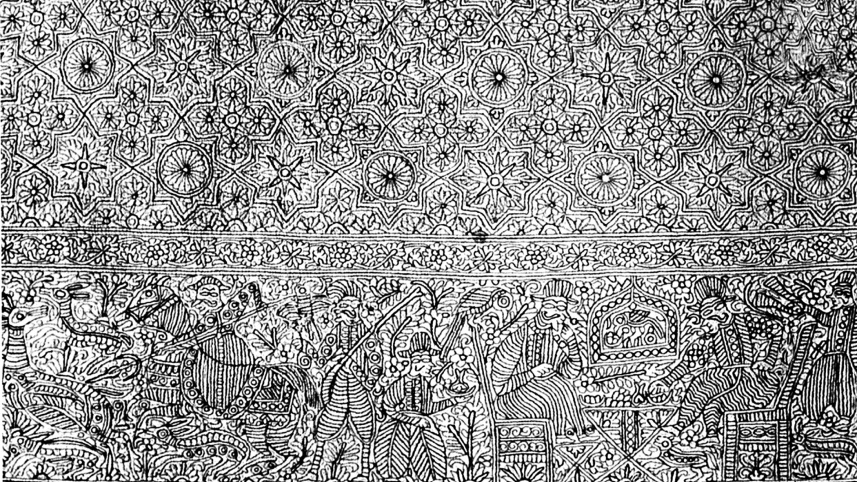
The Mexican archives tell us that Bengali women slaves were especially prized for their dexterous needlework. In 1629, the Portuguese missionary Sebastian Manrique wrote, ‘Among the more important commodities dealt in by the Portuguese in Bengal are very rich back-stitched quilts (colchas)…, bed-hangings, pavilions, and other curious articles worked with hunting scenes’. These quilts, colchas or ‘Bengalla’ quilts, destined for the European market, were made in seventeenth-century Hugli and Satgaon, and probably the needlewomen who decorated them formed part of the captives who were shipped all over.
Why was there a renewed slave trade at this time? According to the historian Anthony Reid, the sixteenth-century Bay saw a boom in trade, but this boom translated into decline and crisis by the seventeenth century. Social contraction was reflected in a vigorous slave trade, which soon became an official trade. Slaves were used as skilled workers to produce goods for international trade, particularly for the textile and bell-metal industries, which would bring in much-coveted silver. Slaves were also in demand for employment in public works, armies, and household work across Southeast Asia.
From the mid-seventeenth century, slave raids in Bengal assumed alarming proportions, and the trade became linked to a wider network in which Sumatra’s Achin, the city-state administered by a ‘Virgin Queen’, became a premier slave port and mart. The traveller Thomas Bowrey noted ships carrying captive children from Bengal arriving there in the 1670s. Ships from Borneo and Macassar brought captives to Achin. A necklace of slave ports radiated from Pipli, Hugli, Balasore, Sagor, Sandwip and Chittagong towards Achin, Kedah and Johor.
The trade created a desolate landscape in Bengal. The East India Company official Streynsham Master wrote on 8 September 1676: ‘This day we passed by the River which goes to Chittygom and Dacca, which the English call the River of Rogues, by reason the Arracaners used to come out there to Rob…’.
Bowrey noted: ‘Many isles there be in the mouth of the Ganges, not inhabited more than with wild beasts ... the natives much dreadinge to dwell there, being timorous of the Arrakcaners with their Gylars who many times have come through the rivers and carried away captive many poor families of the Orixa folks’.
Another contemporary, François Bernier, wrote: ‘They scoured the neighbouring seas in light galleys, called galleasses, entered the numerous arms and branches of the Ganges, ravaged the islands of Lower Bengal, and often penetrating forty or fifty leagues up the country, surprised and carried away the entire population of villages on market days...(or) a marriage. The intruders made slaves of their unhappy captives…It is owing to these repeated depredations that we see so many fine islands at the mouth of the Ganges, formerly thickly peopled, now entirely deserted by human beings, and become the desolate lairs of tigers and other wild beasts’.
When Fray Sebastian Manrique toured the southeast between 1629 and 1643, he found Dakhin Shabazpur, part of Baro Bhuiya Pratapaditya’s domain only some three decades earlier, already deserted as a result of Magh raids. Around 1670, Bakla, a flourishing settlement with pucca houses and cultivated lands yielding high revenue from its betel-nut acreage, was left desolate by the raids. With the encroachment of salt water, much of the land had become unreclaimable. But raiding continued through the marshlands and the semi-moribund channels. William Hedges, who succeeded Master as the English Company agent in Bengal, noted the decline in habitation and trade on 15 December 1684: Sagor, once a flourishing revenue-paying island, had become a ‘wild land’.
 For all latest news, follow The Daily Star's Google News channel.
 The Mexican archives tell us that Bengali women slaves were especially prized for their dexterous needlework. In 1629, the Portuguese missionary Sebastian Manrique wrote, ‘Among the more important commodities dealt in by the Portuguese in Bengal are very rich back-stitched quilts (colchas)…, bed-hangings, pavilions, and other curious articles worked with hunting scenes’. These quilts, colchas or ‘Bengalla’ quilts, destined for the European market, were made in seventeenth-century Hugli and Satgaon, and probably the needlewomen who decorated them formed part of the captives who were shipped all over.
While Arakanese-Portuguese bands organised the raids in the southeast, the Portuguese alone seem to have organised the slave trade in the west. The Mughal chronicler Shihabuddin Talish noted that the Portuguese drove stakes through the prisoners’ hands and kept them trussed like chickens in the ships’ holds until they could be sold. Tambolim (Tamluk) became an important slave port and mart. Captives were sold at Tamluk’s Naraghat (the landing stage for human captives). The documented and well-organised Naraghat Bazaar (human market) attests to this flourishing trade. Because the trade was outlawed, the raiders remained on ships anchored midstream in the Rupnarayan River. Buyers sent the purchase money across from the shore. Brokers, passing from shore to ship and back, conducted the sales. So pervasive is the memory of this malign trade that Tamluk still has a Naraghat Bridge.
But contrary to our preconceptions, slavery also accelerated capital formation, shipping and urbanisation. Take, for example, the case of the Chittagong coast. Manrique, who travelled in the East from 1628 to 1643 and was particularly active in proselytising in Arakan, noted that during a five-year period two formerly small centres, Angarcale and Dianga, handled 18,000 new slaves. As a result, these small fishing villages grew into urban centres. His observation is borne out by the figures cited above, which reveal that the 1620s and 1640s saw the greatest numbers in the Dutch slave trade, both in the Bay as a whole and from Arakan.
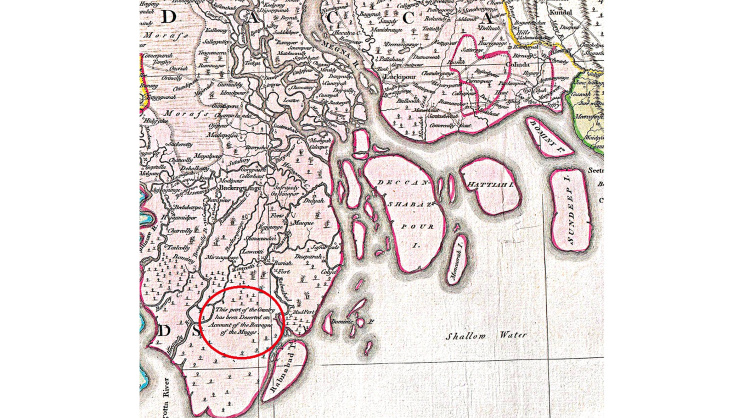
By the eighteenth century, raids had reached unimaginable proportions. The English Company’s business in Dhaka was seriously affected in 1748. James Rennell’s maps of 1771 and 1778 showed southeast Bengal, particularly Dakhin Shahbazpur or Bhola Island, forlorn and covered by forest. ‘This part of the Country’, runs an inscription on his 1776 map, ‘has been Deserted on Account of the Ravages of the Muggs’.
Warren Hastings’ survey (Hastings Papers, British Library, London Add. MSS. 29210, ff. 51–68) of five villages in the Chittagong area from 1768 to 1772 showed birth rates in drastic decline, indicating the terror caused by Magh raids.
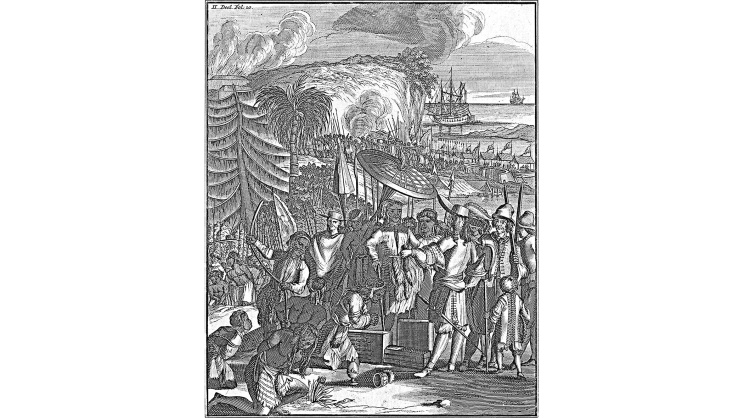
In June 1777 it was noted: ‘In February last the people of Arracan, commonly called mugs, carried off from the most Southern parts of Bengal, about eighteen hundred men, women and children: they arrived at Aracan…after a voyage of ten days. Upon their arrival there, they were conducted to the rajah, or sovereign, who chose from among them, for his slaves, all the handicraftsmen, and most useful persons; amounting to about one fourth of the whole number: the rest he returned to the captors; who conducted them by ropes about their necks, to a market; and there sold them for twenty, to seventy rupee, each; according to their strength abilities & ca’.
Although the Bengal slave trade was negligible in numerical terms, the raids themselves were numerically significant. So where did the captives go? Evidence suggests that they were settled in Arakan and in regions farther north.
Apart from the terrible human cost, the raids had other repercussions. From the seventeenth century onwards, Bengal’s productivity declined sharply in terms of absolute revenue to the Mughals. Whether this was a direct outcome of slave raiding has yet to be established. For the Mughals, Bengal had been central so far as agricultural revenue was concerned. This was the reason for its conquest in 1576. Mughal revenue figures (in copper dams) for the sixteenth to the eighteenth centuries—calculated from the Ain-i-Akbari for Emperor Akbar’s reign and compiled from Maja’lis-us Salatin by Muhammad Sharif Hanafi for Emperor Shah Jahan’s reign and from Mira’t-i-Alam by Bakhtawar Khan for Emperor Aurangzeb’s reign—in other words, almost continuously from the late sixteenth to the early eighteenth centuries—reveal that agricultural growth was initially high in Bengal. In descending order, revenue assessment during Akbar’s reign stood at more than 60 crore dams for Delhi, more than 59 crore for Bengal, more than 55 crore for Lahore, more than 54 crore for Agra and more than 43 crore for Gujarat.
This fabled productivity, however, ultimately gave way to stagnation. Bengal’s growth was not sustained, and revenue became largely static. Statistics show that Bengal’s projected revenue was, in any case, much lower than that of the other subahs in the late seventeenth and early eighteenth centuries, that is, during the reigns of Shah Jahan and Aurangzeb.
Colonialism reversed this malign tide. As the land ceded to the sea, the delta had receded from memory. Once late colonialism reconstituted the frontier, the delta re-entered our imagination. By the 1870s, the Magh menace had been overcome, much of the forest had been cut down, and the southeast had been repopulated.
While many towns disappeared in the southeast, the western delta gained prominence in the nineteenth century. The western delta was divided into ‘upper’ and ‘lower’ islands in people’s minds, and the upper islands gradually merged with Calcutta, thereby blurring the social and political boundary between land and water.
Debjani Bhattacharyya has argued that the western delta became crucial to British Calcutta’s land market, albeit in a radically different manner. The creation and life cycle of Calcutta was a ‘history of forgetting in the Bengal delta … [this was] central to the creation of property for the extraction of value from the marshes’. Property law and hydraulic technologies reordered a mobile landscape by transforming ecologies into a propertied geography in the search for firm, dry land. As legal and engineering technologies of fixing created a collective amnesia about Calcutta’s distinctively marine landscape, human intervention managed and transformed it into a concrete space by drying the delta to make it suitable for reclamation, and made it habitable by notarising possessions in an intensely marine land market.
Rila Mukherjee is a historian and the author of India in the Indian Ocean World: From the Earliest Times to 1800 (Springer Nature, 2022) and Europe in the World from 1350 to 1650 (Springer Nature, 2025).
This is the third part of a four-part series on slave trade in Bengal.
Comments