


Population control in reverse gear after decades
The country's fertility rate rose to 2.4 after decades of decline and stagnation, according to a government survey.
From 6.3 in 1975, the fertility rate steadily fell, largely due to government policies and programmes, and stagnated at 2.3 in 2012. This recent rise could have far-reaching implications.

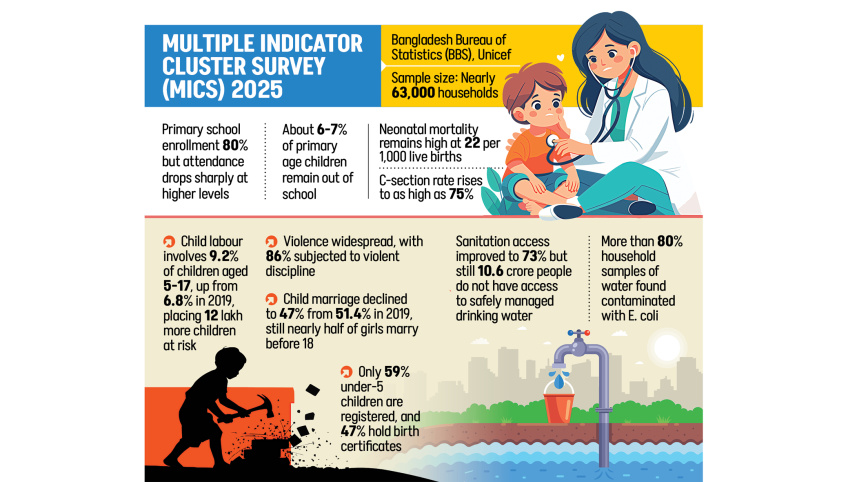
The Multiple Indicator Cluster Survey 2025, the most comprehensive survey on women and children, highlighted progress and challenges in health, nutrition, protection, and development.
Conducted in nearly 63,000 households over one year, the survey report released yesterday showed progress made in reducing mortality of children under five years old, significant gains in births at institutions, births attended by skilled professionals, and improvements in sanitation.
It underscored the rate of child motherhood, severe short-term undernutrition, high child marriage rate, and maternal anaemia as areas of concern.
Child marriage declined from 51.4 percent in 2019 to 47 percent, yet nearly half the girls marry before 18.
Child labour now affects 9.2 percent of children aged 5 to 17, up from 6.8 percent in 2019, the year of the previous survey. This translates to 12 lakh more children at risk. At least 86 percent children were subjected to violent discipline.
The survey, while concluding, said the country is moving forward, but to accelerate the progress and to ensure no child is left behind, it must focus more on quality, safety, inclusion, and protection.
Bangladesh Bureau of Statistics, with technical and financial support from UNICEF, conducted the seventh round of the survey.
BIRTH RATE RISE
The fertility rate for women aged 15 to 49, in the three years preceding the survey, is 2.4. The surveys of 2019 and 2013 put the rate at 2.3.
Asked about the possible reasons behind the recent rise, Prof Aminul Islam of the population science department at Dhaka University told The Daily Star that there has been visible reluctance in family planning in recent years, and some families now expect more than two children. "A combination of these factors likely explains the rise."
The latest survey supports his observation to some extent. It shows that the use of contraceptives by married women, aged 15 to 49, dropped to 58.2 percent from 62.7 percent in 2019.
Access to modern contraception also declined, with 73.5 percent of women's needs met, compared to 77.4 percent in 2019.
An official of the Directorate General of Family Planning said the unmet demand for contraceptives rose sharply during the pandemic. On top of this, there has been a supply and delivery disruption of contraceptives over the last year or so.
DU Prof Aminul said government policies and programmes that place less emphasis on population control need to be revised.
Ashrafi Ahmad, director general of the Directorate General of Family Planning, declined to make any comments as he had not gone through the report.
POSITIVES, CONCERNS
The survey said childbirths at healthcare facilities rose to 71 percent from 53.4 percent in 2019. Rate of deliveries made by skilled healthcare personnel rose to 77 percent from 59 percent in 2019. It said antenatal care coverage improved as well.
However, deliveries via C-section rose to 51.8 percent from 36 percent in 2019.
 For all latest news, follow The Daily Star's Google News channel.
 Children, from 15 to 19 years of age, bearing children rose to 92 percent from 83 percent in 2019.
The survey shows child stunting dropped to 24 percent from 28 percent in 2019, but severe short-term undernutrition (wasting) increased from 9.8 percent in 2019 to 12.9 percent.
The mortality rate of children under 5 dropped to 33 per 1,000 live births from 40 in 2019, marking a steady but slower decline than seen in previous surveys.
Infant, one-year-olds, mortality rate improved to 29 per 1,000 live births from 34 in 2019.
At least 73 percent of the households have access to basic sanitation, up from 64.4 percent in 2019.
However, access to safe drinking water dropped to 39.3 percent from 42.6 percent in 2019. This leaves over 10.6 crore people without access to safe drinking water.
E. coli bacteria was found in nearly half of water sources surveyed and over 80 percent of samples collected from households.
Climate-related hazards impacted 10.2 percent of water sources, highlighting the need for climate-resilient infrastructure.
While primary school enrolment remains high, around 80 percent, it drops off sharply at higher levels. Many children complete primary schooling without mastering basic skills, it said.
Attending the programme, Rana Flowers, UNICEF representative to Bangladesh, said the survey comes at a critical time for Bangladesh and is a reflection of progress and challenges.
"While declines in child marriage and child mortality show what's possible, crises like lead poisoning and child labour are depriving millions of children of potential, and rising cesarean rates threaten women's health," she added.
UNICEF commits to supporting the government to turn this data into targeted action and change that leaves no child behind, she added.
Aleya Akter, secretary of Statistics and Informatics Division, said based on the data, they would work with ministries and divisions concerned.
Hossain Zillur Rahman, former adviser to a caretaker government, said the data has been provided and now the story has to be told for the betterment of children and women.
BBS Director General Mohammed Mizanur Rahman chaired the report unveiling programme held at the Bangladesh-China Friendship Conference Centre.
Comments