


Use jute geo-textile in road construction
International Jute Study Group suggests
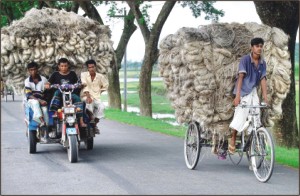
A file photo shows a rickshaw van and an indigenous vehicle carrying jute in Bogra. International Jute Study Group suggested that Bangladesh should use jute geo-textile with concrete for constructing roads and highways in order to enhance jute usage.Photo: Hasibur Rahman Bilu
The International Jute Study Group (IJSG) has suggested that Bangladesh government should use jute geo-textile with concrete in construction of roads and highways in order to enhance jute usage. Pointing to the Indian experience of effective usage of jute geo-textile with concrete in constructing roads in some cases, Sudripta Roy, the group's secretary general, made this suggestion with a recent meeting with some high officials of the Ministry of Jute and Textile. “The result of such experiments in India was successful. This is one of the main reasons for returning of good days for jute in India,” he said in an informal talk with The Daily Star yesterday. Engineers can use geo-textile as layers in making highways as the item is much more biodegradable than any other ingredients, Sudripta also pointed out. The Bangladesh government's stand on the research group's suggestions with regard to the jute's new usage will be made clear in an inter-ministerial meeting scheduled to be organised by the jute ministry on May 15 in Dhaka. Representatives from different ministries and stakeholders as well as IJSG people will attend this crucial meeting. Sudripta said if the usage of jute geo-textile in the construction of roads, the production of jute will definitely increase and farmers will get fair prices of the item because the government will purchase the item in bulk amount directly from them. In response to a query, he said the durability of geo-textile layers in the construction of roads and highways is similar to the fully concrete made roads and highways. He said at present two jute-processing industries in the country have been exporting such items to different countries. Earlier, in a roadmap for revival of the jute sector, the IJSG suggested the government introduces a system for direct purchase of the item at growers' level. “We suggested that the government should buy jute from the growers to stop any price deprivation by middlemen. The jute has lost its glory from this region as farmers are often denied fair prices of their produces," he said. The IJSG also suggested a public-private partnership for operating the jute mills to minimise the losses. The research group prepared the roadmap for the jute sector under a project funded by the Geneva based International Trade Council (ITC), according to Sudripta. The roadmap also advocated for awarding the jute farmers subsidy and increasing uses of jute bags in processing of sugar, rice and other daily necessities. The IJSG top official said the Indian government made the usage of jute bags mandatory in processing of sugar and rice as the bags made of jute are more environment-friendly. Meanwhile, Kamran T Rahman, former president of the Bangladesh Jute Mills Association (BJMA) said the raw jute being grown in the country is too inadequate to cope with the demand for jute geo-textile to be used in the construction of roads and highways. He also pointed to the fact that the country has been producing jute geo-textile for export purposes, not for local use. “Of course the usage of jute in the country will increase if the jute geo-textile can be used in roads and highways construction, but the prices of machinery for processing of jute to produce jute geo-textile is very high,” he said. The United States of America has been using both synthetic and jute geo-textile for roads and highways construction, he pointed out. [email protected]
 For all latest news, follow The Daily Star's Google News channel.
Comments