


At Amirul's farm, nothing goes to waste

"My mother wanted a cow so that nothing from our home or fields would go to waste. That was the beginning."
Thirty years ago, Amirul Islam,58, was a BSc student with no ambition of becoming a dairy farmer. But when his mother expressed a simple wish to own a cow, he bought a cross-bred animal for Tk 14,600.

That decision transformed not only his own life but also the farming landscape of Burampur village in Ishwardi upazila of Pabna.
Today, Amirul runs a dairy farm with more than 100 cattle, producing between 450 and 500 litres of milk each day. Yet milk is only part of the story.
His farm has evolved into a self-sustaining agricultural ecosystem where cow dung generates biogas and electricity, residual waste is turned into organic fertiliser, and even wastewater is reused to irrigate crops.
In Amirul's words, "nothing goes to waste".
Recalling the early years, Amirul said he had to abandon his studies after his father died. Around that time, his mother suggested buying a cow so that household and crop waste could be put to good use instead of being discarded.
"As the cow grew, it gave birth to three calves. I sold one and kept the other two. Within five or six years, I had around a dozen milking cows at home."
As production increased, Amirul began looking beyond milk. He wanted to solve another problem: what to do with the growing volume of animal waste.
A small biogas plant installed nearly two decades ago met the farm's basic fuel needs, but much of the manure still remained unused.
Last year, he took a far bigger step, investing Tk 1.5 crore in a 100-square-metre biogas generation plant, with 40 percent of the funding coming from his own savings.
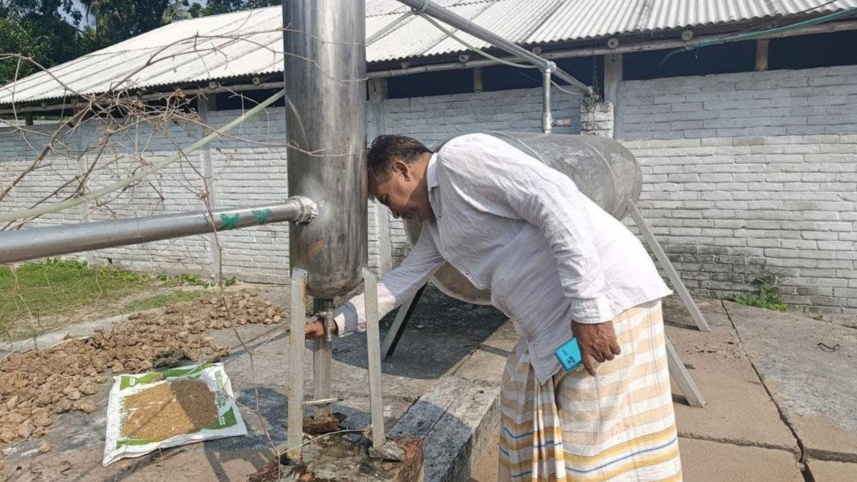
The facility converts cow dung into biogas, generates electricity and processes the remaining waste into organic fertiliser.
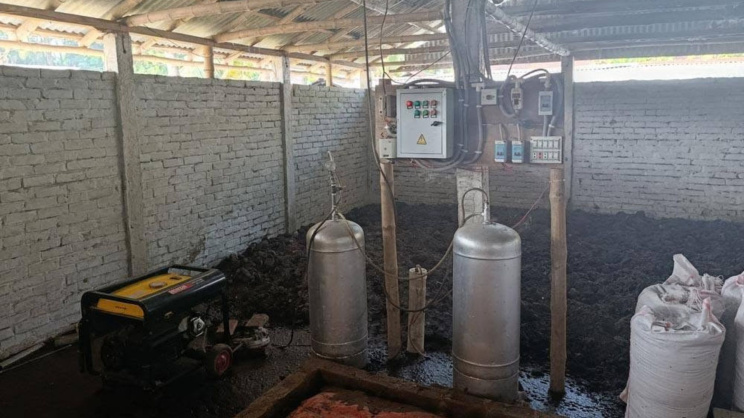
During a visit to the farm, large mechanical mixers could be seen feeding cow dung into processing chambers. The slurry travels through pipelines to produce biogas, which is purified and stored before use. The remaining solid and liquid by-products are processed separately rather than discarded.
"After the entire process, the cow dung becomes gas, the solid residue is turned into organic fertiliser, and the remaining water is channelled to crop fields," Amirul said. "Nothing is wasted."
The plant now supplies cooking gas to around 15 households, including workers' quarters, and powers two generators capable of producing 30 kilowatts of electricity.
The solid residue is dried, ground into powder and mixed with a bio-reagent to produce organic fertiliser. The farm currently produces around 10 to 12 maunds of fertiliser a day.
"Each kilogramme sells for Tk 60," Amirul said. "I use it on my own land, and neighbouring farmers buy the rest."
He hopes to expand production further once he becomes eligible for a commercial licence after completing three years of successful operation.
 For all latest news, follow The Daily Star's Google News channel.
 To run the plant at full capacity, however, he needs at least 85 maunds of cow dung every day. His own farm currently produces only 40 to 50 maunds.
"If I can secure another 80 to 100 maunds daily, production could almost double," he said.
Seven to eight machines operate across the biogas plant, power generation unit and fertiliser processing facility, with most powered by electricity generated on the farm itself.
Amirul's success has encouraged other farmers to rethink livestock farming.
Around 20 to 25 dairy farmers in Burampur and neighbouring Pakiria village have already installed small biogas plants for household use, following his example.
Aklima Khatun, livestock officer of Ishwardi upazila, said Amirul had demonstrated how a conventional dairy farm could be transformed into a modern, integrated enterprise.
"There are many large dairy farmers, but Amirul is among the few who have been willing to make such a significant investment to turn a traditional dairy farm into a full-scale processing facility," she said.
His integrated model, she added, produces milk and meat alongside renewable energy and organic fertiliser, offering an environmentally sustainable and economically viable blueprint for the future of farming.
Comments