


Stronger chemical industry needed to cut import dependence
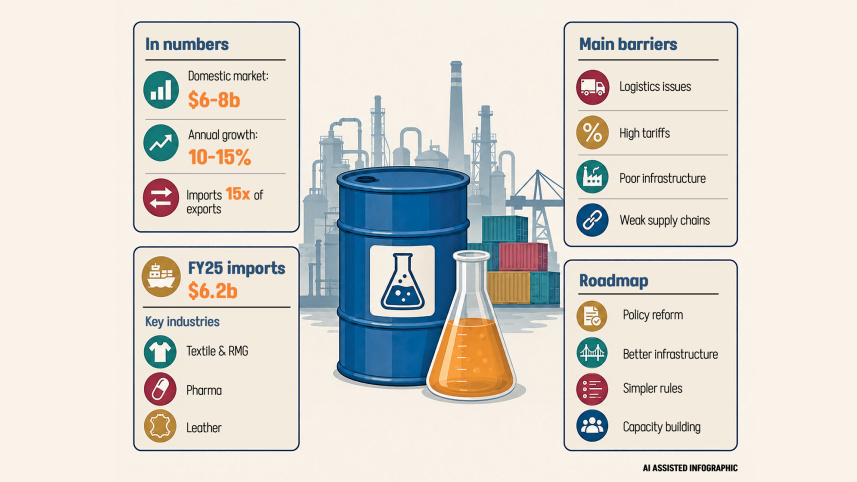
Bangladesh’s major export sectors rely heavily on chemicals, but the country still imports most of its chemical needs despite having a domestic market estimated at $6 to $8 billion that is growing by 10 to 15 percent annually.
Developing a strong domestic chemical industry is essential to reduce import dependence and improve the competitiveness of export sectors, stakeholders said at a seminar yesterday.

The seminar titled “Backward Linkage Development of Chemical-Dependent Key Export-Oriented Industries: Current State & Issues” was organised by the Dhaka Chamber of Commerce and Industry (DCCI) at its auditorium in the capital.
Chemicals are a key input for industries such as textiles, garments, pharmaceuticals, leather, construction, agriculture and plastics. The textile and RMG sector alone uses more than 2,500 chemicals, including dyes, auxiliaries and finishing agents. Pharmaceutical companies require active pharmaceutical ingredients (APIs), excipients and solvents, while leather manufacturers depend on tanning chemicals and dyes.
Rising demand has led to higher chemical imports, with Bangladesh importing $6.2 billion worth of chemicals in FY25, up 17.8 percent from the previous year. Although the pharmaceutical industry exports products to more than 150 countries, it still imports around 90 percent of its APIs.
Chemicals now account for about 10 percent of the country’s total imports, while chemical imports are more than 15 times higher than exports.
BARRIERS HOLD BACK SECTOR
At the seminar, speakers highlighted several challenges facing the sector, including high tariffs, logistics problems, inadequate infrastructure and weak supply chains.
In his keynote presentation, Asif Rabbani, managing director of SR Chemical Industries Ltd, said policy reforms and stronger industrial capacity are needed to develop the sector.
DCCI President Taskeen Ahmed said the competitiveness of Bangladesh’s RMG, textile, leather and pharmaceutical sectors depends on a strong chemical supply chain.
He said industrial growth is being affected by heavy reliance on imported dyes, chemicals and specialised raw materials, along with tariff complexities, lengthy environmental clearance processes and logistics bottlenecks.
KSM Mostafizur Rahman, president of the Bangladesh Agrochemical Manufacturers Association, said high import duties on raw materials are hurting the agrochemical industry and called for stronger policy support.
Md Akter Hossain, director at the Directorate General of Drug Administration, said entrepreneurs are being held back by delays in developing the API Industrial Park.
Md Shaheen Ahamed, chairman of the Bangladesh Tanners Association, said the leather industry remains highly dependent on imported chemicals and urged the government to reduce import-stage duties.
ROADMAP NEEDED TO BUILD LOCAL CAPACITY
Stakeholders also called for a clear roadmap for chemical backward linkage development. Taskeen Ahmed said such a roadmap is now a strategic necessity to protect the future of Bangladesh’s export sector.
Md Salim Ullah, director general of the Bangladesh Institute of Management, said the government is reforming the National Industrial Policy. He said the private sector should decide whether the chemical backward linkage sector requires a separate policy or a dedicated chapter in the existing industrial policy.
Md Moniruzzaman, director of the Bangladesh Knitwear Manufacturers and Exporters Association, said the success of RMG backward linkage industries through government support could serve as a model for the chemical sector by attracting investment and creating jobs.
Sheikh HM Mustafiz, director of the Bangladesh Garment Manufacturers and Exporters Association, said uninterrupted energy supply, supportive policies, compliance with international quality standards and specialised industrial zones are essential for the sector’s growth.
M Mosaddek Hossain, senior vice-president of the Bangladesh Association of Pharmaceutical Industries, stressed the need to strengthen the chemical ecosystem through expanded research activities and skilled manpower development.
 For all latest news, follow The Daily Star's Google News channel.
 Abul Fatah Md Baligur Rahman, member for development at the Bangladesh Council of Scientific and Industrial Research (BCSIR), said stronger cooperation between industries and academia is needed to accelerate economic growth.
“BCSIR is working to add significant value to export products and build competitive import-substitute industries by mobilising local resources,” he said.
Suraiya Sultana, second secretary (Customs: Export and Bond) at the National Board of Revenue, said tariff rates are gradually being reduced to encourage local chemical production.
She added that the bonded warehouse licensing process has been fully digitised to reduce difficulties for entrepreneurs.
Stakeholders said achieving 60 percent chemical backward linkage could save billions of dollars in foreign exchange, increase export competitiveness, create thousands of skilled jobs and strengthen Bangladesh’s industrial base.
Comments