


Dhaka sits on seismic time bomb

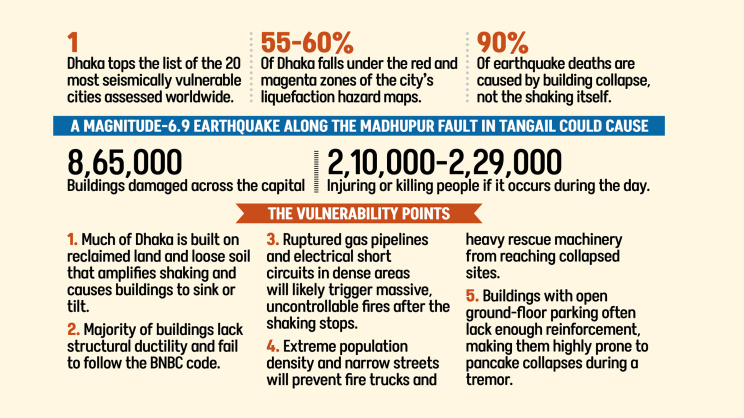
Dhaka does not sit on a major fault line of its own, but it doesn’t need to. According to the earthquake disaster risk index, the capital tops the list of the 20 most vulnerable cities in the world, a ranking driven as much by density and construction quality as by geology. Bangladesh lies close to five fault zones: the Madhupur Fault, the Dauki Fault, and three plate boundary faults, each capable of generating earthquakes between magnitude 7.0 and 8.5. A RAJUK study conducted over four years under the World Bank-funded Urban Resilience Project estimated that a magnitude 6.9 rupture along the Madhupur Fault could damage nearly 865,000 buildings in Dhaka, killing roughly 210,000 people and injuring another 229,000 if it strikes during busy daytime hours, with direct losses above 25 billion dollars and a further 44 billion dollars needed for reconstruction.
On 21 November 2025, a magnitude 5.7 earthquake centred in Narsingdi killed at least 10 people and injured more than 600. This was the deadliest earthquake to strike Bangladesh in over two decades and a jolt that cracked walls and dislodged masonry across the capital. Professor Mehedi Ahmed Ansary of BUET’s Civil Engineering Department, who has studied Dhaka’s building stock for years, put the core problem bluntly: “Earthquakes do not kill people; poorly constructed buildings do.”

Why Modern Buildings Survive Earthquakes
The clearest evidence that construction quality, not magnitude, decides the death toll comes from comparing two earthquakes of similar force. The 2010 Haiti earthquake (magnitude 7.0) killed close to 230,000 people, largely through building collapse, because most structures had no seismic design at all. The 2010 Chile earthquake (magnitude 8.8) released nearly 800 times more energy than Haiti’s, yet killed only about 280 people, because Chile had spent decades enforcing a strict, modern seismic code. A modern earthquake-resistant building is not built to stand rigid against shaking; it is built to flex, absorb energy through controlled deformation, and keep its load path intact even after cracking, while a poorly detailed one shears at its weakest joint and comes down.
Bend Instead of Break
Ductility is what turns a design on paper into a building that survives shaking.
In practice, this means closely spaced steel hoop ties at every beam-column junction so the joint yields and absorbs energy rather than shearing apart when the seismic wave hits. The Bangladesh National Building Code (BNBC) 2020 makes this mandatory rather than optional: ductility class “D” reinforcement steel is required for earthquake-resistant design, and columns in seismic zones must be at least 12 inches in each dimension. Speaking to the Daily Star, architect Ahmed Mukta, managing director of Architectural Consultancy LLC, points to a second, less obvious risk: non-structural failure. Partition walls, false ceilings, glass façades and loose rooftop water tanks are frequently what actually injure people, even when the main frame survives; anchoring these elements and adding shear walls or diagonal bracing to open, soft-storey parking floors, he notes, closes much of that gap.
Foundation Design
The foundation is where a building’s seismic fate is largely decided before construction even reaches ground level. Dhaka’s soil varies sharply within a few kilometres, from firm red Pleistocene clay to soft, water-saturated alluvial fill, so the same foundation type cannot be applied citywide. On reclaimed low-lying land, engineers must deepen piling and improve the soil before a column ever rises; skipping that step is how a structurally correct design still ends up tilting. For its most critical structures, Bangladesh has begun going further than conventional foundations altogether: the Padma Bridge uses double concave friction pendulum bearings, and base isolation systems, which let a structure sway gently on rubber and lead bearings, are already in use at the Rooppur Nuclear Power Plant and several new metro rail stations under BNBC 2020.
Soil Investigations
None of this works without knowing what lies beneath the site first. Under RAJUK, soil samples from 1,825 spots across the city have been tested using more than ten separate laboratory methods, and the resulting liquefaction hazard map is sobering: a joint RAJUK-BUET study found that 55 to 60 per cent of Dhaka falls within the red and magenta zones of highest liquefaction risk, ground so loose or artificially filled that it amplifies shaking and can cause a building to sink or tilt even without collapsing outright. “These areas also face high seismic amplification, as both hazards are linked to loose or artificially filled ground,” Prof. Ansary has explained. Complicating matters, RAJUK records show ten housing companies alone have filled roughly 7,000 acres of low land near the Turag River for plot sales, land now being built on without the intensive piling such soil requires.
Lessons from Nepal, Türkiye, Japan and Venezuela
Bangladesh is not the first densely built, moderate-income country to face this risk, and it does not have to learn every lesson the hard way. Türkiye strengthened its seismic code in 1998; when the magnitude 7.8 earthquake struck in February 2023, buildings raised under the newer code performed dramatically better than older stock, even as roughly 53,500 people died overall, mostly in structures built before, or in defiance of, that code. Japan offers the opposite end of the spectrum: after the 1995 Kobe earthquake destroyed thousands of schools, the government legislated mandatory retrofitting, and during the 2011 Tohoku earthquake, despite the catastrophic tsunami that followed, essentially no buildings collapsed from the shaking itself. Nepal’s 2015 Kathmandu earthquake, which flattened large parts of the capital, was the direct trigger for BUET’s proposal to colour-code Dhaka’s buildings red, yellow and green by vulnerability, a scheme still awaiting full implementation a decade later. Most recently, twin magnitude 7.2 and 7.5 earthquakes struck west of Caracas, Venezuela, in June 2026, destroying a 22-storey building in the capital’s Altamira district and forcing authorities to cut gas supplies to damaged structures as a precaution, a reminder that even upper-middle-income capitals with modern skylines remain exposed when older buildings and enforcement gaps persist.
What Developers Are Doing Today
Bangladesh’s real estate sector is starting to respond, unevenly. The Real Estate and Housing Association of Bangladesh (REHAB) opened a control room after November’s earthquake and reported no member building damage; speaking to the Daily Star, Liakat Ali Bhuiyan, senior vice president, said member developers build with earthquake resistance in mind while acknowledging the limits of that confidence.
At the project level, some developers say seismic design now begins at the drawing board rather than being bolted on. Tanvir Ahmed, managing director of Sheltech Group, says every Sheltech project is designed to BNBC seismic requirements from the outset, with structural analysis run on internationally standard software and checked against those provisions, alongside an ISO-certified quality system and in-house material testing. He points to structural health monitoring, sensors that track vibration, settlement and tilt in real time, as the next standard developers will need to adopt in a seismic zone like Dhaka’s.
The gap between what leading developers say and what the wider market builds remains wide: roughly 84 per cent of Dhaka’s 2.1 million buildings are single-storey, older, and largely untouched by any of this. Closing that gap, through enforced third-party design verification, colour-coded risk tagging, and retrofitting incentives, is now, in the words of civil engineers repeatedly cited across recent coverage, the difference between a moderate tremor and a catastrophe.
 For all latest news, follow The Daily Star's Google News channel.
Comments