


Aussies gone in 60 runs
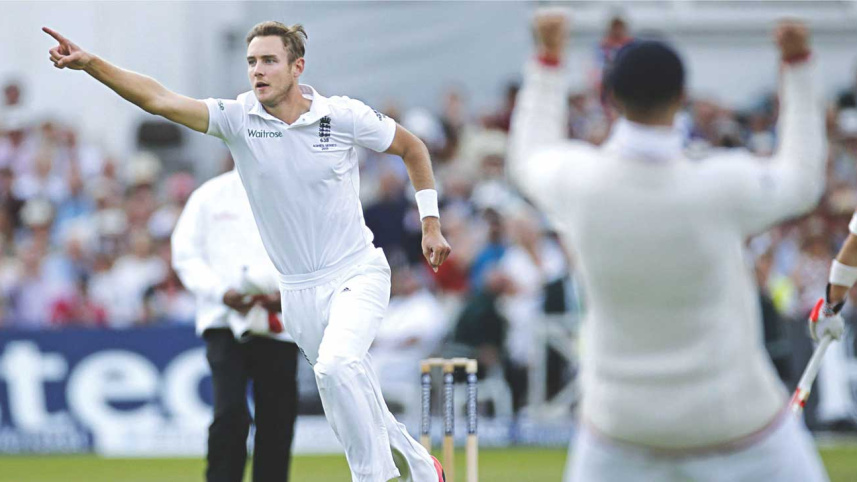
Australia came into the Trent Bridge Test on Thursday needing to make history, as the first team in almost 80 years to overturn a 1-2 Ashes deficit. Within one session they made history for a contrasting reason: crumbling for 60 in what became the shortest first innings of a match in Test history. The total is their seventh-lowest score in Test history and their second-lowest in the last 79 years.

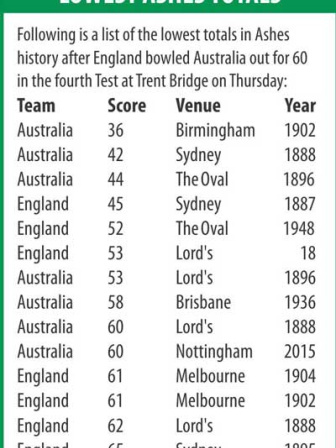
While pitch and weather conditions were helpful for fast-bowling it was nevertheless unfathomable, even given Australia's capitulation last week at Edgbaston, they could be bowled out in just 18.3 overs. The biggest runs contributor for Australia was, humiliatingly, courtesy of England: extras with 14.
In the first 37 balls of the match they shed all six of their specialist batsmen amid an onslaught from acting England lead paceman Stuart Broad that saw him snare 5 for 6 within his first overs with the new ball. He finished with 8-15 in front of his home crowd. Only twice in Test history has anyone taken eight wickets for fewer runs.
After the first ball of Broad's third over, and the fifth of the match in Nottingham, Australia were at a calamitous 5 for 23. It raised memories of Cape Town in late 2011, when Australia were stricken at 5 for 18 on way to being bowled out for 47 by South Africa. It was a close-run thing as to whether Australia beat that total here. They only managed to do so when the last pair of Josh Hazlewood and Nathan Lyon were at the crease.
The only specialist batsman to survive the shedding of the first five wickets was captain Michael Clarke, but only after he came close to being dismissed from his first two scoring deliveries, almost playing on to his stumps and then almost caught from a top-edged hook.
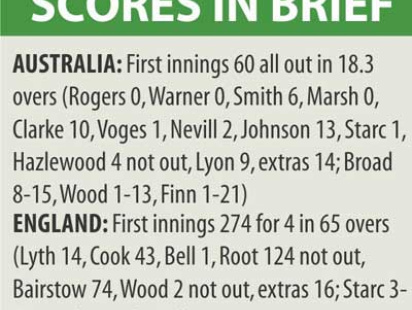
That he was the only top-six batsman to reach double-figures might be deserving of qualified praise in the circumstances, if not for the way he departed.
Only four times in Australia's Test history have they shed their top six more cheaply than they did in Nottingham. One was in Cape Town, the other three were in the 19th century.
If Clarke, who dropped down a place to No. 5 where his average of 61.83 is almost double his record at No. 4, thought the move would lead to a softer entry to the crease he was sadly mistaken; he was called up just eight balls into the match when David Warner became Australia's third victim.
Australia lost two batsmen, Chris Rogers and Steve Smith, within the first over. Rogers's departure, snared at first slip by Cook, vindicated Broad's decision to immediately attack the left-hander from around the wicket -- and meant he only needed three deliveries to reach his 300 Test wickets milestone. Smith sought to strike back by scoring from his first two deliveries, one of them a boundary through extra-cover, yet fell to his third after providing Joe Root with a catch at first slip.
From 7 for 38 at drinks Australia lost their most capable lower-order batsmen, Mitch Johnson and Mitch Starc, within two overs. They last pair, Hazlewood and Lyon, produced the longest partnership of the innings: 33 balls.
Australia need to win at Trent Bridge to maintain any chance of winning their first away series since 2001. With such a limp effort with the bat in their "grand final" it is explicable why they are on track to lose their fourth consecutive series in England.
 For all latest news, follow The Daily Star's Google News channel.
Comments