


When the river takes everything, even a girl's childhood
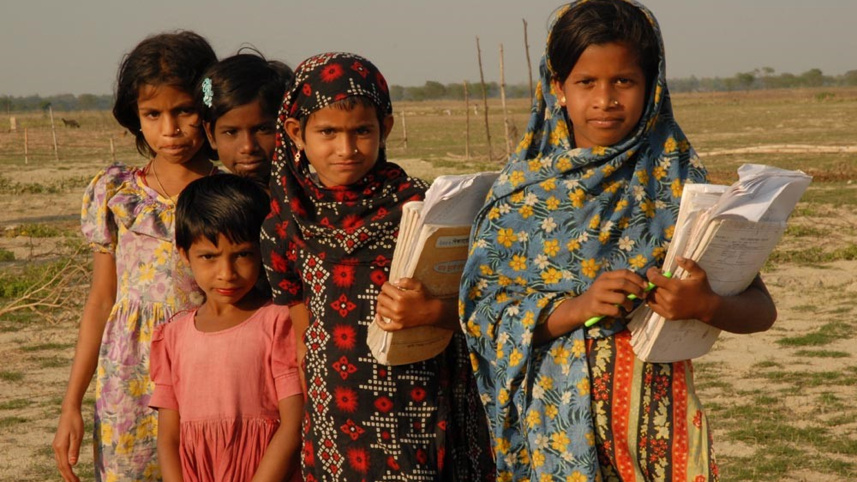
I remember the first time I truly understood what displacement meant in the chars of northern Bangladesh. It was 2010, and I was travelling through the river islands of Gaibandha and Kurigram for a National Geographic assignment on migration. I had come with notebooks and questions, assumptions about poverty, and early marriage. The chars dismantled all of them.
The family I was sitting with had moved four times in seven years. Four times they had dismantled a home—rolled up tin sheets, unloaded bamboo poles, gathered the children and the chickens—and loaded everything onto a boat to find land that the Brahmaputra had not yet swallowed. The mother told me this with the matter-of-factness of someone describing the weather. Because for her, it was simply how life worked.

Over the decades, Bangladesh has made real strides in reducing child marriage. The national rate fell from 62 percent in 2000 to around 47 percent by 2025, according to the Unicef Child Marriage Data Portal. And yet, in the chars—those fragile, shifting islands scattered across the Brahmaputra-Jamuna River system—the practice persists with a stubbornness that national figures cannot capture. Rangpur division, which encompasses much of the northern char belt, recorded a child marriage rate of 58 percent in the 2022 Bangladesh Demographic and Health Survey—among the highest in the country. To understand why, you have to understand what a char actually is.
A char is not a village in the ordinary sense. It is a temporary arrangement between people and a river that owes them nothing. Entire settlements may disappear within a single monsoon season. For generations, char communities developed a remarkable form of social engineering to survive this uncertainty: kinship networks spread across multiple islands. Families deliberately maintained connections—relatives, in-laws, old neighbours—on different chars at different stages of erosion and emergence. The logic was elegant and brutal. When your char went under, you needed somewhere to go, and someone there who would take you in.
Thus, early marriages in the chars are often not arranged solely for the reasons we most commonly discuss—patriarchy, poverty, the desire to unburden a family of a daughter. Those factors remain real, and must be named, but there is an additional layer that is often missed. The calculation—made by mothers and fathers who love their children—that marriage to a family on another char is a form of insurance—a lifeline to a place that might still exist when your own island is gone. And the earlier the alliance, the sooner the connection is secured.
Geography compounds vulnerability in another way. While primary education has expanded considerably through government and NGO initiatives, access to secondary education remains limited in many chars. Adolescent girls often have to travel long distances by boat or along difficult routes to reach a high school. During monsoons, attendance becomes even more uncertain—children in Rangpur district alone lost up to six weeks of schooling to climate-induced closures in 2024, according to Unicef Bangladesh. A 2022 study of riverine island communities in Gaibandha found that barely 7 percent of residents had completed education beyond the secondary level. Faced with these barriers, many families withdraw daughters from school altogether. Once education ends, the pressure for marriage begins. In this way, geographic isolation becomes another pathway through which climate vulnerability contributes to child marriage. This does not justify child marriage. But it means any intervention that ignores this underlying reality, and treats early marriage in the chars as simply a product of ignorance or tradition, will fail. And many have.
The challenge Bangladesh faces in the chars is one the country’s broader development story has yet to fully reckon with. It is the fact that climate displacement is not only a humanitarian crisis, but a driver of social practices we have long catalogued under other headings. When Unicef and the Bangladesh government report that chars have some of the highest rates of child marriage in the country, the response cannot only be more awareness campaigns and helplines. It must also ask: what are these families afraid of losing? The answer, almost always, is safety. Connection. The assurance that when the water comes, and the water always comes, there will be somewhere to go and someone to help.
Bangladesh’s National Plan of Action to End Child Marriage sets 2041 as the horizon for eliminating the practice. It is an ambitious target, and the country has the will to pursue it. But the chars will require a different kind of imagination—one that grasps that you cannot simply tell a family to wait for their daughter to turn eighteen when they do not know if their island will survive until she does. The answers lie in building what the river has always forced these communities to build for themselves: resilience, connection, and a future that does not depend on sacrificing the present of a child. The river does not negotiate. But we can.
Ahmed Toufiqur Rahman is a development professional and Rotarian. He can be reached at [email protected].
Views expressed in this article are the author's own.
Follow The Daily Star Opinion on Facebook for the latest opinions, commentaries, and analyses by experts and professionals. To contribute your article or letter to The Daily Star Opinion, see our guidelines for submission.
 For all latest news, follow The Daily Star's Google News channel.
Comments