


Inclusivity, security, and artistic freedom
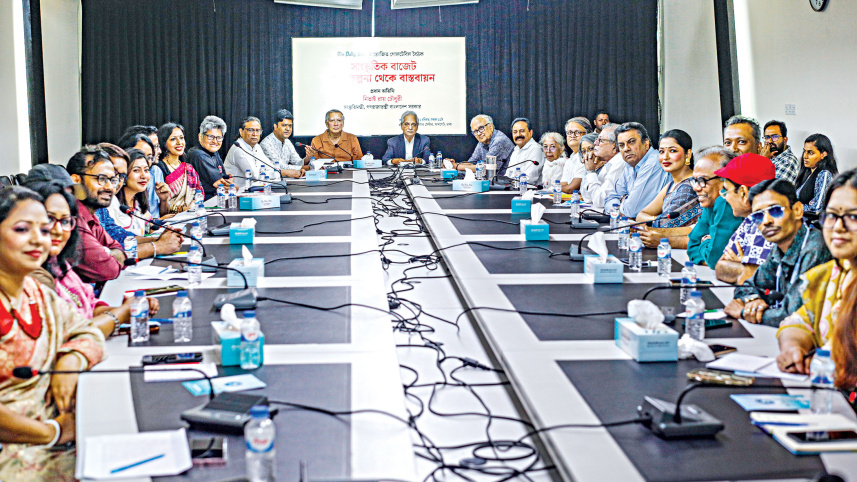
Speakers at a roundtable yesterday called for proper planning, stronger institutional capacity, and wider grassroots participation to ensure effective implementation of the budget allocated to Bangladesh’s cultural sector.
They said cultural budgets had rarely been used optimally over the years, particularly in regional districts, and stressed the need for better management, trained personnel, institutional reforms, and greater inclusion in policymaking.

The Daily Star organised the roundtable, titled “Cultural Budget: Planning to Implementation”, at The Daily Star Centre in the capital.
The event brought members of the country’s cultural community together to discuss the government’s allocation of Tk 825.75 crore for the ministry in the 2026–27 fiscal year.
“We need proper management -- training and capacity building should come first. We should also focus on geographical mapping,” said dance artist and General Secretary of Shadhona Lubna Marium during her opening presentation.
She urged the authorities to enable cultural practice across 64 districts by hiring more technical personnel. Her presentation outlined the overall budget allocation, where the resources were being directed, and what could be done to improve the initiatives.
Nazrul Sangeet artist and BNSS General Secretary Khairul Anam Shakil said, “Our nation still hasn’t become culturally conscious. We need to recruit teachers as well as a large-scale campaign to build cultural awareness from the school level.”
Theatre personality Ramendu Majumdar said, “The laws governing cultural organisations like the Shilpakala Academy need to change. They need to encourage more Jatra and Folk artists to come forward -- we cannot be stuck within just mainstream practices.”
Nataraj NA Palash, president of Bangladesh Jatra Shilpa Development Society, said no artist from the Jatra community was involved in policymaking.
“This is unfortunate indeed. We often find our community to be the most neglected.”
Rezauddin Ahmed Stalin, director general of the Shilpakala Academy, said, “The government can and will provide incentives, but culture, I believe, is created by the people.”
Novelist Ahmad Mostofa Kamal criticised the arrest of Baul Abul Sarkar during the interim period.
“Baul artistes have performed ‘Pala Gaan’ for hundreds of years, carrying subliminal messages. Yet, when people who barely understand the essence attacks them and force their arrest, it is the government that has to step in,” he said.
“Politicisation and tagging of artistes have become common lately. It must stop,” said musician Hamin Ahmed. “It seriously hurts the cultural industry overall. We should be more inclusive about them.”
The artistes present echoed the sentiment.
The speakers also agreed that the notion that religion and culture were in conflict must be challenged.
“When I was growing up in Faridpur, people participated in cultural activity irrespective of religion. Now, we see less and less of that -- and it is a problem,” said actor Fazlur Rahman Babu.
Filmmaker Tanim Noor urged the ministry to look ahead and improve its digital capacity. “We need a separate budget for digital initiatives.”
Afsana Begum, director of Jatiya Grontho Kendra, said, “Budget will only come when these institutions are empowered to plan properly. Without planning, there is no possibility of implementation.”
In his closing remarks, Minister of Cultural Affairs Nitai Roy Chowdhury, also the chief guest, said, “We have communities in the hills and on the plains, indigenous groups, and each has its own culture, its own way of thinking, and its own rituals. We want unity, bringing all of them together.”
 For all latest news, follow The Daily Star's Google News channel.
 He said funding was not the ministry’s real constraint. “Budget is not something we lack. Whatever is needed, we will provide, whenever it is needed.”
“We are also working on supporting Jatra artistes, who are heavily marginalised and often have to stay without work for 6 months at a time,” he said.
Reflecting on the scale of 2024’s uprising, he asked what had driven it.
“What was the budget of the Language Movement? What was the budget of the Liberation War? It was not money that brought people onto the streets, it was passion.”
The discussion was also attended by publisher Mahrukh Mohiuddin, researcher Badiuddin Nazir, novelist Sadat Hossain, dancer Arthy Ahmed, artiste Farzana Wahid Shayan, Bangladesh Film Artistes Association President Shiba Sanu, actress Azmeri Haque Badhan, singer Fahmida Nabi, BAMBA president and musician Hamin Ahmed, Chairperson of Dhaka University Music department Dr Priyanka Gope, development practitioner and Unesco representative Kizzy Tahnin, poet Mohon Raihan, and linguist Mohammad Asaduzzaman.
The Daily Star Editor and Publisher Mahfuz Anam delivered the opening speech. The discussion was moderated by Emran Mahfuz.
Comments