


Saudi Arabia draws the line in Yemen
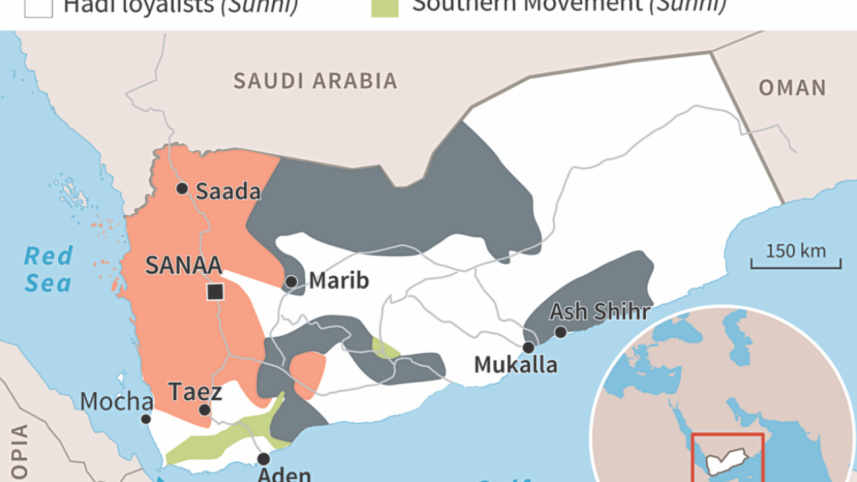
Saudi Arabia kept some key details of its military action in Yemen from Washington until the last moment, US officials said, as the kingdom takes a more assertive regional role to compensate for perceived US disengagement.
The Middle East's top oil power told the United States weeks ago it was weighing action in Yemen but only informed Washington of the exact details just before Thursday's unprecedented air strikes against Iran-allied Houthi rebels, the officials said.

Although the Saudis spoke with top US officials as they debated an air assault in support of embattled Yemeni President Abd-Rabbu Mansour Hadi, US officials acknowledged gaps in their knowledge of the kingdom's battle plans and objectives.
Adel al-Jubeir, Saudi Arabia's ambassador to the United States, said Riyadh consulted closely with Washington on Yemen - but ultimately decided it had to act quickly as Houthi rebels moved toward Hadi's last redoubt in the southern city of Aden.
"The concern was, if Aden falls, then what do you do?" al-Jubeir told a small group of reporters on Thursday. "The concern was that the situation was so dire you had to move."
Saudi Arabia's air strikes point toward an aspiration to defend its regional interests with less reliance on the US security umbrella that has long been the main thrust of Washington's relations with the oil-rich kingdom.
Riyadh has been growing increasingly assertive since early 2011, when Washington's reluctance to back former Egyptian leader Hosni Mubarak in the face of mass protests led the Saudis to doubt its commitment to traditional Arab allies.
Obama's decision in summer 2013 not to bomb Syria after the use of poison gas there, coupled with its sudden announcement it had conducted secret nuclear talks with Riyadh's nemesis Iran, further alarmed the Saudis.
"If the operation is successful, I think we will see a major turn in Saudi foreign policy. It's going to be assertive, become more aggressive in dealing with the Iranian expansionism,” said Mustafa Alani, an Iraqi security analyst with ties to the Saudi Interior Ministry.
Officially, the airstrikes were carried out in direct response to a formal request by Abd-Rabbu Mansour Hadi's foreign minister earlier this week for Gulf Cooperation Council (GCC) military assistance in fighting the Houthis.
But for Saudi Arabia, the decision to form a coalition to take military action in Yemen has less to do with supporting the Hadi government than it does with providing diplomatic cover to take on what it considers to be the its biggest external threat - an increasingly aggressive Iran determined to firmly establish its hegemony in the region.
For more than 30 years, the Saudis have been engaged in a strategic rivalry with Iran for power and influence in the Middle East. Built largely upon sectarian and ideological lines, with Saudi Arabia as leader of the Sunni Arab world and Iran as the leader of the Shia crescent, it has been played out in a series of hot and cold proxy wars throughout the region - in Lebanon, Syria, Iraq, Bahrain.
But Iran's extension of that influence into Yemen, vis-a-vis the Houthis, was a line the Saudis could no longer tolerate.
Consider also, that Iran has significantly strengthened its position in the region over the last several years at Saudi Arabia's expense, particularly in Iraq. For that very reason, Saudi Arabia, which looks at the Houthis as nothing more than an Iranian proxy, has no choice but to draw the line on their southern border.
 For all latest news, follow The Daily Star's Google News channel.
Comments