


China industrial zone takes off in Chattogram
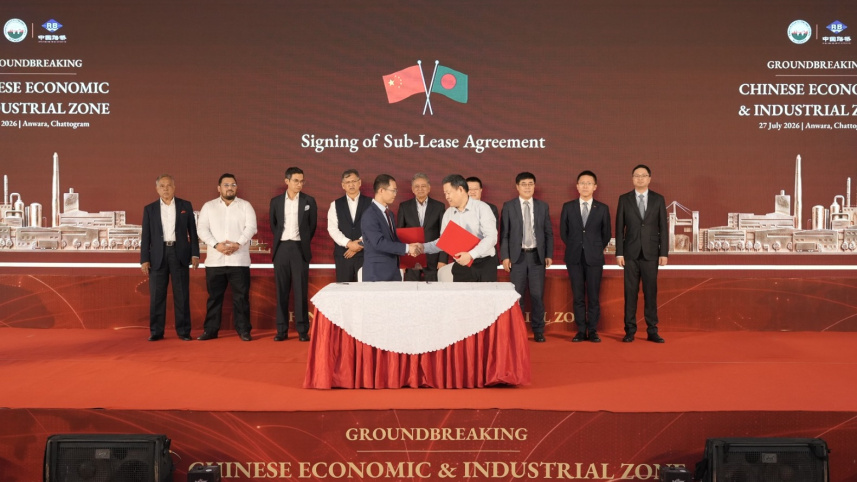
Bangladesh on Monday formally launched construction of the long-awaited China Economic and Industrial Zone (CEIZ) in Chattogram's Anwara.
Expected to attract around $1.3 billion in investment and create more than 100,000 jobs, the project is one of the country's largest China-backed industrial initiatives.

The groundbreaking ceremony also saw the signing of several sub-lease agreements with investors, the inauguration of the CEIZ One Stop Service Centre and the participation of around 70 Chinese business representatives, underscoring growing investor interest in the export-oriented industrial park.
Finance Minister Amir Khasru Mahmud Chowdhury described investment as the government's highest priority, saying it would be the key driver of employment and Bangladesh's ambition of becoming a $1 trillion economy by 2034.
"Investment is the only thing that is going to drive development, create employment and lead Bangladesh to a trillion-dollar economy. Today's development of the China Economic and Industrial Zone is a building block towards that ambition," he said.
Developed on nearly 800 acres under a government-to-government initiative between Bangladesh and China, CEIZ is expected to become a major manufacturing and logistics hub for Chinese and other foreign investors.
The zone aims to attract export-oriented industries, including electric vehicles, batteries, medical equipment, electronics and other advanced manufacturing sectors.
Chinese Ambassador Yao Wen said the groundbreaking marked an important step in implementing the outcomes of Prime Minister Tarique Rahman's visit to China and reflected the two countries' commitment to expanding practical economic cooperation.
China Road and Bridge Corporation (CRBC), the project's developer, said construction would now move into a new phase.
"CRBC will work closely with all partners to build CEIZ into a key platform for bilateral industrial cooperation, a major destination for international investment and a model zone of mutual benefit," said Li Changgui, vice-president of the company.
BEZA Executive Chairman Ashik Chowdhury said investor confidence had strengthened significantly following the prime minister's visit to China in June.
"More than 30 Chinese companies have already committed roughly half a billion dollars to a site that, as of this morning, is still open ground," he said.
Ashik also announced that the government aims to cut the time needed for industrial licences and approvals from the current six months to one year to just 14 days within the next three months as part of broader investment reforms.
Home Minister Salahuddin Ahmed said the project represented more than the construction of an industrial park.
"Bangladesh is open for business, and we mean business. Today's groundbreaking is not just the start of construction, but the foundation of a lasting economic bridge between Bangladesh and China," he said.
The launch came little more than a month after the Executive Committee of the National Economic Council (Ecnec) approved a Tk 41.89 billion supporting infrastructure project for the zone.
The infrastructure project will be financed with Tk 17.22 billion in government funds and Tk 24.67 billion in preferential buyer's credit from China's Export-Import Bank.
It includes a multipurpose jetty, connecting roads, power substations, a gas transmission line, a water reservoir, a central effluent treatment plant, waste management facilities and other utilities needed to make the zone investment-ready.
The project will be implemented between January 2027 and December 2031.
Earlier this month, the Cabinet Committee on Economic Affairs also approved the development and land lease agreements with Bangladesh CEIZ Company Ltd, the joint venture implementing the project. Under the arrangement, BEZA will hold a 30 percent stake, while CRBC will own the remaining 70 percent.
 For all latest news, follow The Daily Star's Google News channel.
 Located on the southern bank of the Karnaphuli River, close to Chattogram Port, the Karnaphuli Tunnel and Shah Amanat International Airport, the economic zone is expected to strengthen Bangladesh's position in regional supply chains while supporting the government's efforts to transform Chattogram into the country's main commercial and industrial hub.
Officials said the project would also increase industrial traffic through the Karnaphuli Tunnel and attract large-scale export-oriented investment, particularly from China.
Comments