


Canada should open visa office in Dhaka to boost trade
Bangladeshi businesspeople have demanded that Canada open a full-fledged visa office here, citing the fast rate at which bilateral trade has been growing.
The North American country is a very important business partner of Bangladesh.

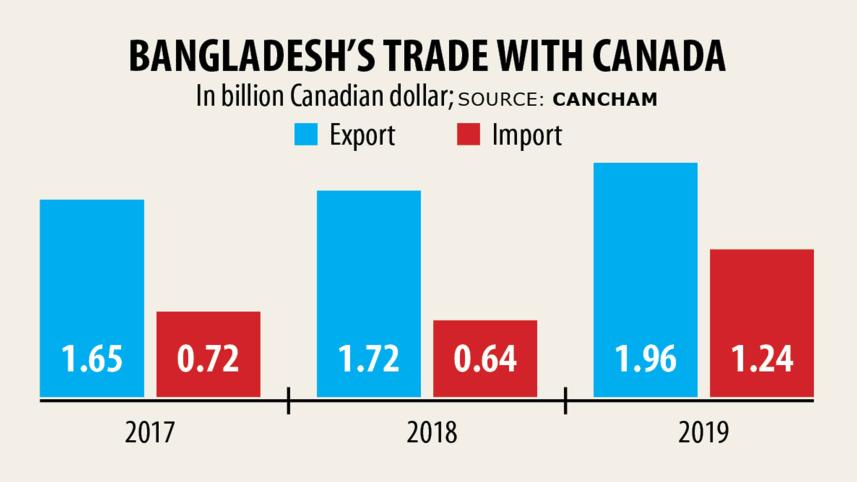
Bilateral merchandise trade has increased from 600.5 million Canadian dollars in 2004 to over 3 billion Canadian dollars in 2019, according to data from the Canada Bangladesh Chamber of Commerce and Industry(CanCham).
Canadian merchandise exports to Bangladesh amounted to 1.24 billion Canadian dollars in 2019. On the other hand, Bangladesh's exports to Canada grew 14.53 per cent year-on-year to 1.97 billion Canadian dollars in 2019.
"You will be happy to know that current bilateral trade between Canada and Bangladesh is over 3 billion Canadian dollars and targets to reach over 5 billion Canadian dollars within a few years," said CanCham President Masud Rahman.
But Bangladeshis intending to go on visits are bound to obtain Canadian visas from neighbouring countries such as India and Sri Lanka or from Singapore, which is a time consuming and expensive process.
The relocation of the visa office is important to explore new business opportunities, to diversify and expand bilateral business in private sectors and to increase student enrolment in Canadian universities and colleges, said Rahman.
"The Canadian government should ease the visa processing system to encourage more people into visiting Canada. It now can relocate the visa office to Dhaka in order to fast track the visa processing system," he said.
"It is a very important subject and a big demand of our private sectors. The Canadian government should seriously look into this matter," Rahman said.
The CanCham president was speaking at a virtual meeting on "Canada Bangladesh Bilateral Trade, Investment and Education and how to take it to the next level" on Wednesday night.
The Immigration, Refugees and Citizenship Canada statistics of 2019 show that Canada was receiving the highest number of students from India (172,600) followed by China (142,985), Republic of Korea (24,195), France (22,745), and the US (14,620), Rahman said.
"On the contrary, only 6,520 students enrolled in Canada from Bangladesh. Canada and Bangladesh needs to look into this area and strengthen education action plan between Canada and Bangladesh," he said.
"We from the private sector should drive forward educational partnership. Canadian universities are recognised as the best institutions globally," Rahman also said.
Canada can grab this opportunity either by direct admission processes or by setting up information or representative offices of those universities in Bangladesh, he said.
The Canadian high commission could also biannually organise virtual education fairs, said the CanCham president.
Its Bangladeshi counterpart could also do the same to disseminate Canadian university admission processes and other related information among Bangladeshi students, he said.
The number of students intending to study in Canada might go up as household incomes are increasing notably in recent times, said Rahman.
Benoit Préfontaine, Canadian high commissioner in Bangladesh, termed Bangladesh an important trading partner of Canada.
Currently, Bangladesh is the 25th largest trading partner of Canada globally, he said, adding that both governments had taken some important steps to increase bilateral trade.
Mizanur Rahman, Bangladeshi high commissioner in Canada, also advocated for the opening of a Canadian visa office in Bangladesh so that people could easily travel there to explore new business opportunities.
 For all latest news, follow The Daily Star's Google News channel.
 Both countries have been working to increase preferential trade benefits for increasing bilateral trade, he said.
In 2019, Canada imported leather goods and footwear worth $3.43 billion, said Saiful Islam, president of the Leathergoods and Footwear Manufacturers and Exporters Association of Bangladesh.
Of it, Bangladesh accounted for $32 million, which was 1.31 per cent of Canada's global import and 8 per cent of Bangladesh's total leather and leather footwear export, he said.
Canada has a lot of opportunities to invest in Bangladesh's leather and leather goods and footwear industry, he said.
Commerce Secretary Md Jafar Uddin said Bangladesh has been working towards signing preferential trade agreements.
It is holding negotiations with some countries for signing free trade agreements to enjoy duty benefits even after its status graduation to a developing country from a least developed one, he said.
Md Sirazul Islam, executive chairman of Bangladesh Investment Development Authority, moderated the meeting.
Syed Almas Kabir, president of the Bangladesh Association of Software and Information Services; Shibli Rubayat Ul Islam, chairman of the Bangladesh Securities and Exchange Commission; and Sultana Afroz, CEO of Public Private Partnership Authority Bangladesh, also spoke.
Diplomats of both countries, government high-ups, businesspeople and business chamber leaders also participated.



Comments