


Skills mismatch demands labour policy reforms: experts
Bangladesh needs urgent policy reforms to prepare its workforce for the technological and structural changes that will reshape jobs over the next decade, experts said at a global webinar organised by the Centre for Policy Dialogue (CPD).
“The world of work is changing. The labour ecosystem is changing, and the policies and institutions are struggling to keep pace,” CPD Distinguished Fellow Debapriya Bhattacharya said on Wednesday at the webinar, titled “Work in Flux: Foresight for the Future of Work in the Global South.”

Findings from CPD’s Bangladesh foresight study were presented at the webinar.
Debapriya said today’s changes differ fundamentally from those of the past, with little disagreement among researchers, stressing that reforms must happen within this generation as the window narrows.
Quantifying job creation, displacement and labour substitution by technology, he said, was key to guiding policy.
A second challenge, he said, is moving from diagnosis to action through strong public, private, social and political institutions, as well as partnerships that “translate research into meaningful action”.
Debapriya said the labour ministry should look beyond job creation and regulation towards inclusive employment, aligning workers’ skills with market demand.
The webinar was organised by CPD with JustJobs Network, LIRNEasia, Southern Voice and the Citizen’s Platform for SDGs, Bangladesh, under the FutureWORKS Asia initiative, supported by the International Development Research Centre (IDRC).
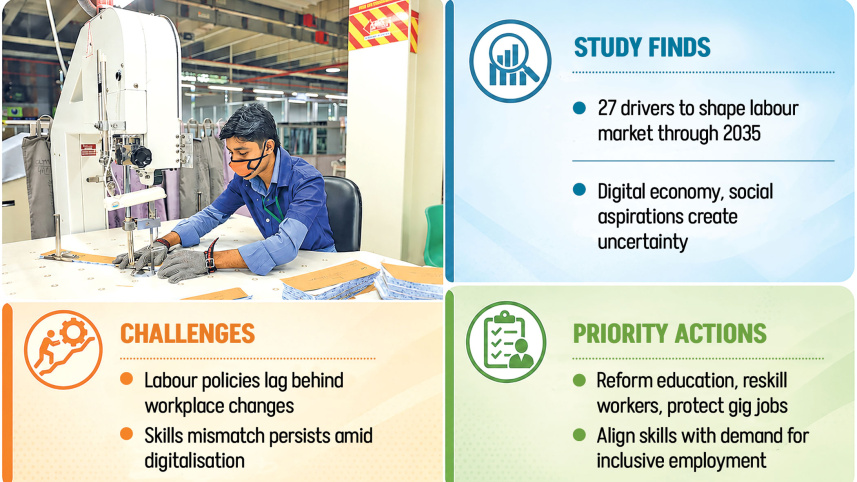
CPD Additional Research Director Towfiqul Islam Khan said the research identified 27 drivers of change shaping the country’s labour market through 2035.
The study found two major uncertainties -- the expansion of the global digital economy and shifting social aspirations -- and five constant trends: irreversible digitalisation, a shift to higher-value services, persistent skills mismatches, exposure to shocks such as climate change and trade disruptions, and growing institutional agility.
To respond, it recommends eight priority interventions, including reforms in education and skills development, lifelong reskilling, employment-linked industrial policies and modernised social protection for gig and platform workers.
The webinar drew experts from the International Labour Organization, Sri Lanka’s LIRNEasia, Argentina’s Sur Futuro Initiative and India’s JustJobs Network.
Panellists called for closer alignment between education and market demand, expanded partnerships, stronger social protection, and measures to address the impacts of automation, noting that policy, not technology, will determine whether transformation creates inclusive jobs or deepens inequality.
The discussion concluded with a call for governments, employers, researchers and development partners to move beyond diagnosis and adopt evidence-based policies for inclusive job creation, institutional agility and decent work, leaving no one behind.
 For all latest news, follow The Daily Star's Google News channel.



Comments