


Islamic, 4th-gen banks buckle under NPL, liquidity crises
Full-fledged Islamic banks and fourth-generation private commercial banks are facing mounting pressure from rising default loans and worsening liquidity shortages, making them the most vulnerable segments of the country’s banking sector, according to Bangladesh Bank.
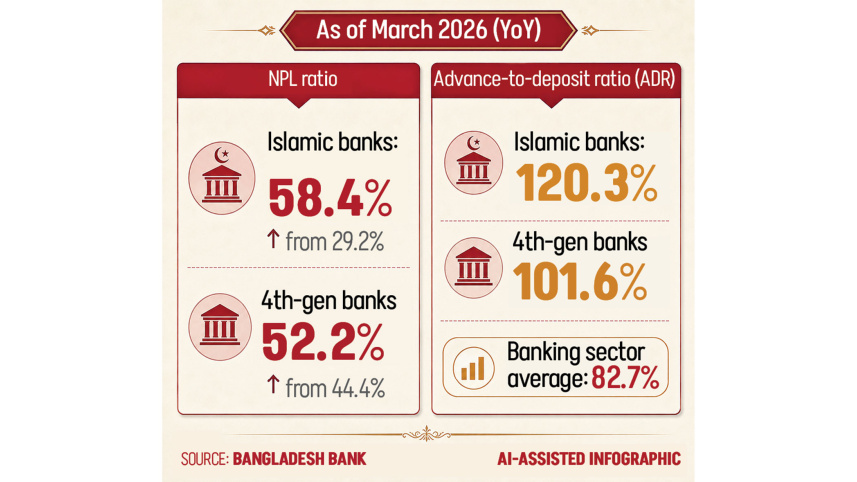
The central bank’s latest Banking Sector Update shows that the non-performing loan (NPL) ratio of full-fledged Islamic banks surged to 58.4 percent in March 2026, up from 29.2 percent a year earlier.

Fourth-generation private commercial banks -- the nine banks established in 2013 -- recorded the second-highest NPL ratio at 52.2 percent, compared with 44.4 percent in March 2025.
The report said both groups are under severe liquidity pressure due to aggressive lending and elevated credit risk.
Full-fledged Islamic banks remained heavily exposed, with their Advances-to-Deposit Ratio (ADR) climbing to 120.3 percent in March 2026. The average ADR of fourth-generation banks stood at 101.6 percent, with several lenders posting ratios above 100 percent.
Bangladesh Bank said the elevated ADRs reflect aggressive lending by fourth-generation banks as they rapidly expanded their loan portfolios. The ADRs of both groups were well above the banking sector average of 82.7 percent, raising concerns over liquidity risk.
The report noted that Islamic banks have long struggled with structural weaknesses, including limited liquidity management tools and rapid credit expansion.
Last year, the government merged five troubled Islamic banks -- First Security, Global, Social Islami, Union and EXIM Bank -- to form Sammilito Islami Bank PLC after they suffered acute liquidity shortages and alleged loan irregularities linked to the S Alam Group and Nazrul Islam Mazumder.
According to the report, the sharp increase in bad loans at these banks points to weak credit discipline and possible governance failures.
While the overall banking sector reduced its ADR to strengthen liquidity, Islamic and fourth-generation banks remained highly exposed despite relatively slow deposit growth.
Other banking segments performed comparatively better.
Second-generation private commercial banks maintained an NPL ratio of 19.2 percent. Foreign commercial banks remained in a stronger position, with an NPL ratio of 6.3 percent and an ADR of 53.4 percent, enabling them to maintain comfortable liquidity buffers.
Bangladesh Bank warned that aggressive lending and rising default loans at Islamic and fourth-generation banks pose a significant risk to the stability of the banking sector.
It said urgent measures are needed to reduce NPLs and bring ADRs under control. Without corrective action, the existing weaknesses could evolve into broader systemic risks, threatening financial stability and economic growth.
 For all latest news, follow The Daily Star's Google News channel.
Comments