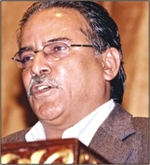
Nepali Maoist chief eyes presidency
Afp, New Delhi
Maoist warlord turned statesman Prachanda said he is willing to serve as president of a future Nepal republic, and that only a "small, rich and corrupt clique" wants to retain the monarchy, a news report said yesterday. "If the masses want to give me the responsibility and if my party chooses me as the best candidate (for president), then I will have to take it," said Prachanda, who waged a decade of armed struggle against Nepal's royalty, in the Indian Express. His offer came after the former teacher signed a peace pact with Nepal's ruling coalition last month, formally ending a civil war that claimed at least 12,500 lives. "Except perhaps for a small, rich and corrupt clique close to the palace, I don't think the majority need a king, even emotionally," Prachanda, whose nom-de-guerre means "the fierce one," told the daily newspaper. In rare comments about his personal life, Prachanda added things had changed for his family after 25 years underground, including the Maoists' 10 years of fighting in the impoverished nation's jungles and hills. "It is certainly exciting for my family. Our (three) kids were small at the time when we went underground, now the outside world is also theirs -- it is challenging," said Prachanda, who is still viewed by many Nepalis as a ruthless revolutionary, responsible for deadly attacks and executions. Prachanda, whose real name is Pushpa Kamal Dahal, said the monarchy lost support after a massacre of most of the royal family by a drunk crown prince in 2001 catapulted King Gyanendra to the throne. Gyanendra's slain brother, King Birendra, was much more popular, but "the Nepalis have a serious problem with his successor Gyanendra and his son Paras," Prachanda added. Conspiracy theories abound in Nepal, questioning how Gyanendra happened to be away from the palace when the killings occurred and how his only son, Prince Paras, who was at the palace, escaped the bloodbath unhurt. The playboy reputation of Paras has deepened Gyanendra's unpopularity. Some political leaders wish to retain a ceremonial Shah monarchy but the government has passed a proclamation giving it the right to choose the next king. In line with the government's new policy of treating Gyanendra as a "normal citizen", the king and Paras had been forced to pay customs tax to collect goods at the airport in a first for the embattled dynasty, officials said Friday. Under the peace deal supposed to bring the Maoists into the government, the rebels pledged to abide by the decision of a special assembly, which will write a new constitution that will decide the monarchy's fate. But in later statements, the Maoists have said even if the monarchy was retained in the constitution, they would work for its abolition and "tell the people they have made a mistake". "We are going to restructure the state in a democratic way. We are going to end the centralised and autocratic monarchy," Prachanda said in the interview. Gyanendra seized power in 2005 in what he said was a bid to crush the insurgency, but a pro-democracy alliance between the rebels and political parties forced him to restore parliament last April. Prachanda accused the United States, which has kept the Maoists on its list of terrorist groups, of "consistently trying to sabotage the peace process". "Even after the peace agreement their attitude has not changed. They obviously want some sort of an equation with the monarch," Prachanda said. The Maoists wanted "an interaction" with the US, but the first step was "up to the US," he said.
|