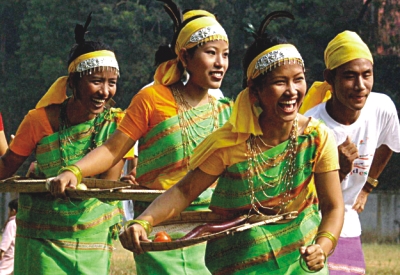
Garos celebrate Wangala
Bishawjit Das
Responding to the call of nakma, a Garo tribal leader, thousands of urban Garo people yesterday gathered on a school playground in the capital to celebrate Wangala, the centuries-old harvest festival of the indigenous community. Clad in colourful traditional clothing, the indigenous community thanked the god for the first harvest of the Bangla calendar with due respect and festivity on the playground of Lalmatia Housing Society School and College. People of other communities like Chakma, Marma, Rakhaine and Bangalee also joined the most important of all Garo festivals, making it a multi-cultural gathering. Most of the Garos, who were at the Wangala yesterday, are no longer farmers, neither do the rural communities celebrate the festival at this time of the year, but the urban Garos had no other choice. The celebration usually takes place in the month of Ashwin of the Bangla calendar which falls in October of the Gregorian calendar, but the organisers did not get a suitable place for the event on time, said leaders of Wangala 2006 Celebration Committee. On the other hand, 98 percent of the Garos have been converted to Christianity, who no longer follow the traditional Sangsarek religion, said Tapan Marak, who was the nakma of 1999 Wangala Committee. "The celebration in the city gives us a scope to reminisce about our traditional culture, a chance to get together regardless of religion and denominations of Christianity, and a means to introduce the next generation to their heritage as well," said Pradip Gabriel Sku, nakma and president of 2006 Wangala Committee. The urban Garos could not celebrate the festival in 2005 due to political unrest in the country, and as a result the aspiration was high to make it happen this year, added Pradip. So, the Garos of the city gathered together yesterday with traditional foods, clothing, musical instruments, and other items representing the community and its heritage. The celebration began with a ceremonial thanksgiving to Christ, instead of the traditional practice of thanking the harvest deity Sun-god, known as Shishi Soujan in the community, since most of the Garos are Christians now. Around 4,000 people of all ages and professions gathered at the festival, said the organisers. There were also painting competition for the children, cultural programmes and a raffle draw at the end of the day. A dozen of kiosks were selling traditional clothing, food, books, booklets, cassettes and CDs on the lifestyle of the community. Not only the Garos, but people of other communities also thronged the kiosks selling traditional garments including Dakshari and Dakbanda, popular clothing for males and females respectively. There was also a food exhibition showcasing wak, a preparation of pork with crushed rice which was sold out by noon, tha [a kind of potato], dishes made of turtle meat, snails, and also some local leaves Michang and Chuka Pata. Traditional music and musical instruments are no longer in much use, explained Pradip. But some traditional drums like Dama and Khrar were seen in the festival. "Instruments like Aduru, Drumchang, Nagra, Ran, Khrika are no longer played even in the villages as many of those have long been extinct," he added. Many people of other indigenous communities who came to the festival also clad themselves in their own traditional clothing.
|