Photography exhibition
Unheard stories from tea stalls
Karim Waheed
CHA or tea is the most popular beverage in the subcontinent. We like to have tea almost everywhere -- home, restaurants, office, universities and streets. Hence tea stalls on the sidewalks or vendors carrying thermo-flasks of tea are just natural in this part of the world. Tea with milk and sugar or ginger or lemon, whatever soothes your taste bud -- the chawallahs of Dhaka have it all and at a nominal price, a cup of tea is affordable even to people living on the streets. Catering to people from all walks of life, vendors at the tea stalls are usually friendly and often chatty. But while sipping on a cup of hot tea, we seldom show interest in their lives, their families, their stories. The contact is considered so insignificant that often people address these vendors as "Oi cha". The ongoing photography exhibition titled Cha Garam, by Pathshala: South Asian Institute of Photography zooms in on the vendors selling tea on the streets. Images by Gazi Nafis Ahmed, Abdul Aziz, Md Iqram Chowdhury, Md Mobarak Hossain, Mustafa Mamun, Shah Md Sazzad Hossain, Indranil Kishor, Syed Mahfuz Ali, Tanvir Ahmed and Shawon Ali are on display. The exhibition stands out in the sense that chawallahs in our country are still somewhat of an uncharted territory as far as subjects of photography is concerned. There is no apparent fancy wizardry of camera, no unusual angle, just a glimpse of faces we see everyday on the streets. In the exhibit, however, these images are provided with random details that give these faces identities. Indranil Kishor's photograph features Md Billal, whose tea stall is near Sadarghat launch terminal. Billal has three daughters and is originally from Chandpur district. His day starts at 4:30 in the morning when the terminal starts operating. His favourite time is evenings, watching people go home. Billal earns about Tk 150-200 a day and tries to be flexible with his customers regarding prices of tea, cookies and other snack items. The local mafia is putting pressure on him to move. From the photograph it becomes apparent that Billal has a weakness for betel leaf. The photograph of Beauty selling tea, near Aziz Supermarket, is quite impressive. Bright colours and the confidence in her gleaming eyes in the image are accompanied with the story of a young woman who knows "she can". Selling tea for last 15 years, Beauty has helped educate her brother up to his Master's degree. Her day starts at the crack of dawn; most customers being people on their morning walk. Her favourite time is when her mother brings lunch. She has studied up to class six, and has recently applied for a job as a nurse at BIRDEM Hospital. Beauty has a daughter named Sumaiya. Her dream is to educate her daughter to become a doctor. The photograph is by Shawon Ali. Gazi Nafis Ahmed's photograph features 10-year-old Kamal Hossain working at a tea stall on Baily Road (Natok Shoroni). Originally from Uttar Baraga village in Chandpur district, Kamal has studied up to class three. His work hours are 7am to 10pm. The young one gets a one and half hour break in the afternoon. His favourite time is in the evening when the 'Broadway of Dhaka' gets busy with the hustle bustle of theatre-enthusiasts and people sitting on the sidewalks immersed in group-conversations. Kamal's favourite customer is a journalist whom he calls mama (uncle). This mama often gives him a Tk 10/20 tip and music CDs. The latest song that Kamal really likes goes Laaf dibi tui kothae dibi... (You want to leap, but where to?) Kamal wants to finish his studies. These images and more provide a glimpse of people, with whom the urbanites unknowingly share a significant amount of time everyday. The exhibition ends tomorrow.
|
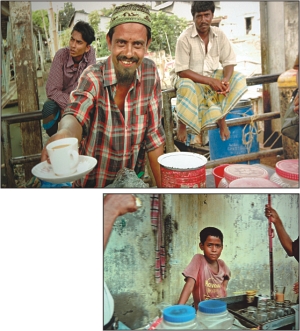
Billal offers tea (top), Kamal eagerly waits for customers |

